


Key Metrics For Construction Quality Assurance




Try Before you Buy Download Free Sample Product
 Impress Your
 Audience
 100%
100% Editable
 Save Hours
 of Time


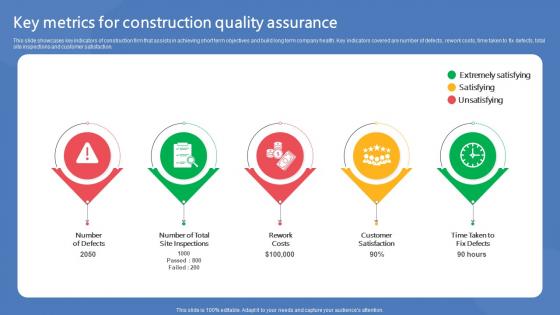
This slide showcases key indicators of construction firm that assists in achieving short term objectives and build long term company health. Key indicators covered are number of defects, rework costs, time taken to fix defects, total site inspections and customer satisfaction.
People who downloaded this PowerPoint presentation also viewed the following :
Key Metrics For Construction Quality Assurance with all 6 slides:
Use our Key Metrics For Construction Quality Assurance to effectively help you save your valuable time. They are readymade to fit into any presentation structure.





FAQs for Key Metrics For
Key construction quality metrics include defect rates, rework percentages, material compliance scores, safety incident frequency, schedule adherence, and inspection pass rates. These metrics enable project managers to identify issues early, reduce costs through preventive measures, and maintain consistent standards, with many construction firms finding that systematic monitoring ultimately delivers improved client satisfaction and competitive advantage in bidding processes.
Construction quality control effectiveness is measured through defect rates, rework percentages, inspection pass rates, compliance scores, and cost variance tracking. These metrics enable project managers to identify improvement areas, reduce material waste, and enhance delivery timelines, with many construction firms finding that systematic measurement ultimately delivers higher client satisfaction and competitive advantage.
Client expectations serve as the foundational framework for defining construction quality metrics, establishing benchmarks for materials, workmanship, timelines, budget adherence, and performance standards. These expectations directly influence measurement criteria across residential, commercial, and infrastructure projects, with many construction firms finding that aligning quality metrics with client requirements ultimately delivers higher satisfaction rates, reduced rework costs, and stronger long-term partnerships.
Technology like BIM and drones revolutionize construction quality assessment by enabling real-time monitoring, precision measurement, automated defect detection, and comprehensive documentation throughout project lifecycles. These tools streamline quality control by delivering faster inspections, enhanced accuracy, and seamless data integration, with construction firms increasingly finding that automated assessments reduce costs while improving safety standards and project outcomes.
Poor quality metrics lead to significant project delays, cost overruns, rework cycles, resource misallocation, and stakeholder disputes throughout construction projects. These deficiencies cascade into budget increases of 15-30%, with many construction firms finding that inadequate quality tracking ultimately compromises client relationships, regulatory compliance, and competitive positioning in an increasingly accountability-focused industry.
Industry standards and regulations significantly shape construction quality metrics by establishing mandatory safety requirements, material specifications, environmental compliance measures, and performance benchmarks that projects must meet. These frameworks, from OSHA safety protocols to LEED environmental standards, enable construction companies to standardize quality assessments, reduce liability risks, and deliver projects that meet regulatory approval while maintaining competitive advantage.
Stakeholder feedback can be integrated through regular surveys, digital feedback platforms, on-site inspections with clients, and structured review meetings at project milestones. This multi-channel approach enables construction teams to capture real-time concerns, adjust quality standards dynamically, and enhance project outcomes, with many firms finding that systematic stakeholder input significantly improves client satisfaction and reduces costly rework.
Prioritize quality metrics by aligning them with project complexity, regulatory requirements, stakeholder expectations, and risk factors specific to your construction type. For infrastructure projects, focus on structural integrity and safety compliance, while commercial builds emphasize schedule adherence and cost control, with many contractors finding that tracking 3-5 core metrics delivers better outcomes than monitoring everything.
Common pitfalls include setting overly complex metrics that are difficult to track consistently, focusing solely on lagging indicators rather than predictive measures, inadequate data collection systems, and poor stakeholder buy-in across project teams. These challenges often result in inconsistent measurement approaches, delayed problem identification, and missed opportunities for proactive quality improvements, with many construction firms finding that streamlined, actionable metrics deliver better project outcomes and client satisfaction.
Lean construction principles improve quality metrics by eliminating waste, standardizing processes, and implementing continuous improvement cycles. These methodologies enhance construction projects by reducing rework, minimizing material waste, and streamlining workflows, with many contractors finding that lean approaches deliver faster project completion, lower costs, and significantly improved quality outcomes.
Construction quality metrics and safety performance share a strong positive correlation, as higher quality standards typically reduce workplace hazards, structural failures, and compliance violations. Quality metrics like material testing, workmanship standards, and inspection frequencies directly influence safety outcomes, with construction companies finding that rigorous quality control processes ultimately deliver fewer accidents, reduced liability, and enhanced project reliability across residential and commercial developments.
Construction quality metrics should be reviewed daily for critical activities, weekly for overall progress assessments, and at major project milestones to ensure continuous compliance and early issue detection. This systematic approach enables project managers to identify deviations quickly, implement corrective measures before costs escalate, and maintain consistent quality standards, with many construction firms finding that frequent monitoring ultimately delivers reduced rework and improved client satisfaction.
Long-term durability metrics include concrete strength ratings, water permeability coefficients, thermal cycling resistance, structural deflection measurements, and material fatigue thresholds. These assessments enable construction teams to predict performance across decades, with many infrastructure projects finding that comprehensive durability testing reduces maintenance costs while enhancing safety and operational reliability.
Data analytics enhances quality metric reliability by identifying patterns in historical defects, predicting potential failure points, and correlating multiple data sources for comprehensive insights. Through machine learning algorithms and real-time monitoring systems, construction companies streamline quality assessments, reduce measurement errors, and deliver more accurate project evaluations, ultimately enabling proactive quality management and improved construction outcomes.
Several organizations have successfully leveraged construction quality metrics, including Skanska's defect tracking systems reducing rework by 30%, Turner Construction's real-time monitoring improving schedule adherence, and Bechtel's comprehensive quality dashboards enhancing project transparency. These implementations streamline operations by identifying issues early, optimizing resource allocation, and improving client satisfaction, with many construction firms finding that systematic metrics ultimately deliver competitive advantages and stronger project outcomes.
-
Wow, never been this impressed with any online service provider. Really appreciate the customer support all along from the navigation to purchasing the right products.
-
The design is very attractive, informative, and eye-catching, with bold colors that stand out against all the basic presentation templates.