


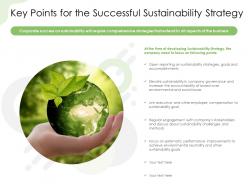
Key points for the successful sustainability strategy





Try Before you Buy Download Free Sample Product
 Impress Your
 Audience
 100%
100% Editable
 Save Hours
 of Time


Our Key Points For The Successful Sustainability Strategy are topically designed to provide an attractive backdrop to any subject. Use them to look like a presentation pro.
People who downloaded this PowerPoint presentation also viewed the following :
Key points for the successful sustainability strategy with all 2 slides:
Use our Key Points For The Successful Sustainability Strategy to effectively help you save your valuable time. They are readymade to fit into any presentation structure.
FAQs for Key points for the
Effective sustainability strategies include environmental impact reduction, social responsibility initiatives, economic viability assessments, stakeholder engagement frameworks, and transparent reporting mechanisms. These components work together by aligning operational practices with long-term value creation, regulatory compliance, and brand reputation enhancement, with many organizations finding that integrated approaches deliver both cost savings and competitive differentiation in increasingly conscious markets.
Organizations can measure long-term sustainability impact through comprehensive metrics including carbon footprint reduction, resource consumption tracking, waste diversion rates, energy efficiency improvements, and stakeholder engagement scores. These measurement frameworks enable companies across manufacturing, retail, and financial services to quantify environmental progress, demonstrate ROI to investors, and maintain competitive advantage while building transparent sustainability reporting that drives continuous operational improvements.
Stakeholder engagement serves as the foundation for developing effective sustainability strategies by identifying priorities, ensuring accountability, gathering diverse perspectives, and building implementation support. Through collaborative dialogue with employees, customers, investors, and communities, organizations can align their environmental initiatives with stakeholder expectations, ultimately delivering enhanced credibility, reduced risks, and sustainable competitive advantage.
Companies align their sustainability goals with UN SDGs by mapping current initiatives to relevant goals, integrating SDG targets into strategic planning, and establishing measurable KPIs that track progress toward specific outcomes. Through this strategic alignment, organizations across sectors like manufacturing, retail, and financial services enhance stakeholder engagement, attract sustainable investment, and demonstrate measurable social impact, ultimately delivering competitive advantage while contributing to global sustainability efforts.
Businesses can foster sustainability culture through comprehensive training programs, green employee incentive systems, cross-departmental sustainability committees, transparent environmental impact reporting, and integrating eco-friendly practices into daily operations. These initiatives enhance employee engagement while delivering measurable environmental outcomes, with many organizations finding that sustainability-focused workplaces attract top talent, reduce operational costs, and strengthen brand reputation in increasingly eco-conscious markets.
Technology and innovation enhance sustainability strategies by enabling automated resource monitoring, optimizing energy consumption through AI-driven systems, and facilitating circular economy practices with advanced recycling technologies. These solutions streamline environmental compliance, reduce operational costs, and deliver measurable carbon footprint reductions, with many organizations finding that strategic technology integration ultimately drives both sustainability goals and competitive advantage.
Companies face implementation challenges including high upfront costs, resistance to organizational change, complex supply chain integration, measuring ROI on sustainability investments, and balancing short-term profits with long-term environmental goals. These obstacles can be overcome through phased implementation strategies, employee education programs, and strategic partnerships with sustainable suppliers, while many organizations find that transparent communication about environmental commitments ultimately delivers enhanced brand reputation and operational efficiency.
Businesses can effectively communicate sustainability efforts through transparent reporting, authentic storytelling, measurable data sharing, third-party certifications, and consistent messaging across all channels. Companies like Patagonia and Unilever demonstrate that combining specific environmental metrics with genuine narrative resonates with consumers, while regular stakeholder updates and verified achievements build trust, ultimately strengthening brand loyalty and competitive positioning.
Companies should evaluate sustainability strategies using carbon footprint reduction, energy efficiency improvements, waste diversion rates, water usage optimization, and sustainable sourcing percentages. These metrics enable organizations to track environmental impact while measuring cost savings, regulatory compliance, and stakeholder satisfaction, with many corporations finding that comprehensive measurement ultimately delivers competitive advantage and enhanced brand reputation.
SMEs can integrate sustainability by adopting energy-efficient technologies, implementing waste reduction programs, sourcing from local suppliers, and establishing clear environmental goals with measurable targets. These approaches streamline operations while reducing costs, with many retail and manufacturing SMEs finding that sustainable practices enhance customer loyalty, attract eco-conscious talent, and ultimately deliver competitive advantage in increasingly environmentally-aware markets.
Supply chain management plays a pivotal role in sustainability strategy by enabling resource optimization, waste reduction, ethical sourcing, and carbon footprint minimization across operations. Through strategic supplier partnerships and transparent tracking systems, companies streamline environmental compliance, enhance operational efficiency, and deliver measurable cost savings, with many organizations finding that sustainable supply chains ultimately strengthen competitive advantage while meeting stakeholder expectations.
A circular economy model integrates into sustainability strategy through waste reduction initiatives, resource recovery systems, product lifecycle extension, and regenerative design principles. Organizations across manufacturing, retail, and technology sectors streamline operations by minimizing material inputs, maximizing reuse opportunities, and creating closed-loop processes, ultimately delivering cost savings while enhancing environmental performance and competitive positioning.
Industry-specific sustainability considerations include regulatory compliance requirements, supply chain complexities, resource consumption patterns, waste generation types, and stakeholder expectations unique to each sector. Manufacturing companies focus on emissions reduction and circular economy practices, while financial services prioritize ESG investing and green financing, with retail organizations emphasizing sustainable sourcing and packaging innovations.
Partnerships with NGOs and governmental bodies strengthen sustainability efforts by providing regulatory expertise, funding opportunities, community credibility, and implementation resources that individual organizations often lack. Through strategic collaboration, companies access specialized knowledge, navigate complex environmental policies more effectively, and demonstrate authentic commitment to stakeholders, while NGOs and governments gain private sector innovation and scalability, ultimately delivering enhanced environmental impact and competitive advantage.
Current sustainability trends include circular economy adoption, carbon neutrality commitments, ESG integration, supply chain transparency, and renewable energy transitions. These approaches streamline operations by reducing waste, enhancing resource efficiency, and improving stakeholder trust, with many organizations finding that strategic sustainability initiatives ultimately deliver cost savings, regulatory compliance, and competitive advantage in an increasingly environmentally-conscious marketplace.
-
Informative design.
-
The Designed Graphic are very professional and classic.
-
Illustrative design with editable content. Exceptional value for money. Highly pleased with the product.
-
Awesome presentation, really professional and easy to edit.
-
Understandable and informative presentation.
-
Helpful product design for delivering presentation.
-
Visually stunning presentation, love the content.
-
Top Quality presentations that are easily editable.