

Key Trends For Global Footwear Market Comprehensive Guide




Try Before you Buy Download Free Sample Product
 Impress Your
 Audience
 100%
100% Editable
 Save Hours
 of Time


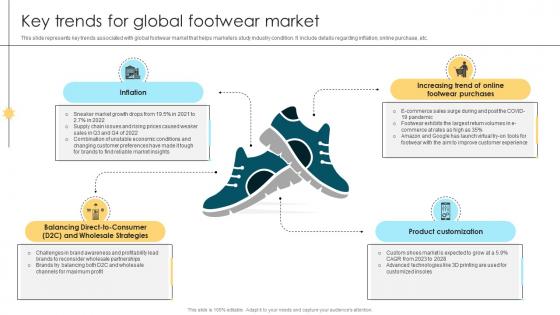
This slide represents key trends associated with global footwear market that helps marketers study industry condition. It include details regarding inflation, online purchase, etc.
People who downloaded this PowerPoint presentation also viewed the following :
Key Trends For Global Footwear Market Comprehensive Guide with all 9 slides:
Use our Key Trends For Global Footwear Market Comprehensive Guide to effectively help you save your valuable time. They are readymade to fit into any presentation structure.








FAQs for Key Trends For Global Footwear
Key drivers influencing global footwear market growth include rising disposable incomes, increasing health consciousness, fashion trend evolution, e-commerce expansion, and demographic shifts toward younger consumers. These factors combine to create diverse opportunities across athletic, luxury, and sustainable footwear segments, with many brands finding that strategic positioning in emerging markets and direct-to-consumer channels ultimately delivers enhanced market share and customer engagement.
Consumer preferences are shifting toward athletic footwear due to increasing health consciousness, remote work flexibility, and athleisure trends, while fashion footwear faces challenges from changing lifestyle priorities. However, many fashion brands are finding success by incorporating comfort technologies and athletic-inspired designs, ultimately delivering hybrid products that blend performance functionality with style aesthetics, enabling them to capture both market segments.
E-commerce has significantly disrupted traditional footwear retail by shifting consumer purchasing behaviors, forcing brick-and-mortar stores to reduce physical footprints, and compelling omnichannel integration strategies. While traditional retailers face challenges with declining foot traffic, many are successfully leveraging digital platforms to enhance customer experiences, streamline inventory management, and ultimately deliver competitive advantages through hybrid retail models.
Asia-Pacific and Latin America are experiencing the fastest footwear sales growth, driven by rising disposable incomes, urbanization, and expanding middle-class populations. These regions benefit from increasing consumer demand for both athletic and fashion footwear, with countries like India, China, Brazil, and Mexico leading growth through enhanced retail infrastructure and evolving lifestyle preferences, ultimately delivering significant market opportunities.
Sustainability practices significantly influence footwear purchasing decisions through environmental consciousness, ethical sourcing transparency, and brand value alignment. With many consumers, particularly millennials and Gen Z, prioritizing eco-friendly materials, carbon-neutral production, and fair labor practices, brands implementing sustainable approaches ultimately deliver enhanced customer loyalty, premium pricing opportunities, and competitive advantage in an increasingly environmentally-conscious marketplace.
Technology revolutionizes footwear innovation through 3D printing, smart materials, digital design software, automated manufacturing systems, and IoT-enabled wearables. These advancements streamline production processes, enable mass customization, and enhance performance features, with athletic brands and luxury manufacturers increasingly leveraging data analytics to create personalized experiences, ultimately delivering faster time-to-market and competitive differentiation.
Aging populations are driving increased demand for comfort-focused footwear, orthopedic shoes, and supportive designs that prioritize health benefits over fashion trends. This demographic shift creates significant opportunities for footwear manufacturers specializing in therapeutic features, wider sizing options, and slip-resistant soles, with many retailers finding that senior-targeted collections deliver strong profit margins and customer loyalty.
Emerging athleisure footwear trends include sustainable materials, versatile hybrid designs, tech-integrated features, customization options, and wellness-focused construction that supports active lifestyles. Brands are adapting by incorporating recycled materials, developing shoes suitable for both gym workouts and office environments, and partnering with fitness influencers, with many companies finding that these strategic combinations deliver enhanced customer loyalty and competitive advantage.
Social media and influencer marketing significantly reshape footwear brand perceptions by creating authentic connections, driving trend awareness, and enabling real-time consumer engagement across demographics. Through strategic partnerships with lifestyle influencers, athletic personalities, and fashion icons, brands like Nike and Adidas accelerate product launches, build community loyalty, and ultimately deliver enhanced brand visibility and consumer trust in an increasingly digital marketplace.
Footwear manufacturers face challenges including limited supplier networks for sustainable materials, higher costs compared to conventional options, maintaining quality standards, and ensuring consistent supply chains. While sustainable materials like recycled plastics, organic cotton, and bio-based alternatives often require new manufacturing processes, many companies find that investing in these materials ultimately delivers competitive advantage and meets increasingly environmentally-conscious consumer demands.
Smart technology integration is revolutionizing the footwear market by introducing connected features, health monitoring capabilities, and personalized user experiences that enhance performance and convenience. These innovations enable brands to differentiate products, capture higher profit margins, and access new market segments, with athletic and healthcare sectors finding that smart footwear delivers valuable data insights and improved customer engagement.
Leading footwear brands employ product diversification, strategic partnerships, direct-to-consumer channels, sustainability initiatives, and technology integration to maintain competitive advantage. Through digital innovation and targeted marketing, companies like Nike, Adidas, and Puma streamline customer experiences, enhance brand loyalty, and accelerate market penetration, ultimately delivering stronger positioning in an increasingly competitive global landscape.
COVID-19 significantly shifted footwear preferences toward comfort-focused and casual styles, with consumers prioritizing athleisure, loungewear-compatible shoes, and versatile designs suitable for remote work. The pandemic accelerated demand for wellness-oriented footwear, sustainable options, and direct-to-consumer purchasing channels, while formal and dress shoe categories declined substantially, ultimately reshaping the industry toward health-conscious, lifestyle-driven consumer choices.
Customization and personalization enable footwear brands to differentiate themselves in saturated markets by offering tailored fit, design preferences, and performance specifications that meet individual consumer needs. These approaches drive higher profit margins, enhanced customer loyalty, and competitive advantage, with companies like Nike and Adidas finding that personalized offerings significantly increase customer engagement and reduce return rates.
Economic factors significantly influence footwear spending through reduced disposable income, shifting consumer priorities toward essential purchases, and delayed replacement cycles during high inflation or unemployment periods. However, these conditions also create opportunities for value-oriented brands and discount retailers, with many footwear companies finding success by diversifying price points, emphasizing durability messaging, and targeting budget-conscious segments while maintaining quality.
-
Attractive design and informative presentation.
-
Very unique and reliable designs.