


LAER Model For Effective Customer Renewal





Try Before you Buy Download Free Sample Product
 Impress Your
 Audience
 100%
100% Editable
 Save Hours
 of Time


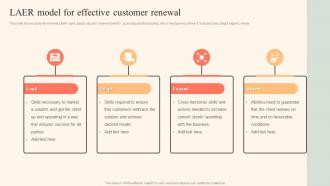
This slide shows customer renewal LAER land, adopt, expand, renew model for accessing and transacting over a fixed period of time. It includes land, adopt, expand, renew.
People who downloaded this PowerPoint presentation also viewed the following :
LAER Model For Effective Customer Renewal with all 6 slides:
Use our LAER Model For Effective Customer Renewal to effectively help you save your valuable time. They are readymade to fit into any presentation structure.





FAQs for LAER Model For
The LAER model comprises Listen (understanding customer concerns), Acknowledge (validating their perspective), Explore (asking probing questions to uncover root issues), and Respond (providing targeted solutions). These components work sequentially to transform difficult conversations into opportunities, with customer service teams, sales professionals, and support staff finding that this structured approach enhances relationship building, reduces conflict escalation, and ultimately delivers improved customer satisfaction and retention rates.
The LAER model improves customer engagement by systematically listening to customer concerns, acknowledging their perspectives, exploring underlying needs, and responding with tailored solutions. This structured approach enhances trust and satisfaction across industries, with many retail and financial services organizations finding that LAER delivers more meaningful interactions, reduces resolution times, and ultimately strengthens long-term customer relationships.
The LAER model differs from traditional frameworks by emphasizing continuous engagement through Listen, Acknowledge, Explore, and Respond phases, rather than one-time transaction-focused interactions. While traditional approaches often prioritize immediate sales conversions, LAER creates sustained customer relationships through active listening and collaborative problem-solving, ultimately delivering enhanced customer satisfaction and long-term retention across service industries.
The LAER model applies across industries by adapting its Listen, Acknowledge, Explore, Respond framework to sector-specific challenges, from healthcare patient concerns to financial services complaints and retail customer issues. While universal in structure, successful implementation requires tailoring each phase to industry regulations, communication styles, and stakeholder expectations, with many organizations finding that consistent application enhances customer relationships and operational efficiency.
Feedback within the LAER model serves as the critical mechanism for continuous improvement, enabling sales professionals to refine their listening skills, adjust their acknowledgment techniques, and enhance their exploration and response strategies. Through systematic feedback collection from prospects, managers, and self-assessment, salespeople can identify communication gaps, strengthen relationship-building approaches, and ultimately deliver more personalized customer experiences that drive higher conversion rates.
Businesses can measure LAER model effectiveness through customer retention rates, response resolution times, escalation frequency reduction, and customer satisfaction scores following service interactions. These metrics enable organizations to track improvements in customer experience quality, operational efficiency, and relationship strength, with many companies finding that systematic LAER implementation delivers measurable increases in loyalty and reduced churn rates.
Common challenges include resistance to change from traditional sales approaches, difficulty in active listening skill development, inadequate training on emotional intelligence techniques, and inconsistent implementation across sales teams. Many organizations find that overcoming these hurdles requires comprehensive coaching, regular practice sessions, and cultural shifts toward customer-centric selling, ultimately delivering improved conversion rates and stronger client relationships.
The LAER model promotes retention by systematically addressing customer concerns through Listen, Acknowledge, Explore, and Respond phases, transforming negative experiences into loyalty opportunities. Through structured problem resolution, organizations in sectors like telecommunications and retail minimize churn rates, enhance customer satisfaction, and build stronger relationships, with many finding that effective complaint handling ultimately delivers competitive advantage and increased lifetime customer value.
Companies like HubSpot, Salesforce, and Zendesk have successfully implemented the LAER model to transform customer interactions into revenue opportunities. These organizations systematically listen to customer concerns, acknowledge pain points, explore underlying needs, and respond with tailored solutions, ultimately delivering enhanced customer satisfaction, reduced churn rates, and increased upselling success across their service operations.
Organizations can train their teams in the LAER model through structured workshops covering listening techniques, acknowledging customer concerns, exploring underlying issues, and responding with tailored solutions. Through role-playing exercises and real-world simulations, sales teams, customer service representatives, and account managers develop these skills systematically, ultimately delivering improved customer relationships and higher conversion rates.
Customer relationship management (CRM) systems, sales enablement platforms, conversation intelligence tools, training management software, and analytics dashboards facilitate LAER model implementation effectively. These technologies streamline listen-acknowledge-explore-respond processes by automating data capture, providing real-time coaching insights, and tracking engagement metrics, with many sales organizations finding that integrated platforms ultimately deliver improved conversion rates and enhanced customer experiences.
The LAER model aligns with modern marketing and sales strategies by emphasizing Listen, Acknowledge, Explore, and Respond principles that mirror today's customer-centric approaches. Through active listening and exploration phases, sales teams can deliver personalized experiences, build stronger relationships, and ultimately close deals more effectively, with many organizations finding that this consultative approach enhances conversion rates significantly.
Digital transformation revolutionizes the LAER model by automating lead scoring, enhancing customer data analytics, and streamlining renewal processes through AI-powered insights. These technologies enable organizations to accelerate account expansion, predict churn more accurately, and deliver personalized customer experiences, with many SaaS companies finding that integrated digital platforms ultimately reduce acquisition costs while increasing lifetime value.
Storytelling enhances the LAER model by creating emotional connections during each phase, transforming technical presentations into compelling narratives that resonate with customer needs, concerns, and aspirations. Through strategic storytelling, sales professionals can listen more effectively, acknowledge challenges authentically, explore solutions collaboratively, and respond with relevant case studies, ultimately delivering more persuasive and memorable customer experiences.
The LAER model adapts to B2B contexts through extended relationship-building phases, detailed technical presentations, and committee-based decision processes, while B2C applications emphasize rapid rapport establishment, simplified presentations, and individual purchasing decisions. B2B implementations typically involve longer sales cycles with multiple touchpoints and stakeholder engagement, whereas B2C approaches streamline the process for immediate conversions, ultimately delivering targeted customer experiences and improved sales performance across both market segments.
-
Great combination of visuals and information. Glad I purchased your subscription.
-
SlideTeam is a great place for PPT templates. They have many templates on a single topic. It has made my life a lot easier.