

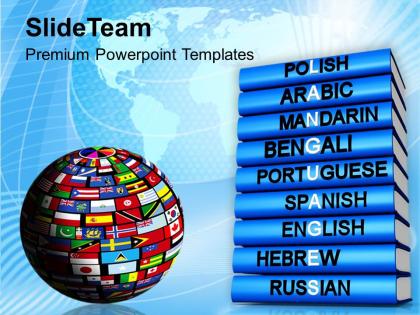
Languages of the world global powerpoint templates ppt themes and graphics 0113




Try Before you Buy Download Free Sample Product
 Impress Your
Audience
 100%
Editable
 Save Hours
of Time


We are happy to exhibit our languages of the world global PowerPoint templates PPT themes and graphics 0113. Our world global PowerPoint formats are the ligaments of your address. Give them the muscle of your lively musings. Our dialects of the world worldwide PPT formats give you the fundamental structure of your discussion. Give it the shape you want with your great perspectives. The gainful use of the gave water taps symbols PPT PowerPoint slide case gives an entire sense to your introduction and an all-encompassing way to deal with it. Being an expert, time is your greatest limitation, so make utilization of our predesigned slides to make your PowerPoint outlines which are simple, quick and also proficient. Basically, tap on the download button, spare the introduction in wanted organization and modify it for conclusive introduction.Use the power of visualization to create powerful stories that hit the mark. This you can only achieve with our Languages Of The World Global Powerpoint Templates Ppt Themes And Graphics 0113.
People who downloaded this PowerPoint presentation also viewed the following :
Languages of the world global powerpoint templates ppt themes and graphics 0113 with all 3 slides:
Paint a pretty picture for your audience. Describe it in detail with our Languages Of The World Global Powerpoint Templates Ppt Themes And Graphics 0113.


FAQs for Languages of the world global powerpoint templates ppt themes
Your language literally shapes how you think and see the world. It's wild - some concepts just don't exist in other languages at all. When you speak your native tongue, you're tapping into thousands of years of cultural wisdom and inside jokes that can't be translated. Values, humor, family relationships - language influences all of it. Actually, untranslatable words are my favorite thing because they reveal what a culture cares about most. Want to understand any culture better? Pay attention to those unique expressions. They're like little windows into what that community values.
Okay so basically, when society changes, our language changes with it - it's like a mirror. New tech gives us words like "googling" and "ghosting." Social movements push things like gender-neutral pronouns into mainstream use. Internet culture totally flipped how we talk (my mom still has no clue what half my texts mean lol). Economic stuff shows up too - look at all the gig economy terms we didn't have before. Even slang tracks cultural shifts. You can literally watch a society's priorities by seeing what new words stick around and which old ones die out.
Ok so apparently learning languages literally changes how your brain works. Your multitasking gets way better because you're juggling different language systems all the time. Problem-solving improves too. It's like CrossFit for your mind, which sounds cheesy but whatever. You get better at focusing and blocking out random stuff. The crazy part? You don't even need to be good at it to see results. Just starting helps strengthen those brain muscles. Oh and it might help prevent that scary cognitive decline thing when you're older. Pretty solid reasons to finally tackle Spanish, right?
Oh man, language barriers are brutal for business deals. Misunderstandings happen constantly and they're expensive as hell. You'll miss key details in negotiations, team members get excluded from important conversations, and clients just walk away frustrated. Trust me, I've watched entire projects crash because someone mistranslated one crucial detail - it's honestly heartbreaking. Building trust becomes nearly impossible when you're both struggling just to communicate basic ideas. My advice? Don't cheap out on translation tools or bilingual staff. Way better to invest upfront than scramble later when everything's already gone sideways.
Yeah, it's wild how tech works both ways with languages. Social media pushes everyone toward English and other big languages, which sucks for smaller ones. But then you've got these amazing digital archives now - like actual video and audio recordings that let diaspora kids learn their grandparents' languages through apps. The Endangered Languages Archive does crazy cool documentation work if you want to check that out. AI translation is getting weirdly good at catching subtle language stuff too. Honestly, without tech we'd probably lose way more languages, but it's also speeding up the whole process.
Dude, your brain literally gets rewired when you speak multiple languages! Like, you're constantly juggling two language systems, which makes you way better at filtering out distractions and switching between tasks. Bilingual people actually have more gray matter in language and attention areas - plus better connections between brain regions. The mental workout strengthens things like working memory and cognitive flexibility. Starting young gives you the biggest boost, but even learning as an adult helps. Honestly makes me feel less guilty about those random 2am Spanish lessons I keep doing instead of sleeping.
Oh man, idioms are tricky because they're so tied to specific cultures - you can't just translate them word-for-word. Like "it's raining cats and dogs" would sound absolutely insane in most other languages! What you gotta do is figure out what the idiom actually *means* emotionally, then find how that other culture says the same thing. I learned this the hard way trying to explain American expressions to my exchange student roommate. Focus on the concept behind it rather than the literal words. Each culture has their own weird ways of expressing ideas, so hunt for their version that hits the same way.
Okay so basically dialects are about pronunciation, vocab, and grammar differences. You know how saying "soda" vs "pop" instantly gives away where you're from? Communities just naturally develop their own ways of talking about stuff that matters to them. Coastal places have like a million words for different types of waves - makes sense when you think about it. What's wild is how one word can totally reveal someone's background. These patterns actually show you what each group values and their history. Honestly, whenever I hear a weird phrase now I always look up where it came from.
Honestly, the biggest thing is making sure the community actually wants this - sometimes outsiders get more excited about revitalization than the speakers do, which is weird. Don't be that person. Community leadership has to drive everything, not academics swooping in for data. There's usually drama within communities too about keeping the language "pure" vs adapting it. Who owns the materials you create? That's huge. Keep everything under their control, not yours or some university's. Also different families might have totally different ideas about pronunciation or which dialect to use. It's messier than people think, but just follow their lead always.
So there's this thing called linguistic relativity - basically your language affects how you think. Russians have separate words for light and dark blue, which actually makes them quicker at spotting different blue shades. Crazy, right? The extreme version got debunked (where language totally controls thought), but there's real evidence for smaller effects. I notice this when I'm trying to translate something and there's just no English equivalent. Next time you're learning a language, watch for those untranslatable concepts. You might start thinking differently without realizing it.
Mix immersion with actual practice - get them hearing, speaking, reading, and writing regularly. Real-world stuff works way better than endless grammar drills (seriously, when's the last time anyone ordered coffee by reciting verb tables?). Let them mess up - mistakes are gold for learning. Short bursts help too. Try doing just 15 minutes of target-language-only time in class. Makes a huge difference for confidence building. Multimedia keeps things from getting stale, and honestly? Communication beats perfection every time, especially early on. Consistent exposure is what really sticks.
Honestly, English globalization is such a mixed bag. Yeah, it opens up job opportunities and makes traveling easier, but it's also kind of bulldozing smaller languages. Kids watch English YouTube all day instead of listening to their grandparents' stories, you know? Some languages are just... gone. Which is depressing when you think about it. But there's cool stuff happening too - like how people mix languages and create Spanglish or Hinglish. I think the trick is using English when you need it while still keeping your native language alive at home and in your community.
Dude, social media language is wild right now. People are code-switching like crazy - mixing languages in the same post constantly. Plus there's all this hyper-local slang that honestly makes me feel ancient sometimes lol. Visual stuff is taking over too. Emojis, GIFs, voice messages - they're replacing actual words. Translation tech got way better, so you see these random multilingual convos happening naturally now. If you're doing social content, just watch how people actually talk instead of using proper grammar rules. That formal approach doesn't work anymore.
Honestly, learning morphology is like having a cheat code for vocabulary. You can break down scary-looking words into pieces you already know. Take "biography" - if you recognize "bio" (life) and "graphy" (writing), you've got it figured out instantly. This trick works everywhere. Instead of memorizing every single word, you start spotting the same building blocks everywhere. Like, once you know "micro" means small, suddenly microscope, microphone, microbiology all click. I got obsessed with this in college - kept finding word parts in random places. Try it with a few unknown words today and see what happens.
Sign languages completely flipped how I think about language - they're full linguistic systems that don't need sound at all. ASL actually has way more in common with Japanese than English, which is wild when you think about it. They're not just hand-waving versions of spoken languages either. These visual-spatial languages have their own grammar and syntax that developed naturally in Deaf communities over centuries. Honestly, if you want to understand how diverse human language can be, sign languages are where it's at. They've been thriving and passing down through generations this whole time.
-
The Designed Graphic are very professional and classic.
-
Use of icon with content is very relateable, informative and appealing.