


Leadership Strategy Development Powerpoint Ppt Template Bundles






Try Before you Buy Download Free Sample Product
 Impress Your
 Audience
 100%
100% Editable
 Save Hours
 of Time


Our Leadership Strategy Development Powerpoint Ppt Template Bundles are topically designed to provide an attractive backdrop to any subject. Use them to look like a presentation pro.
People who downloaded this PowerPoint presentation also viewed the following :
Leadership Strategy Development Powerpoint Ppt Template Bundles with all 19 slides:
Use our Leadership Strategy Development Powerpoint Ppt Template Bundles to effectively help you save your valuable time. They are readymade to fit into any presentation structure.
-
Leadership Strategy Development
-
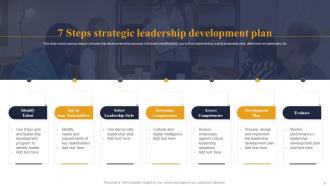
Leadership Strategy Development
-
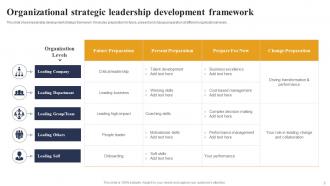
Organizational strategic leadership development framework
-

Strategies for business leadership development
-
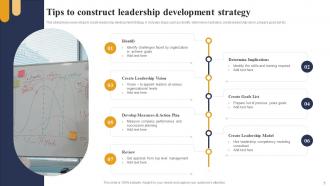
Tips to construct leadership development strategy
-
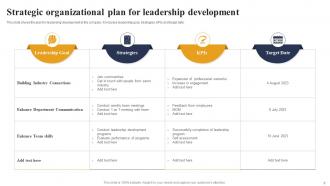
Strategic organizational plan for leadership development
-
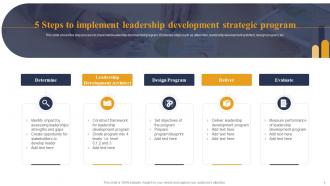
Leadership Strategy Development
-
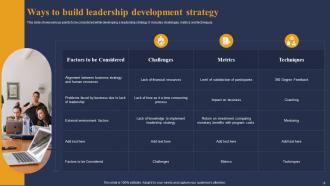
Ways to build leadership development strategy
-
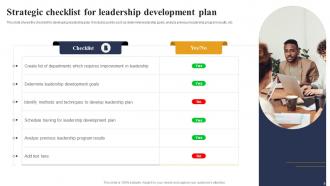
Strategic checklist for leadership development plan
-
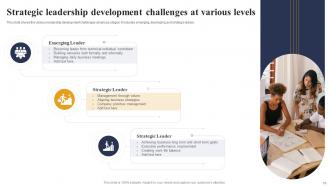
Strategic leadership development challenges at various levels
-
Icon to develop leadership strategy in organization
-
Manager presenting leadership development strategies icon
-
Leadership strategy for employee growth and development icon
-

Thanks for watching
-

-

-

-

-

FAQs for Leadership Strategy Development Powerpoint
Effective leaders demonstrate emotional intelligence, strategic thinking, adaptability, decisiveness, and strong communication skills that directly shape their strategic choices. These traits enable leaders to assess complex market conditions, build stakeholder consensus, and pivot quickly when needed, with many organizations finding that emotionally intelligent leaders make more sustainable long-term decisions while maintaining team alignment.
Organizations cultivate leadership culture through mentorship programs, cross-functional project assignments, leadership development workshops, delegation of decision-making authority, and recognition systems that reward initiative-taking behaviors. These approaches empower employees by providing growth opportunities, building confidence through real responsibilities, and creating pathways for advancement, with many companies finding that distributed leadership enhances innovation, employee engagement, and organizational agility.
Emotional intelligence enables leaders to understand team dynamics, manage conflicts effectively, and make strategic decisions that consider human factors alongside business metrics. Through enhanced self-awareness and empathy, leaders in sectors like healthcare, retail, and financial services build stronger stakeholder relationships, improve employee engagement, and ultimately deliver better organizational outcomes while navigating complex strategic challenges.
Leaders should adapt their strategies during crises by prioritizing transparent communication, accelerating decision-making processes, reallocating resources strategically, and maintaining employee engagement through uncertainty. These approaches enable organizations to navigate disruptions while preserving team morale and operational continuity, with many companies finding that crisis-adapted leadership ultimately delivers enhanced resilience and competitive advantage.
Common pitfalls in developing leadership strategy include lack of alignment with organizational goals, insufficient stakeholder input, unclear accountability structures, and inadequate succession planning processes. Many organizations find that rushing implementation without proper assessment, failing to address cultural dynamics, and neglecting ongoing development ultimately undermines strategic effectiveness and long-term leadership sustainability.
Leaders effectively balance short-term goals with long-term vision by establishing clear milestone frameworks, maintaining flexible resource allocation strategies, and creating communication systems that connect daily operations to strategic objectives. Through integrated planning approaches, organizations streamline decision-making processes while ensuring immediate achievements support broader vision fulfillment, ultimately delivering sustainable growth and competitive advantage.
Key metrics for evaluating leadership strategy effectiveness include employee engagement scores, retention rates, productivity indicators, goal achievement percentages, and 360-degree feedback results. These measurements enable organizations to assess leadership impact across talent development, operational efficiency, and strategic execution, with many companies finding that combining quantitative performance data with qualitative feedback delivers comprehensive insights into leadership effectiveness and organizational growth.
Leaders ensure alignment by clearly communicating organizational mission through regular team meetings, one-on-one discussions, and collaborative goal-setting sessions that connect individual values to company objectives. Through transparent dialogue and feedback mechanisms, managers in sectors like healthcare, technology, and financial services create shared understanding, ultimately delivering stronger employee engagement and organizational cohesion.
Leaders can foster innovation by encouraging creative risk-taking, establishing dedicated brainstorming sessions, providing resources for experimentation, creating cross-functional collaboration opportunities, and implementing reward systems for innovative ideas. These strategies enable teams to explore new solutions while maintaining operational efficiency, with many organizations finding that psychological safety and structured innovation processes ultimately deliver breakthrough products, enhanced competitive advantage, and sustained growth.
Diverse leadership styles significantly enhance team dynamics by fostering adaptability, innovation, and comprehensive problem-solving approaches across different situations and team member needs. Organizations with varied leadership approaches, from collaborative to directive styles, experience improved employee engagement, higher retention rates, and stronger performance outcomes, as teams benefit from multiple perspectives and leadership methods that accommodate diverse working preferences.
Mentoring accelerates leadership development by providing personalized guidance, knowledge transfer, real-world experience sharing, and strategic thinking development that formal training often cannot deliver. Through structured mentoring programs, organizations in sectors like healthcare, finance, and technology cultivate stronger decision-makers, enhance succession planning, and build leadership pipelines, ultimately delivering improved organizational performance and competitive advantage.
Leaders leverage data analytics to inform strategies by identifying market trends, measuring performance metrics, predicting customer behavior, and optimizing resource allocation across operations. Through advanced analytics platforms, organizations streamline decision-making processes, enhance competitive positioning, and minimize strategic risks, with many finding that data-driven approaches ultimately deliver faster adaptability and measurable business outcomes.
Remote leaders face communication barriers, team cohesion difficulties, performance monitoring challenges, cultural maintenance issues, and technology coordination complexities. Through regular virtual check-ins, structured collaboration platforms, and outcome-based management approaches, organizations streamline remote leadership effectiveness, with many companies finding that strategic digital communication frameworks ultimately deliver stronger team engagement and operational efficiency.
Storytelling enhances leadership strategy by building emotional connections, communicating vision clearly, and inspiring action across teams. Through compelling narratives, leaders in organizations like healthcare systems, financial institutions, and manufacturing companies create shared understanding, drive cultural transformation, and motivate employees toward strategic goals, ultimately delivering stronger engagement and organizational alignment.
Feedback serves as a critical refinement mechanism for leadership strategies, enabling leaders to identify gaps, measure effectiveness, assess team responses, and adapt approaches based on real outcomes. Through regular input from stakeholders, performance metrics, and organizational results, leaders can continuously evolve their strategies, address emerging challenges, and enhance decision-making processes, ultimately delivering more responsive leadership and sustainable competitive advantage.
-
Their products can save your time, effort and money. What else you need. All in one package for presentation needs!
-
Designs have enough space to add content.