

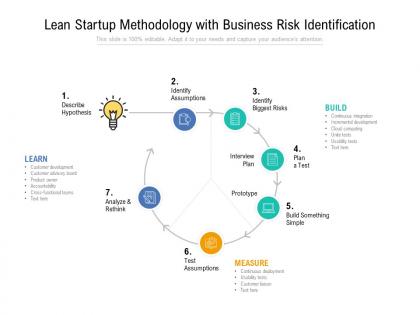
Lean startup methodology with business risk identification




Try Before you Buy Download Free Sample Product
 Impress Your
 Audience
 100%
100% Editable
 Save Hours
 of Time


Breakthrough the clutter with our Lean Startup Methodology With Business Risk Identification. Clear the channels with your thoughts.
People who downloaded this PowerPoint presentation also viewed the following :
Lean startup methodology with business risk identification with all 2 slides:
Bring more to the table with our Lean Startup Methodology With Business Risk Identification. Add new flavours with your thoughts.
FAQs for Lean startup methodology with
Lean Startup Methodology's core principles include building minimum viable products, validated learning through customer feedback, iterative development cycles, pivot-or-persevere decisions, and continuous experimentation. These principles enable startups to minimize resource waste, accelerate time-to-market, and reduce failure risks, with many organizations finding that this approach delivers faster product validation and sustainable competitive advantages.
The Build-Measure-Learn feedback loop enhances product development by creating rapid prototypes, testing assumptions with real users, and iterating based on data-driven insights. This cyclical approach enables companies to minimize development costs, reduce time-to-market, and build products that truly meet customer needs, with many startups and established organizations finding that systematic validation prevents costly feature investments and accelerates market fit.
**INPUT**: In what ways does the Lean Startup approach minimize waste in product validation? **OUTPUT**: Lean Startup minimizes validation waste through rapid prototyping, continuous customer feedback, and data-driven iteration cycles that eliminate unnecessary features before full development. This approach enables companies across sectors, from fintech to healthcare, to test core assumptions with minimal resources, ultimately delivering faster market entry and reduced development costs while avoiding expensive product failures. [Word count: 54 words]
Customer feedback serves as the foundation of Lean Startup methodology, driving product development through validated learning, rapid iteration, and data-driven decision making. Through systematic customer interviews, surveys, and behavioral analytics, startups can pivot strategies, refine features, and optimize market fit, with many entrepreneurs finding that continuous feedback loops significantly reduce development costs while accelerating time-to-market and competitive positioning.
Startups can effectively identify their MVP by conducting customer interviews, analyzing competitor offerings, defining core value propositions, and mapping essential user journeys. Through rapid prototyping and iterative testing, companies like Dropbox and Airbnb validated their concepts with minimal features, ultimately delivering faster market entry and reduced development costs while maximizing learning opportunities.
Lean Startup assumption testing strategies include building minimum viable products (MVPs), conducting customer interviews, running A/B tests, creating landing page experiments, and implementing cohort analysis. These approaches enable startups to validate market demand, pricing models, and user behavior patterns quickly and cost-effectively, with many entrepreneurs finding that systematic testing reduces product development risks while accelerating time-to-market.
The Lean Startup Methodology enables rapid pivots through iterative build-measure-learn cycles, minimum viable products, and continuous customer feedback validation. This approach allows organizations to test assumptions quickly, minimize resource waste, and adjust strategies based on real market data, with many startups and established companies finding that validated learning accelerates product-market fit while reducing development costs.
Essential lean experimentation metrics include customer acquisition cost, lifetime value, conversion rates, activation rates, retention metrics, and validated learning indicators. These measurements enable startups to assess product-market fit, optimize resource allocation, and pivot strategically, with many organizations finding that focusing on actionable metrics rather than vanity metrics ultimately delivers faster product iterations and sustainable growth.
Iterative development emphasizes rapid cycles of building, testing, and learning with continuous customer feedback, while traditional methodologies follow linear phases with extensive upfront planning and delayed market validation. This approach enables companies to minimize resource waste, respond quickly to market changes, and reduce product failure risks, with many tech startups and established enterprises finding that iterative cycles deliver faster time-to-market and better customer alignment.
Lean Startup may struggle in heavily regulated industries like pharmaceuticals or aerospace, where extensive upfront research and compliance requirements prevent rapid iteration. It's also less effective for infrastructure projects requiring substantial capital investments, complex B2B enterprise solutions with long sales cycles, or scenarios where customer feedback is difficult to obtain quickly, ultimately requiring more traditional planning approaches.
Teams foster experimentation culture by encouraging hypothesis-driven testing, celebrating both successes and failures as learning opportunities, implementing regular retrospectives, and empowering employees to propose and run small-scale experiments. Through structured feedback loops and data-driven decision making, organizations streamline innovation processes, reduce risk aversion, and accelerate product development cycles, ultimately delivering competitive advantage.
Lean Startup tools include customer development platforms like Typeform and SurveyMonkey, analytics tools such as Google Analytics and Mixpanel, prototyping software like Figma and InVision, A/B testing platforms, and project management systems. These resources streamline hypothesis testing, accelerate feedback loops, and minimize development costs, with many startups finding that integrated tool ecosystems ultimately deliver faster validation and sustainable growth.
Established companies can apply Lean Startup principles by creating dedicated innovation teams, implementing rapid prototyping processes, conducting customer validation experiments, and adopting fail-fast mentalities within controlled environments. Through internal incubators and cross-functional teams, organizations like GE and IBM streamline product development, minimize resource waste, and accelerate time-to-market, ultimately delivering competitive advantage in increasingly dynamic markets.
Entrepreneurs commonly face challenges including resistance to rapid iteration, difficulty identifying meaningful metrics, struggle with customer feedback integration, and fear of premature pivoting when implementing Lean Startup practices. These obstacles often stem from traditional business planning mindsets, with many startups finding that overcoming these hurdles requires cultural shifts toward experimentation and data-driven decision making, ultimately delivering faster market validation and reduced development costs.
Lean Startup Methodology enhances investor relations by demonstrating validated customer demand, reduced risk through iterative testing, and efficient capital allocation across development cycles. Through MVP testing and pivot capabilities, startups present compelling evidence-based growth stories to investors, ultimately securing funding more effectively while building confidence through measurable progress and market validation.
No Reviews