


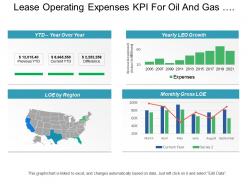
Lease operating expenses kpi for oil and gas industry kpi dashboard





Try Before you Buy Download Free Sample Product
 Impress Your
 Audience
 100%
100% Editable
 Save Hours
 of Time


Really wow them at your next presentation. Lease Operating Expenses Kpi For Oil And Gas Industry Kpi Dashboard in a range of modern designs are available.
People who downloaded this PowerPoint presentation also viewed the following :
Lease operating expenses kpi for oil and gas industry kpi dashboard with all 6 slides:
Acquire cross cultural ability with our Lease Operating Expenses Kpi For Oil And Gas Industry Kpi Dashboard. They help compete in the global arena.


FAQs for Lease operating expenses kpi for oil and gas
Lease Operating Expenses include labor costs, utilities, maintenance and repairs, chemical treatments, insurance premiums, and regulatory compliance fees. These operational components enable energy companies to maintain production efficiency, ensure safety standards, and optimize resource allocation across drilling sites, with many operators finding that strategic expense management ultimately delivers enhanced profitability and competitive advantage.
Companies can effectively track LOE by implementing automated expense management systems, establishing standardized cost categories like maintenance, labor, utilities, and regulatory compliance, and utilizing real-time monitoring dashboards. This strategic combination enables organizations to identify cost optimization opportunities, benchmark performance against industry standards, and make data-driven decisions that ultimately enhance operational efficiency and profitability.
Key performance indicators for evaluating LOE efficiency include cost per barrel equivalent, LOE variance from budget, operating ratio, downtime percentage, and maintenance cost trends. These metrics enable operators to identify operational inefficiencies, optimize resource allocation, and benchmark performance across wells, with many oil and gas companies finding that comprehensive LOE tracking delivers significant cost reductions and enhanced profitability.
Crude oil price fluctuations impact Lease Operating Expenses through energy costs, equipment pricing, service contractor rates, and maintenance material expenses. When prices rise, operators face higher fuel costs for equipment and transportation, increased service fees, and elevated supply costs, while price drops can reduce these operational expenses, ultimately affecting profitability margins and operational efficiency across upstream operations.
Common pitfalls in calculating LOE include inconsistent expense categorization, overlooking indirect costs, failing to allocate shared resources accurately, and inadequate tracking of variable operational expenses. These challenges often result in skewed profitability metrics and poor investment decisions, with many oil and gas companies finding that standardized accounting frameworks and automated tracking systems significantly enhance accuracy and strategic planning capabilities.
Technology streamlines LOE tracking through automated data capture, real-time expense monitoring, integrated financial reporting systems, and predictive analytics platforms. These solutions enhance operational efficiency by eliminating manual data entry, reducing human error, and providing instant visibility into cost patterns, with many oil and gas companies finding that automated systems deliver faster reporting and improved budget accuracy.
Regulatory changes affect Lease Operating Expenses through updated environmental compliance costs, revised safety standards requiring new equipment investments, and modified reporting requirements increasing administrative burdens. These regulatory shifts often demand enhanced monitoring systems, additional training programs, and upgraded operational procedures, with many oil and gas operators finding that proactive compliance strategies ultimately deliver operational efficiency and competitive advantage.
Companies benchmark LOE against industry standards by analyzing cost per barrel metrics, operational efficiency ratios, maintenance expenditures, and regional performance data from industry reports and peer analyses. Through platforms like IHS Markit, Wood Mackenzie, and trade associations, oil and gas operators compare their lease operating costs with similar assets, geological formations, and production volumes, ultimately identifying optimization opportunities and competitive positioning within their operational segments.
Asset management significantly controls Lease Operating Expenses through preventive maintenance scheduling, equipment lifecycle optimization, vendor relationship management, and strategic resource allocation. By implementing predictive analytics and maintenance protocols, organizations streamline operational costs, minimize unexpected repairs, and enhance asset performance, with many oil and gas companies finding that proactive asset management reduces lease operating costs by 15-25% while improving overall operational efficiency.
Operators use LOE metrics to inform strategic decisions by identifying cost reduction opportunities, optimizing resource allocation, and benchmarking performance against industry standards. These insights enable targeted investments in automation, preventive maintenance, and operational efficiency improvements, with many oil and gas companies finding that disciplined LOE analysis drives competitive advantage and maximizes asset profitability.
Best practices for communicating LOE data include creating standardized dashboards, using visual trend analysis, providing comparative benchmarks, establishing regular reporting cadences, and contextualizing variances with operational explanations. These approaches enable stakeholders across finance, operations, and executive teams to quickly assess cost performance, identify optimization opportunities, and make informed decisions, with many energy companies finding that clear LOE communication significantly enhances budget accuracy and operational accountability.
Variations in LOE reveal operational performance through cost pattern analysis, equipment maintenance trends, labor productivity metrics, and resource allocation effectiveness across different wells or fields. When energy companies experience declining LOE per barrel, it typically indicates improved operational efficiency, optimized maintenance schedules, and streamlined processes, while increasing variations often signal equipment issues, inefficient workflows, or suboptimal resource management, ultimately impacting profitability and competitive positioning.
Geographical location significantly impacts lease operating expenses through varying labor costs, regulatory requirements, environmental conditions, and infrastructure accessibility across different regions. Remote or harsh climate areas typically experience higher transportation, maintenance, and personnel costs, while regions with established oil and gas infrastructure often deliver operational efficiencies and reduced expenses, ultimately affecting profitability and competitive positioning.
Companies align LOE strategies with sustainability goals by implementing energy-efficient equipment upgrades, adopting renewable energy sources, optimizing resource consumption, and integrating environmental monitoring systems. These approaches streamline operations while reducing carbon footprints, with many oil and gas operators finding that sustainable practices ultimately deliver significant cost reductions, enhanced regulatory compliance, and improved stakeholder confidence in an increasingly environmentally-conscious market.
Innovative approaches to reduce Lease Operating Expenses include predictive maintenance using IoT sensors, automated data collection systems, remote monitoring technologies, energy-efficient equipment upgrades, and strategic vendor consolidation. These technologies streamline operations by minimizing downtime, reducing manual labor costs, and optimizing resource allocation, with many oil and gas companies finding that predictive analytics ultimately delivers 15-30% cost reductions while maintaining operational excellence.
-
Great product with highly impressive and engaging designs.
-
Very unique and reliable designs.