


Evolution Of Robo Advisory For Wealth Management How AI Is Revolutionizing Finance Industry AI SS




Try Before you Buy Download Free Sample Product
 Impress Your
 Audience
 100%
100% Editable
 Save Hours
 of Time


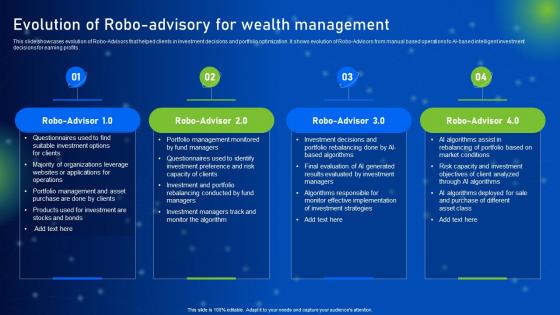
This slide showcases evolution of Robo-Advisors that helped clients in investment decisions and portfolio optimization. It shows evolution of Robo-Advisors from manual based operations to AI-based intelligent investment decisions for earning profits.
People who downloaded this PowerPoint presentation also viewed the following :
Evolution Of Robo Advisory For Wealth Management How AI Is Revolutionizing Finance Industry AI SS with all 6 slides:
Use our Evolution Of Robo Advisory For Wealth Management How AI Is Revolutionizing Finance Industry AI SS to effectively help you save your valuable time. They are readymade to fit into any presentation structure.





FAQs for Evolution Of Robo Advisory For Wealth Management How AI Is Revolutionizing Finance
Key technological advancements include machine learning algorithms, natural language processing, cloud computing, API integrations, and advanced analytics platforms. These technologies streamline portfolio management by automating risk assessments, personalizing investment strategies, and enabling real-time rebalancing, with many financial institutions finding that clients receive more consistent, cost-effective advisory services while advisors focus on complex wealth planning strategies.
Robo-advisors typically deliver competitive investment returns through low-cost, diversified portfolios and systematic rebalancing, while traditional advisors offer personalized guidance and relationship-based service that many clients value. Studies show robo-advisors excel in cost efficiency and consistency, whereas traditional advisors provide superior performance during market volatility and complex financial planning, with client satisfaction ultimately depending on individual preferences for human interaction versus automated convenience.
Artificial intelligence enhances robo-advisors through advanced portfolio optimization, predictive analytics, behavioral pattern recognition, risk assessment algorithms, and personalized investment recommendations. These AI-driven capabilities enable wealth management firms to deliver more sophisticated investment strategies, reduce human bias in decision-making, and provide 24/7 client services, ultimately delivering cost-effective solutions and competitive advantages.
Regulatory changes have significantly shaped robo-advisory platforms by establishing clearer compliance frameworks, enhancing investor protections, and standardizing fiduciary responsibilities across digital wealth management services. These evolving regulations have enabled platforms to scale more confidently while building greater client trust, with many financial institutions finding that structured oversight ultimately delivers operational clarity, reduced liability risks, and accelerated market adoption.
Robo-advisors cater to different demographics through age-appropriate asset allocation models, personalized risk tolerance questionnaires, goal-based investment strategies, and customizable portfolio options tailored to income levels and investment timelines. These platforms enable younger investors to access low-cost diversified portfolios while providing conservative options for retirees, ultimately delivering personalized wealth management solutions across generational and financial segments.
Robo-advisors face significant trust barriers with high-net-worth individuals due to concerns about personalized service, complex portfolio needs, regulatory compliance, and the lack of human relationship management for sophisticated financial situations. While these platforms excel at cost efficiency and accessibility, wealthy clients often require bespoke strategies, tax optimization, and estate planning that traditional human advisors provide, with many finding that hybrid models combining technology with personal advisory services ultimately deliver the trust and customization needed.
Robo-advisors integrate ESG criteria through automated screening algorithms, sustainability scoring systems, impact measurement tools, and values-based portfolio construction that filters investments based on environmental, social, and governance factors. These platforms enable wealth managers to offer personalized ESG portfolios at scale, with many financial institutions finding that automated ESG integration delivers both competitive differentiation and enhanced client satisfaction while meeting growing demand for sustainable investing.
Robo-advisors are reshaping market dynamics by democratizing wealth management, reducing fees, increasing market accessibility, and driving passive investment strategies through algorithm-driven portfolio management. These platforms enable financial institutions to serve broader client segments while delivering cost-effective diversification, automated rebalancing, and data-driven insights, ultimately forcing traditional advisors to enhance their value propositions and embrace hybrid advisory models.
Robo-advisor fees typically range from 0.25% to 0.75% annually, significantly lower than traditional wealth management services which charge 1% to 2% or more. This cost advantage enables investors to retain more returns over time, with many finding that robo-advisors deliver comparable portfolio management and rebalancing services at substantially reduced expense ratios.
Future trends in robo-advisory services include hyper-personalized AI algorithms, behavioral finance integration, ESG-focused portfolio construction, real-time tax optimization, and seamless cryptocurrency incorporation. These advancements enhance client experiences by delivering more sophisticated risk assessment, personalized investment strategies, and automated rebalancing, with many wealth management firms finding that strategic technology adoption ultimately drives competitive advantage and operational efficiency.
Robo-advisory platforms enhance personalization through advanced behavioral analytics, dynamic risk profiling, goal-based portfolio construction, real-time preference learning, and integration of life event triggers. These technologies streamline wealth management by analyzing spending patterns, adjusting allocations automatically, and incorporating client feedback continuously, with many financial institutions finding that personalized algorithms ultimately deliver more relevant investment strategies and improved client satisfaction.
Behavioral finance principles guide robo-advisory algorithms by incorporating investor psychology, loss aversion patterns, overconfidence biases, and emotional decision-making tendencies into automated portfolio management systems. These algorithms leverage behavioral insights to deliver personalized investment strategies, automated rebalancing during market volatility, and nudging mechanisms that counteract common investor mistakes, ultimately enhancing long-term wealth outcomes.
The COVID-19 pandemic significantly accelerated robo-advisory adoption by driving digital-first investing behaviors, reducing face-to-face financial interactions, and increasing demand for accessible wealth management solutions. Market volatility prompted investors to seek automated portfolio rebalancing and 24/7 digital access, with many financial institutions finding that robo-advisors delivered cost-effective client engagement and streamlined onboarding during remote operations.
Robo-advisors are employing diversification into alternative investments, enhanced personalization through AI, hybrid human-advisor models, expanded financial planning services, and competitive fee structures to differentiate themselves. These strategies enable firms to attract broader client segments, deliver more comprehensive wealth management solutions, and ultimately provide greater value proposition than traditional investment platforms, with many finding that integrated approaches combining technology and human expertise drive client retention.
Financial education can be integrated into robo-advisory platforms through interactive tutorials, personalized learning modules, real-time market insights, automated explanations of investment decisions, and gamified financial literacy tools. These educational features enhance client confidence and engagement by demystifying investment processes, with many wealth management firms finding that informed clients demonstrate greater platform loyalty and increased investment contributions.
-
They helped us design the pamphlets for our church’s food drive! The people loved the design, and I’m happy to say it was successful. Thank you, SlideTeam!
-
I’ve been your client for a few years now. Couldn’t be more than happy after using your templates. Thank you!