


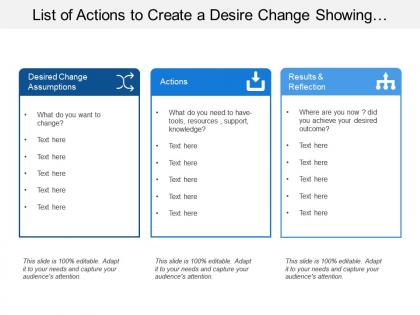
List of actions to create a desire change showing results and reflection




Try Before you Buy Download Free Sample Product
 Impress Your
 Audience
 100%
100% Editable
 Save Hours
 of Time


Our List Of Actions To Create A Desire Change Showing Results And Reflection give off brilliance. Your genius will come through bright and clear.
People who downloaded this PowerPoint presentation also viewed the following :
List of actions to create a desire change showing results and reflection with all 5 slides:
Highlight and improve on existing flaws with our List Of Actions To Create A Desire Change Showing Results And Reflection. Halt any errors from happening.


FAQs for List of actions to create a desire change showing
Key principles of effective change management include clear communication, stakeholder engagement, leadership commitment, structured planning, and continuous feedback mechanisms. These principles work together by building organizational buy-in, minimizing resistance, and ensuring smooth transitions, with many companies finding that combining strong leadership support with transparent communication ultimately delivers faster implementation and higher adoption rates.
Organizations can measure change initiative success through key performance indicators, employee engagement metrics, adoption rates, productivity benchmarks, and financial impact assessments. These measurement frameworks enable businesses to track progress across departments, identify implementation gaps, and demonstrate ROI, with many companies finding that comprehensive metrics ultimately drive accountability and sustain long-term transformation outcomes.
Leadership drives organizational change by setting clear vision, communicating benefits, allocating resources, and modeling desired behaviors throughout the transformation process. Effective leaders in sectors like manufacturing and healthcare facilitate buy-in through transparent communication, strategic training programs, and consistent support, ultimately delivering higher adoption rates, reduced resistance, and sustainable competitive advantage.
Common barriers to successful change management include employee resistance, inadequate communication, insufficient leadership support, lack of clear vision, and poor resource allocation. These challenges can be addressed by engaging stakeholders early, implementing transparent communication strategies, securing executive buy-in, and providing comprehensive training, with many organizations finding that structured change frameworks ultimately deliver smoother transitions and higher adoption rates.
Communication strategies during change can be optimized through transparent messaging, multi-channel delivery, two-way feedback loops, targeted audience segmentation, and consistent leadership visibility. These approaches enhance employee engagement by addressing concerns proactively, building trust through regular updates, and creating dialogue opportunities, ultimately reducing resistance while accelerating adoption across organizations navigating transformation initiatives.
Techniques to manage employee resistance include transparent communication, involving employees in planning processes, providing comprehensive training programs, addressing concerns directly, and implementing gradual transitions. Through strategic change management, organizations streamline adoption across departments like HR, operations, and IT, while building trust and engagement, ultimately delivering smoother transformations and enhanced workforce adaptability in increasingly dynamic business environments.
The ADKAR model applies to real-world scenarios by building awareness of change necessity, creating desire through clear benefits communication, developing knowledge via targeted training, providing ability through skill development and resources, and ensuring reinforcement through recognition systems. Organizations implementing new technologies, restructuring operations, or shifting cultural practices find that this sequential approach delivers higher adoption rates, reduced resistance, and ultimately sustainable transformation outcomes.
Organizational culture significantly influences change management success by shaping employee attitudes, resistance levels, communication patterns, and leadership effectiveness throughout transformation initiatives. Cultures that emphasize adaptability, open communication, and continuous learning typically experience smoother transitions, while rigid organizational environments often require more structured change strategies, ultimately determining whether initiatives deliver sustainable competitive advantage and operational improvements.
Technology supports change management initiatives by providing communication platforms, training systems, project management tools, analytics dashboards, and feedback mechanisms. These digital solutions streamline change processes by enhancing transparency, enabling real-time collaboration, and tracking adoption metrics, with many organizations finding that automated workflows and data-driven insights significantly accelerate transformation while minimizing resistance.
Best practices for implementing change in remote or hybrid environments include establishing clear communication channels, creating structured virtual collaboration processes, providing comprehensive digital training resources, maintaining regular check-ins with distributed teams, and ensuring consistent leadership visibility across all platforms. These approaches streamline transitions by fostering transparency, building trust, and maintaining team cohesion, with many organizations finding that strategic digital engagement ultimately delivers faster adoption and stronger employee buy-in.
Feedback loops can be integrated through regular pulse surveys, focus groups, town halls, digital collaboration platforms, and structured review sessions at key milestones. These mechanisms enable organizations to capture real-time insights, address resistance early, and adjust strategies dynamically, with many companies finding that continuous feedback accelerates adoption and ultimately delivers more successful transformations.
Training and development serve as critical enablers for change adoption by building employee competencies, reducing resistance through understanding, and creating confidence in new processes and systems. Through targeted skill-building programs, organizations streamline transitions, enhance employee engagement, and accelerate implementation timelines, with many companies finding that comprehensive training delivers significantly higher adoption rates and sustained organizational transformation.
Change management frameworks can be tailored by adapting communication strategies, stakeholder engagement approaches, timeline considerations, and resistance management techniques to match industry-specific cultures, regulatory requirements, and operational constraints. Healthcare organizations might emphasize patient safety protocols during transitions, while manufacturing companies focus on minimizing production disruptions, ultimately delivering more effective change adoption and sustainable organizational transformation.
Key factors include stakeholder impact assessment, resource allocation timelines, communication frameworks, risk mitigation protocols, and performance measurement systems. These strategic elements work together by ensuring organizational buy-in, minimizing operational disruption, and maintaining productivity levels, with many companies finding that early alignment between change initiatives and core business objectives ultimately delivers faster implementation and sustainable competitive advantage.
Emotional intelligence and empathy enable change leaders to understand employee concerns, anticipate resistance, and communicate effectively during transitions. These skills help managers recognize emotional responses to change, provide appropriate support, and build trust through genuine understanding, with organizations finding that empathetic leadership significantly reduces change resistance and accelerates adoption timelines.
-
Excellent design and quick turnaround.
-
Very unique and reliable designs.