


Logistic Value Chain Analysis Powerpoint Ppt Template Bundles




Try Before you Buy Download Free Sample Product
 Impress Your
 Audience
 100%
100% Editable
 Save Hours
 of Time


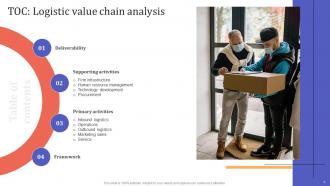
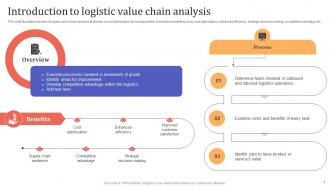
Embark on a strategic journey through the intricate world of logistics with our dynamic PowerPoint presentation, Logistic Value Chain Analysis. Explore the critical elements shaping supply chain logistics, unravel the complexities of the distribution network, and understand the seamless integration of transportation within the logistics chain. Dive deep into the operational efficiency of our logistics and distribution system, dissecting each stage for optimal performance. Discover the strategic importance of freight within the logistics value chain, showcasing how it drives seamless connectivity. This presentation is your compass for comprehending the interwoven threads that make up a resilient and effective logistics value chain. Elevate your logistics understanding with this insightful analysis.
People who downloaded this PowerPoint presentation also viewed the following :
Logistic Value Chain Analysis Powerpoint Ppt Template Bundles with all 22 slides:
Use our Logistic Value Chain Analysis Powerpoint Ppt Template Bundles to effectively help you save your valuable time. They are readymade to fit into any presentation structure.









FAQs for Logistic Value Chain Analysis Powerpoint
Key components of a logistic value chain include procurement, warehousing, transportation, inventory management, order fulfillment, and customer service integration. These interconnected elements streamline operations by coordinating supplier relationships, optimizing storage facilities, and automating distribution processes, with many manufacturing and retail organizations finding that strategic alignment across all components delivers reduced costs, faster delivery times, and enhanced customer satisfaction.
Organizations identify logistic value chain inefficiencies through comprehensive data analysis, process mapping, performance benchmarking, technology audits, and stakeholder feedback collection. These diagnostic approaches streamline operations by revealing bottlenecks in transportation, warehousing, and inventory management, with many companies finding that systematic analysis ultimately delivers cost reductions and enhanced customer satisfaction.
Technology revolutionizes logistic value chain analysis through real-time tracking, predictive analytics, automated data collection, AI-driven optimization, and integrated supply chain platforms. These digital tools enable companies to streamline operations, reduce costs, and enhance visibility across warehousing, transportation, and distribution networks, ultimately delivering faster services and competitive advantage in increasingly complex markets.
Companies measure logistic value chain effectiveness through key performance indicators like delivery times, cost per shipment, inventory turnover rates, order accuracy, and customer satisfaction scores. These metrics enable organizations to identify bottlenecks, optimize resource allocation, and enhance operational efficiency, with many logistics providers finding that comprehensive measurement systems deliver reduced costs and improved service reliability.
External factors like regulatory changes significantly impact logistic value chains by altering compliance requirements, transportation routes, documentation processes, and operational timelines. These regulatory shifts create both challenges and opportunities, with companies in pharmaceuticals, automotive, and food industries finding that proactive adaptation through technology integration, supply chain diversification, and strategic partnerships ultimately delivers competitive advantage and enhanced operational resilience.
Collaboration between logistic partners enhances outcomes by enabling shared data visibility, coordinated planning, and integrated technology systems that streamline operations across the entire supply chain. Through strategic partnerships, companies reduce redundancies, optimize inventory levels, and accelerate delivery times, with many retailers and manufacturers finding that collaborative networks ultimately deliver lower costs and improved customer satisfaction.
Common logistics value chain challenges include inventory management inefficiencies, transportation delays, supplier coordination issues, demand forecasting inaccuracies, and technology integration gaps. These obstacles can be addressed through predictive analytics, real-time tracking systems, and strategic supplier partnerships, with many organizations finding that automated inventory management and integrated logistics platforms ultimately deliver reduced costs and enhanced customer satisfaction.
Demand forecasting influences the logistics value chain by enabling proactive inventory management, optimizing transportation routes, and aligning warehouse capacity with anticipated needs. Through predictive analytics, companies streamline procurement schedules, reduce carrying costs, and minimize stockouts, with retailers and manufacturers finding that accurate forecasting ultimately delivers improved customer satisfaction and significant cost reductions.
Sustainability can be incorporated through carbon footprint assessments, renewable energy adoption, waste reduction strategies, green transportation modes, and circular economy principles. These approaches enable organizations to optimize environmental performance while maintaining operational efficiency, with many logistics companies finding that sustainable practices reduce costs, enhance brand reputation, and deliver competitive advantage in increasingly eco-conscious markets.
Firms utilize data analytics to optimize their logistic value chain by analyzing transportation patterns, predicting demand fluctuations, monitoring inventory levels, and identifying bottlenecks across distribution networks. Through predictive analytics and real-time tracking, companies in retail, manufacturing, and e-commerce streamline route planning, reduce warehousing costs, and enhance delivery times, ultimately delivering improved customer satisfaction and competitive operational efficiency.
Businesses can create logistics resilience through diversified supplier networks, strategic inventory buffers, flexible transportation modes, robust risk assessment protocols, and advanced digital monitoring systems. These strategies enable organizations to quickly pivot during disruptions, maintain operational continuity, and minimize service interruptions, with many companies finding that multi-modal logistics and predictive analytics ultimately deliver competitive advantage and enhanced customer satisfaction.
Globalization significantly transforms logistic value chains by expanding geographic reach, increasing complexity through multiple suppliers and distribution points, and requiring advanced coordination systems across different time zones, regulations, and markets. While this presents challenges in inventory management and quality control, it enables organizations to optimize costs, access diverse markets, and leverage regional advantages, ultimately delivering enhanced competitiveness and operational flexibility.
Best practices for evaluating supplier performance include tracking delivery reliability, cost efficiency, quality metrics, communication responsiveness, and risk management capabilities through standardized KPIs and regular audits. These assessments enable organizations to optimize partnerships by identifying improvement areas, negotiating better terms, and ensuring supply chain resilience, with many companies finding that systematic supplier evaluation ultimately delivers reduced costs and enhanced operational efficiency.
Customer feedback integration occurs through real-time tracking systems, automated satisfaction surveys, delivery performance analytics, IoT sensors, and predictive modeling tools. These technologies streamline operations by identifying bottlenecks, optimizing route efficiency, and enhancing delivery experiences, with many logistics companies finding that continuous feedback loops ultimately deliver reduced costs and improved customer retention.
E-commerce growth significantly disrupts traditional logistic value chains by demanding faster delivery speeds, increased warehouse automation, direct-to-consumer shipping capabilities, and enhanced last-mile delivery solutions. These changes compel logistics providers to invest in omnichannel distribution networks, real-time tracking systems, and flexible fulfillment centers, ultimately delivering improved customer experiences while requiring substantial operational restructuring for competitive advantage.
-
Thank you for offering such helpful pre-designed templates. They are really beneficial to me in my job.
-
Mesmerized with the fantastic collection! Super sleek, relevant infographics.