

Luxury Brand Pyramid With Marketing Strategies




Try Before you Buy Download Free Sample Product
 Impress Your
 Audience
 100%
100% Editable
 Save Hours
 of Time


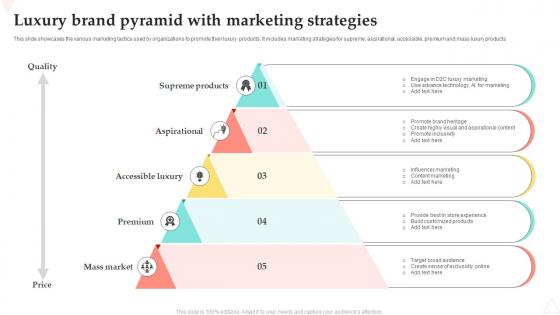
This slide showcases the various marketing tactics used by organizations to promote their luxury products. It includes marketing strategies for supreme, aspirational, accessible, premium and mass luxury products.
People who downloaded this PowerPoint presentation also viewed the following :
Luxury Brand Pyramid With Marketing Strategies with all 6 slides:
Use our Luxury Brand Pyramid With Marketing Strategies to effectively help you save your valuable time. They are readymade to fit into any presentation structure.





FAQs for Luxury Brand Pyramid
So there's basically three levels to luxury brands. Bottom tier is accessible stuff - Coach, Michael Kors - where regular people can treat themselves sometimes. Middle's aspirational luxury like Gucci or Prada (where I do most of my dreaming lol). Top tier is absolute luxury - Hermès, Rolls-Royce - costs more than most people's cars and you'll wait forever to even buy it. Higher you go, more expensive and exclusive it gets. Honestly, the snobbery factor jumps pretty dramatically too. When you're positioning a brand, just match whatever tier your customers can actually afford, not what they wish they could afford.
So basically, luxury shoppers think totally differently depending on how much they're spending. Accessible luxury buyers (like Coach) see it as treating themselves for special moments. Mid-tier customers? They're investing in quality and showing off their success a bit. But ultra-luxury is honestly insane - those people expect crazy exclusivity and heritage that somehow makes dropping $50k feel reasonable. They're literally buying into centuries of tradition and experiences most people will never have. It's wild how the mindset shifts. You've got to nail these differences when you're figuring out your messaging.
Look, exclusivity is what makes the whole luxury thing work - it's literally how brands justify charging insane amounts. Hermès does this perfectly with those Birkin waitlists that are basically impossible to get on. Meanwhile, accessible luxury brands let anyone walk in and buy stuff. The middle-tier brands get creative with limited drops and invite-only events to keep things feeling special. Honestly, manufacturing scarcity like that is pretty genius when you think about it. So whatever tier you're going for, you need some kind of exclusivity angle. Otherwise you're just overpriced, not actually luxurious.
Honestly, you can't just throw a crazy price on something and expect people to buy into the luxury thing. Focus on getting your product quality absolutely perfect first. Create some scarcity - maybe limited drops or exclusive access for certain people. Building relationships with the right influencers helps too, but they need to actually believe in what you're selling. The whole luxury positioning thing is painfully slow though, like we're talking years to build real credibility. Oh, and don't try jumping multiple tiers at once. Pick one level and completely dominate it before moving up.
For base pyramid stuff, go wide not narrow - you want mass appeal here. Price-sensitive customers do tons of research, so digital is everything. Social media campaigns work great, plus influencer collabs but with normal people, not celebrities. Honestly, the "democratic luxury" angle kills it - like everyone should get some nice things, you know? Skip the exclusive vibe completely. Multi-channel is key since convenience matters huge. Your whole thing should be quality that doesn't break the bank. Pick your main value message and just blast it everywhere consistently.
So luxury pricing is totally backwards from regular stuff. Entry-level luxury still does sales and discounts to hook people - they're competing on price somewhat. Mid-tier cuts way back on discounting since they want exclusivity but need volume too. Here's the weird part though: ultra-luxury brands almost never discount because high prices actually make people want it more. Scarcity drives demand, you know? I always think it's crazy how a $5000 handbag becomes more desirable at $8000. Figure out which tier you're going for first, then build your pricing around that. Don't try to force premium pricing if you're really targeting accessible luxury.
Honestly, you'll get caught in this weird middle ground where nobody trusts you. Current customers feel like you're ditching them, and your new target market thinks you're fake. Going upmarket? Premium buyers see you as trying too hard to be fancy. Down-market is worse though - your luxury customers think you sold out, plus budget shoppers assume it's just overpriced garbage with pretty packaging. Your whole brand gets stuck in limbo. Better to launch separate product lines instead of moving everything at once. Way less messy.
So the luxury pyramid thing is basically psychological manipulation, but it works. People buy that Coach wallet first - boom, they're hooked on the brand. Then they start climbing up to pricier stuff as they make more money or want to flex harder. It's honestly genius because each purchase feels like you're "leveling up" in life or whatever. Once you're in that ecosystem, you naturally crave the next tier. For your brand strategy, you'll want those entry-level products that get people addicted early. Then they do the rest of the work themselves.
Start with pricing - how do your average selling prices stack up against competitors? Customer demographics matter a lot too, especially income levels. Distribution is huge - are you in 200 stores or 20? Quality perception surveys will tell you what people actually think (not what you hope they think). Look at purchase frequency, customer lifetime value, brand heritage strength. Oh and organic buzz versus paid marketing spend - that ratio says a lot. I'd honestly just pick 3-4 direct competitors and benchmark everything against them. Most brands think they're positioned higher than they actually are, so be brutal about it.
Honestly, social media totally flipped how luxury works. Before, only people reading Vogue saw Chanel campaigns - now millions see them on Instagram instantly. Brands are hitting up younger audiences on TikTok who never would've discovered them otherwise. It's crazy how accessible these prestige brands feel now, even when you can't actually afford them. People build these weird aspirational relationships with brands they'll never buy from. The tricky part? Luxury houses have to stay exclusive while being all over social media. They can't look too desperate for attention or they'll cheapen themselves. It's honestly a pretty fine line to walk.
Oh man, culture totally changes how people see luxury brands! Like Coach or Kate Spade will push their "artisan craftsmanship" angle in the US, but flip to pure status flex mode in Asian markets. Same exact brand, completely different vibe. Premium brands do this dance too - what looks classy somewhere might come off as trying too hard elsewhere. I learned this the hard way on a project last year, honestly. Short version: definitely scope out how locals view luxury before you launch anything, because your messaging has to vibe with what people actually expect from each tier.
Look, sustainability is totally flipping the luxury game right now. Even Hermès and Chanel are pouring money into ethical sourcing because their rich clients actually care about responsibility now - crazy how fast that shifted! The mid-tier brands? They're using it as their main selling point to justify higher prices. Short version: figure out where you sit on the luxury ladder and make sure your sustainability story actually matches that level. Don't try to fake it though - people can smell BS from a mile away, especially when they're dropping serious cash.
Honestly, it's all about protecting what makes you special while still evolving. Look at Louis Vuitton - they're doing cool digital stuff but still obsessing over craftsmanship. Hermès stays crazy exclusive but throws younger buyers a bone with new product lines. You can't just ignore what millennials want, but don't water down your premium vibe either. I'd start with collaborations or new categories - expand around the edges without messing with your heritage story. Figure out what's absolutely untouchable about your brand first. Then you can experiment a bit.
LV's a perfect case study - they literally started making trunks for royalty, then slowly worked their way down to handbags regular people could actually afford. Porsche did something similar, honestly. They kept making those insane supercars nobody can buy, but then threw in SUVs like the Cayenne so normal rich people could get in on it too. The smart part? Both brands never ditched their fancy flagship stuff. When you're buying that "entry-level" LV bag, you're still buying into the whole fantasy of their crazy expensive trunk heritage at the top.
Honestly, heritage and storytelling are what separate the real luxury brands from the wannabes. Look at Hermès - they've got 180+ years of craftsmanship stories, while newer brands are still trying to prove themselves. Customers want that "earned not bought" feeling, you know? It's crazy how much extra people will pay just for a good story. Your narrative has to hit emotionally while screaming exclusivity and quality. Start by digging through whatever heritage you've got - even tiny historical details can become game-changers for positioning. Sometimes the smallest stories pack the biggest punch.
-
I joined SlideTeam last month and there’s no doubt that I tend to find our bond only strengthening over time. Best place to find world-class themes, templates, and icons.
-
SlideTeam just saved my project! Thank you so much. The variety of templates helped me showcase multiple perspectives easily.