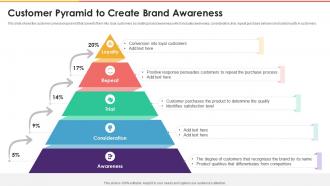
Customer Pyramid To Create Brand Awareness

Rating:
90%
Customer Pyramid To Create Brand Awareness
Slide 1 of 6
Favourites Favourites

Try Before you Buy Download Free Sample Product

Audience Impress Your
Audience
Editable 100%
Editable
Time Save Hours
of Time
The Biggest Sale is ending soon in
0
0
:
0
0
:
0
0
AI-Ready
Upload this template to AI and ask it to make any changes to content or color
100% editable Powerpoint Template for AI-assisted presentations. Finish your work in less time. Download Prompt Kit ​
Works with
Microsoft PowerPoint
Microsoft 365
Claude for PowerPoint
ChatGPT
Google Slides
Microsoft Copilot
Rating:
90%
This slide shows the customer conversion pyramid that converts them into loyal customers by creating brand awareness which includes awareness, consideration, trial, repeat purchase behavior and builds loyalty in customers. Introducing our premium set of slides with Customer Pyramid To Create Brand Awareness. Elucidate the five stages and present information using this PPT slide. This is a completely adaptable PowerPoint template design that can be used to interpret topics like Repeat, Trial, Consideration, Awareness, Loyalty. So download instantly and tailor it with your information.

FAQs for Customer Pyramid To

Honestly, segmentation is a game changer - you stop blasting the same message at everyone and actually speak to what different groups want. Your conversion rates will thank you. I've watched companies slash their ad spend by like 30% just from better targeting instead of spraying and praying. Way less money down the drain on campaigns that totally whiff. Product features, pricing, messaging - you can customize all of it. Don't overthink it though. Just start with 2-3 basic segments, maybe by buying habits or age groups, then expand once you get the hang of it.

Start with your CRM data - that's where all the good stuff lives. Demographics, buying patterns, how people actually engage with your brand. Pretty boring but super useful. Survey data helps too if you've got it, since it shows you the "why" behind customer behavior. Honestly, most companies go overboard here. Stick to 3-5 segments max or you'll just confuse yourself trying to create different campaigns for everyone. Each group needs to be big enough to actually matter and distinct enough that they'd respond to different messaging. I'd keep it simple at first - you can always get fancier later once you see what works.

Honestly, start with what you've already got - your CRM and purchase data are probably sitting there underused. Transaction history is pure gold: what people buy, how often, how much they spend. Your website behavior tells you tons too. Customer service logs? Super underrated - they'll show you problems you never knew existed. I'd throw in some survey data if you want to understand the "why" behind what people do, though it's kind of a pain to scale up. Social media stuff can help if your crowd actually uses it. Don't overthink this though - basic transactional data will get you pretty far before you need anything fancy.

Most companies go with demographic stuff first - age, income, where people live. Pretty straightforward. You can also look at behavior like what they buy or how they browse your site. RFM is huge right now (recency, frequency, monetary - basically how recently they bought, how often, how much they spend). Psychographic gets into lifestyle and values, which is cool but harder to track. Geographic is obvious. Look, don't stress about picking the "perfect" method - just use whatever data you've got lying around and start there. You can always get fancier later once you see what actually works.

Demographic segmentation is just the basic stuff - age, income, where people live, education level. Pretty straightforward. Psychographics gets way more interesting though. It's all about digging into someone's values, hobbies, lifestyle, personality quirks. Think of it this way: demographics show you who your customers are on paper. Psychographics reveal what actually drives them to buy something. Honestly, psychographics is where the real magic happens for messaging. You'll want both for your campaigns - use demographics to narrow down your audience, then let psychographics guide how you talk to them.

Honestly, tech is what makes modern segmentation actually work. Machine learning can spot patterns in huge datasets that you'd never catch manually - it's pretty wild. Instead of basic demographic groups, you're getting predictive segments based on purchase intent and behavior patterns. Way more useful. The cool part? These segments update automatically as customers change. I'd say start by looking at what data you're already collecting (probably more than you think), then test one advanced tool. Don't overthink it at first.

Just grab whatever customer data you've got - purchase history, email clicks, whatever. Excel works fine, no need for expensive tools yet. Hunt for basic patterns like how often people buy or what they spend. Create maybe 3-4 groups to start with. I'd keep it super simple honestly - the obvious insights usually work better than the clever ones anyway. Mailchimp has free audience tools if you need them. Google Analytics too if you have a site. Then just test different messages with each group and see what actually gets people to bite. Don't overthink it.

Honestly, the worst part is customers just don't stay in neat little boxes - their behavior shifts all the time. Your segments get stale super fast. We learned this the hard way when our "budget shoppers" suddenly started buying premium stuff during the holidays. You'll need someone constantly refreshing data and checking if your groups still make sense, which nobody ever budgets enough time for. Technical stuff gets messy too when you're pulling in new data sources. Set up some alerts to catch when segment performance drops. Way better than scrambling when your campaigns tank.

Honestly, segmentation is a game-changer for your marketing ROI. You stop wasting money on generic ads that nobody cares about. Different groups respond to totally different things - what motivates millennials won't work on boomers, you know? Your email open rates will actually improve when you're speaking their language. Same with conversion rates since you're hitting their specific pain points. Ad spend becomes way more efficient too. I'd start small though - pick like 2 or 3 main segments and test targeted campaigns against whatever broad stuff you're doing now.

Dude, customer segmentation is huge for product development. Instead of building random stuff hoping it sticks, you actually know what different groups want. I'd start by mapping your current features to specific segments - honestly, you'll probably find some weird gaps where you're way over-investing in features nobody cares about. The cool part? You can finally prioritize features for your best customers and stop wasting time on one-size-fits-all solutions. Makes roadmap decisions so much clearer. You'll customize experiences for different personas instead of just guessing what works.

Honestly, it's all about treating different customer groups like... well, different people. Your VIP customers get the fancy product showcases and premium stuff, while bargain hunters see your discount alerts first. Don't blast everyone with the same boring "Hey there!" emails - that's just lazy marketing if you ask me. Think about it like texting different friends differently. Website content, pricing, recommendations - customize it all based on what each group actually wants. Oh, and definitely start with email personalization since that's the easiest win. Map out what matters to each segment first, then work from there.

Honestly, the big things to worry about are consent and transparency - you've got to be upfront about collecting data and what you're doing with it. Privacy regulations like GDPR will bite you if you're not careful there. Bias is probably the trickiest part though. Your algorithms might accidentally discriminate against certain groups, which is both wrong and could get you in legal trouble. I'd start by auditing your current data practices. Also, check your segmentation criteria regularly - you don't want to accidentally reinforce stereotypes or anything sketchy like that.

Quarterly reviews are probably your sweet spot, but honestly it varies. Tech and fashion move crazy fast - maybe check monthly. Boring industries? Twice yearly works. Watch for behavior shifts or when performance tanks suddenly. I'd set reminders plus alerts for major drops. My old boss used to obsess over this stuff weekly which was overkill, but better than ignoring it completely. Just pick something regular and stick with it. You can always tweak the timing once you figure out what actually matters for your business.

Honestly, just start with what you've already got - don't go buying new stuff right away. Google Analytics is great for seeing how people behave on your site. If you're using Salesforce or HubSpot, those work perfectly for CRM segments too. Tableau and Power BI are solid for making everything visual (though Tableau can be a bit much sometimes). SQL or Python help if you want to dig deeper - I get it though, not everyone wants to code. Qualtrics handles surveys well, and for the really nerdy clustering stuff, R or scikit-learn do the trick. Main thing is picking tools that actually talk to your existing data.

So you can basically charge different prices to different groups based on what they'll pay. Premium customers who want all the bells and whistles? Hit them with higher prices. Price-sensitive folks get the budget version. Same core product, different packaging - it's actually genius if you ask me. Think enterprise clients dropping thousands while students get steep discounts. The trick is figuring out each group's price sensitivity first. Then you map that to how much value they think they're getting. Start there and build your tiers around it. Way better than having one flat price that makes you miss out on revenue.

Ratings and Reviews

90% of 100
Review Form
Write a review
Most Relevant Reviews
  1. 100%

    by Donnie Knight

    One word for SlideTeam–Versatile!
  2. 80%

    by Edison Rios

    Unique and attractive product design.

2 Item(s)

per page: