

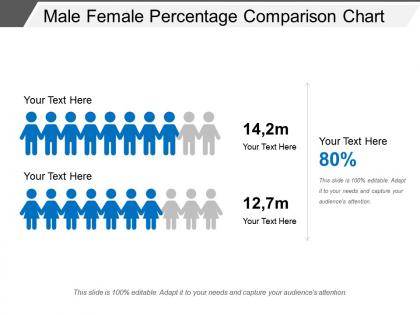
Male female percentage comparison chart




Try Before you Buy Download Free Sample Product
 Impress Your
 Audience
 100%
100% Editable
 Save Hours
 of Time


Utilize this Male Female Percentage Comparison Chart slideshow to showcase the variation in the sex ratio of the population. Take the assistance of this gender inequality PPT visual and highlight the issues and concerns related to women and men. You can generate data on how gender ratio varies across the world by utilizing this sex ratio PowerPoint layout. Utilize this gender equality PPT layout to safeguard the rights of women. Showcase that there are equal opportunities for both men and women in the corporate sector and education. Mention the percentage of literacy rate of females in different countries of the world by taking advantage of this population PPT graphic. Also, include in your presentation countries with the highest female to male ratio with the help of impressive graphs present in the PPT slide. You can also include general differences in social behavior with the help of this male-female PPT slide. Encourage people to work in order to achieve gender equality by downloading this ready to use gender report PowerPoint presentation.
People who downloaded this PowerPoint presentation also viewed the following :
Male female percentage comparison chart with all 5 slides:
Insist on highlighting facts with our Male Female Percentage Comparison Chart. It will increase your credibility.



FAQs for Male female
Current global trends show declining birth rates, aging populations, and persistent gender imbalances, with regions like East Asia experiencing significant male surplus due to cultural preferences, while Sub-Saharan Africa maintains more balanced ratios. These demographic shifts create varying workforce compositions, consumer market dynamics, and policy challenges across regions, with many countries finding that understanding gender distribution patterns enables more strategic resource allocation, targeted market approaches, and enhanced social planning initiatives.
Cultural factors influence gender ratio through traditional preferences for male children, practices like selective healthcare allocation, and varying access to education and employment opportunities across societies. Countries with strong son preference traditions, particularly in parts of Asia and the Middle East, often show skewed ratios, while more egalitarian cultures demonstrate balanced demographics, ultimately reflecting deeply embedded social values and economic structures.
Gender ratio imbalances impact economic development through reduced workforce participation, limited innovation capacity, decreased consumer market diversity, and weakened social stability. These demographic shifts create labor shortages in key sectors, constrain entrepreneurial activities, and ultimately limit GDP growth potential, with many developing economies finding that balanced gender ratios correlate strongly with sustained economic expansion.
Government policies play a crucial role in addressing gender ratio disparities through legal frameworks prohibiting gender-based discrimination, healthcare initiatives promoting equal access, education programs targeting underserved populations, and economic incentives encouraging gender balance. These comprehensive policy approaches enable countries to tackle systemic imbalances by combining regulatory measures with resource allocation, ultimately delivering measurable improvements in gender equality across sectors like healthcare, education, and workforce participation.
Technology enhances gender accessibility through remote work platforms, online education, digital banking, and e-commerce opportunities, while also presenting challenges like digital divides and bias in algorithms. These advancements enable women in developing regions to access global markets, financial services, and skill development programs, ultimately delivering greater economic participation and reduced gender gaps across industries.
Gender ratio in educational attainment reveals crucial insights into societal development, economic potential, workforce diversity, and social equity across nations. Countries with balanced educational gender ratios, such as Nordic nations and Canada, often demonstrate stronger economic growth, enhanced innovation capabilities, and improved social outcomes, while nations with significant disparities face reduced competitiveness and limited human capital development.
Healthcare access and outcomes vary significantly based on gender ratios, with women facing barriers in cardiovascular care and men experiencing lower mental health service utilization rates across different age groups. These disparities manifest through delayed diagnoses, varying treatment protocols, and resource allocation differences, with healthcare systems increasingly recognizing that gender-balanced care teams and targeted outreach programs ultimately deliver more equitable outcomes and improved patient satisfaction.
Gender ratio imbalances significantly affect family structures through altered marriage patterns, caregiving responsibilities, and intergenerational relationships, while reshaping broader social dynamics around workforce participation and community roles. These demographic shifts create both challenges and opportunities for societies, with many regions finding that strategic policy responses can enhance gender equality, strengthen economic participation, and ultimately deliver more resilient social frameworks.
Visual data representation conveys gender ratio status through comparative charts, population pyramids, interactive dashboards, heat maps, and infographic formats that instantly highlight disparities and trends. These visualization tools enable organizations, policymakers, and researchers to identify imbalances across sectors like healthcare, education, and corporate leadership, ultimately delivering actionable insights that drive strategic diversity initiatives and informed decision-making.
Historical shifts in gender ratio include war-induced male population declines, economic migration patterns, cultural preferences affecting birth rates, policy interventions like China's one-child policy, and industrial development attracting specific demographics. These demographic changes influence labor markets, marriage patterns, political representation, and social structures, with many societies finding that gender imbalances ultimately reshape economic policies, family dynamics, and cultural norms across generations.
NGOs and advocacy groups address gender ratio discrepancies through education campaigns, policy advocacy, healthcare initiatives, economic empowerment programs, and legal reform efforts. These organizations streamline interventions by partnering with governments, implementing community-based solutions, and leveraging data-driven approaches, with many finding that targeted strategies in regions like South Asia and Sub-Saharan Africa deliver measurable improvements in gender equality outcomes.
Research methods for measuring gender ratios include demographic surveys, census data analysis, workplace audits, educational enrollment tracking, and statistical sampling techniques. These approaches enable organizations to identify disparities across sectors like healthcare, technology, and finance, while delivering comprehensive insights that support strategic diversity initiatives, ultimately enhancing organizational performance and competitive advantage.
Migration influences gender ratio by creating demographic shifts when one gender migrates more than another, often leaving gender imbalances in origin countries while altering compositions in destination regions. Economic migration patterns, family reunification policies, and labor market demands drive these changes, with many developing countries experiencing altered ratios as working-age populations relocate, ultimately affecting workforce dynamics and social structures in both locations.
Skewed gender ratios in aging populations create significant healthcare burdens, altered family structures, economic strain on social services, and shifts in cultural norms around caregiving responsibilities. These demographic imbalances ultimately challenge traditional support systems, with many societies finding that strategic policy adaptations, enhanced healthcare infrastructure, and innovative eldercare solutions become essential for maintaining social stability and economic sustainability.
Businesses can leverage gender ratio insights to identify representation gaps, set targeted recruitment goals, design mentorship programs, and track progress across departments and leadership levels. Through data-driven strategies, organizations streamline diversity initiatives by pinpointing underrepresented areas, enhancing promotion pathways, and creating inclusive cultures, ultimately delivering improved employee engagement, better decision-making, and competitive advantage in talent acquisition.
-
Wonderful templates design to use in business meetings.
-
Awesomely designed templates, Easy to understand.