


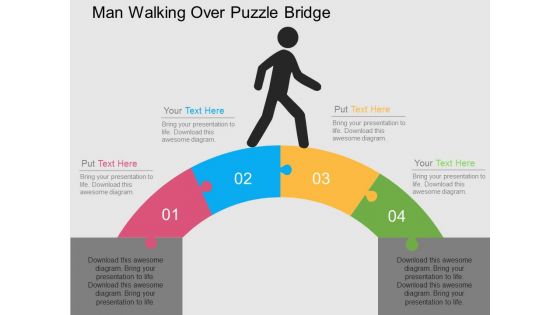
Man walking over puzzle bridge flat powerpoint design





Try Before you Buy Download Free Sample Product
 Impress Your
 Audience
 100%
100% Editable
 Save Hours
 of Time


Are you in search of a good PPT example through which you can present your ideas to your potential viewers? Do you believe that a professionally designed PowerPoint slide show has the power to mesmerize the audience into believing your concept, idea or product? Is your search for PowerPoint slide information taking too long without fruition? You have certainly arrived at the right place. The design team is ready to assist you with all issues and challenges you face while designing a beautiful Presentation slide. Click and download our man walking over puzzle bridge flat Presentation deck. This PPT slide combines beautifully designed PPT icons combined with the use of strikingly rich colors for added affects. Text areas alongside each step helps you in adding more meaning to the PowerPoint layout. This slide is designed in a way so that people from all professions and businesses can employ it for presentation purposes. Enjoy additional customization power by changing icon features. Avert accidents with our Man Walking Over Puzzle Bridge Flat Powerpoint Design. Ensure folks don't commit any errors.
People who downloaded this PowerPoint presentation also viewed the following :
Man walking over puzzle bridge flat powerpoint design with all 4 slides:
Our Man Walking Over Puzzle Bridge Flat Powerpoint Design bring in the funds. Everyone will begin to bet on you.
FAQs for Man walking over puzzle bridge
So puzzle bridge started in the 1930s - basically pre-made hands designed to teach specific skills instead of just dealing random cards. Pretty clever idea actually! Each deal focuses on something particular like finessing or counting cards. Back then it was huge for bridge education, showing up in clubs and newspapers everywhere. You'd work through the "puzzle" to find the best play. Honestly, I probably should do more of these myself. There's tons of them online now and in bridge apps. Worth trying a few daily if you want to get better at declarer play fast.
So basically, Puzzle Bridge skips the competitive part - you're just trying to solve specific card problems. Like, they'll give you a hand and say "make 4 spades" and you figure out the best way to play it. Bidding's usually gone since it's all about technique. Way more like doing a crossword than actual bridge, honestly. You don't have to worry about partnerships or reading opponents, just pure card analysis. Gets pretty addictive tbh! Oh, and definitely start with the easier ones - builds up your pattern recognition before you tackle the crazy stuff.
First thing - study the bridge layout before you do anything. Figure out which pieces have to move and what order makes sense. I used to just randomly try stuff and got stuck on level 3 for ages, so don't make that mistake lol. Work backwards from where you want to end up. Each piece blocks others in specific ways, so think about those constraints. Try to picture your next 2-3 moves instead of just winging it. The puzzles usually have one sequence that actually works, you just gotta find it.
Oh man, Puzzle Bridge is perfect for this! Since you can't see each other's cards, you're literally forced to talk through everything. No choice but to communicate, which honestly makes it way more fun than regular card games. You'll be asking stuff like "what've you got for the logic section?" or coordinating who tackles what - like maybe you handle the word puzzles while they do math. The whole thing just flows naturally because you both need different skills to connect the puzzle sections. Start with easier ones though, helps you get into that back-and-forth rhythm without getting frustrated.
Dude, visualization is everything in Puzzle Bridge. Picture the whole card layout in your head - where everything sits, what's been played, the works. I used to just guess and honestly sucked at it. Try mentally running through different plays before you commit. During practice games, force yourself to visualize the full deal first. Then work up to holding more complex stuff in your mind. It's like building muscle memory but for your brain, you know? Short cuts don't really work here. You'll get way better once you can see those sequences playing out mentally.
Yeah totally! Bridge Base Online is probably your best bet - I use it all the time. You can work through puzzle deals at your own pace or jump into real-time games with other people. Honestly, it's almost as good as playing in person. You're still getting all that strategic thinking without having to coordinate schedules with people. The downside is you miss out on reading your partner's facial expressions and stuff, but for just getting better at the game it's super convenient. Only weird thing is the interface takes a minute to get used to, but whatever. I'd start with BBO's practice rooms to see if you like it.
So bidding is how you and your partner talk about your cards without showing them. You start at 1 Club and go up to 7 No Trump - each bid means something specific about your hand. It's honestly like having a secret language. The auction keeps going until three people pass in a row, then whoever bid highest becomes declarer. Your job is swapping enough info to find the best contract for both your hands combined. Oh and definitely learn the basic conventions first - I made that mistake when I started. They're boring but you really can't play without them.
Get the basics down first - bidding and card play before jumping into crazy advanced stuff. I wasted months on complicated squeezes that just made everything harder lol. Daily practice is huge, maybe 30 minutes focusing on declarer play and defense. Puzzle books work great if you start simple - single suits, then full deals. Pattern recognition comes from doing tons of these repeatedly. Online bridge forums are solid for discussing tricky hands with other players. Don't try cramming everything at once. Consistency beats marathon sessions every time, trust me on that one.
Honestly, the biggest thing is not rushing into the first line that looks decent. I used to do this constantly - see something that works and boom, done. But then you miss way better plays. Count your tricks systematically too, don't get distracted by some flashy squeeze when basic math gets you there faster. Oh and here's what really helped me: think about what the opponents know from the bidding. What would they logically do in declarer's shoes? Sometimes that perspective shift changes everything. Take an extra beat to double-check your count before committing.
First thing - count your points and check the distribution. Puzzle hands love weird shapes like voids or really long suits, so watch for those. I usually hunt for finesses and safety plays right away since that's where they hide the trick. Entry problems too. The bidding gives you tons of clues about what opponents have, don't ignore that part. Honestly, most people jump to the first line they see and miss the elegant solution. Work through it step by step instead of rushing. Once you get into that habit, you'll crack these way faster.
So your brain's constantly hunting for patterns, right? But that can bite you when you get tunnel vision on one approach. Time pressure makes everything worse - you'll either panic or completely freeze up. After doing several tough puzzles, my mind just turns to complete mush honestly. There's also this thing where you stick with your gut reaction even when it's clearly wrong. Confirmation bias or whatever. Taking quick breaks between the really hard ones helps reset your focus. Risk tolerance plays into it too - some people give up way too early while others bang their head against impossible sequences forever.
Dude, scoring methods are honestly game-changers for puzzle strategy. Point-based systems? Hit the easy ones first, build up your score, then go after the hard stuff. Time-based is trickier though - you're constantly weighing whether that tough puzzle is worth the minutes. Some setups will actually dock points for wrong answers, which makes me way more paranoid about guessing. Honestly, I learned this the hard way last time and just jumped in without checking the rules first. Big mistake. Figure out their scoring system before you start, then plan around it. Makes such a difference.
Dude, practice hands are a game-changer for puzzle bridge. You're basically training your brain to spot patterns and make quick decisions. Every hand you work through teaches you something new - defensive moves, declarer tricks, all that good stuff. After a while you'll recognize situations way faster during real games. Like when to finesse or hold back, plus you get better at reading what opponents have based on their plays. Honestly, even 15-20 minutes a day makes a huge difference if you stick with it. Sometimes I get carried away and do way more though!
Dude, online platforms totally changed the game for Puzzle Bridge. No more driving to stuffy clubs on Tuesday nights - you can literally play in your pajamas at 2am if you want. The tutorials are actually pretty decent too, which helps since bridge can be intimidating at first. What's cool is you're playing against people from like, everywhere, not just the same five people from your neighborhood club. BBO is probably your best bet to start - it's free and tons of people use it. Though honestly, I still don't fully get why they call it "Puzzle" Bridge sometimes.
Dude, conventions are huge in Puzzle Bridge. Your bids need to tell your partner exactly what you've got - like is that 2♣ opening showing strength or is it artificial? Without agreed-upon meanings, you're just guessing at contracts. Honestly, I've seen people overthink this and pick super complex systems they can't even remember. Better to stick with conventions you both actually know cold. The puzzle setups are testing whether you can find the right contract, and that's impossible if you're miscommunicating through your bidding. Keep it simple but solid.
-
Best way of representation of the topic.
-
Topic best represented with attractive design.