


Manpower And Construction Equipment Supply E Invoice By Agency Channel




Try Before you Buy Download Free Sample Product
 Impress Your
 Audience
 100%
100% Editable
 Save Hours
 of Time


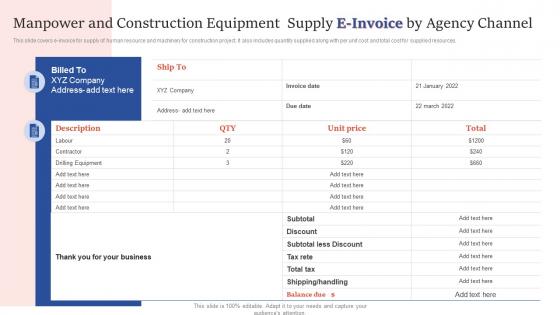
This slide covers e invoice for supply of human resource and machinery for construction project. It also includes quantity supplied along with per unit cost and total cost for supplied resources.
People who downloaded this PowerPoint presentation also viewed the following :
Manpower And Construction Equipment Supply E Invoice By Agency Channel with all 6 slides:
Use our Manpower And Construction Equipment Supply E Invoice By Agency Channel to effectively help you save your valuable time. They are readymade to fit into any presentation structure.





FAQs for Manpower And Construction Equipment Supply E Invoice
E-invoicing for manpower and construction equipment delivers streamlined project cost tracking, automated billing processes, reduced administrative overhead, enhanced regulatory compliance, and real-time financial visibility across construction sites. These digital solutions enable construction companies to minimize payment delays, eliminate manual data entry errors, and accelerate project settlements, with many contractors finding that automated invoicing ultimately reduces administrative costs by up to 40% while improving cash flow management.
E-invoicing streamlines contractor billing by automating invoice generation, reducing manual data entry, enabling real-time tracking of payment status, and providing instant document sharing between parties. Through digital workflows, construction companies minimize administrative overhead, accelerate payment cycles, and improve cash flow management, while subcontractors gain faster approvals and enhanced transparency, ultimately delivering operational efficiency across project networks.
Companies transitioning to e-invoicing in construction face challenges including system integration complexities, staff training requirements, vendor compliance coordination, and initial implementation costs. However, construction firms increasingly find that these short-term hurdles deliver significant long-term advantages through streamlined project accounting, faster payment cycles, and enhanced cost tracking capabilities, ultimately improving cash flow management and operational efficiency across multiple project sites.
E-invoicing improves cash flow management by accelerating invoice processing, reducing payment delays, and providing real-time visibility into outstanding receivables and payment statuses. Through automated workflows and digital tracking, construction companies streamline billing cycles, minimize administrative costs, and enhance client payment experiences, with many finding that faster invoice delivery and automated follow-ups ultimately reduce collection periods and improve working capital efficiency.
**INPUT**: What are the best practices for ensuring compliance with tax regulations when using e-invoicing in construction? **OUTPUT**: Best practices include maintaining detailed audit trails, implementing automated tax calculations, ensuring proper digital signatures, establishing robust data backup systems, and conducting regular compliance reviews. These practices streamline tax reporting by minimizing errors, enhancing transparency, and providing real-time documentation, with many construction firms finding that automated e-invoicing systems ultimately deliver faster regulatory approvals and reduced compliance costs.
E-invoicing software integrates with construction management systems through APIs, cloud-based platforms, and enterprise resource planning connections that enable seamless data flow between project management, accounting, and billing functions. Through automated synchronization, construction companies streamline equipment tracking, labor cost allocation, and vendor payments while reducing manual data entry errors, ultimately delivering faster project billing and improved cash flow management across multiple construction sites.
Automation and artificial intelligence enhance construction e-invoicing by streamlining data extraction from equipment rental receipts, labor timesheets, and material delivery documents, while automatically validating project codes and cost allocations. These technologies enable construction enterprises to reduce manual processing errors, accelerate payment cycles, and improve cash flow management, with many finding that AI-powered invoice matching delivers significant operational efficiency gains.
E-invoicing significantly reduces payment discrepancies by automating data entry, eliminating manual transcription errors, and ensuring consistent formatting across all billing documents. Through digital validation systems, construction companies and equipment suppliers can automatically verify quantities, rates, and calculations before invoice submission, while real-time integration with project management systems ensures accurate labor hours and equipment usage tracking, ultimately delivering faster dispute resolution and improved cash flow.
Essential security measures for e-invoicing include end-to-end encryption, multi-factor authentication, digital signatures, secure data storage, and regular security audits. These protocols streamline financial processes by protecting contractor information, equipment costs, and payment details, with construction companies finding that robust cybersecurity ultimately delivers client trust and regulatory compliance.
E-invoicing significantly accelerates project timelines and streamlines procurement processes by automating invoice processing, reducing approval cycles, and eliminating manual data entry errors. Construction companies leveraging digital invoicing systems experience faster vendor payments, improved cash flow management, and enhanced supplier relationships, while project managers gain real-time visibility into equipment costs and resource allocation, ultimately delivering more efficient project execution and competitive advantage.
Construction-specific e-invoicing solutions include project-based billing capabilities, equipment rental tracking, labor cost allocation, progress billing functionality, and materials cost management. These systems enhance operational efficiency by integrating with construction management software, automating compliance with industry regulations, and enabling real-time project cost tracking, ultimately delivering improved cash flow and reduced administrative overhead for construction companies.
E-invoicing enhances communication by providing real-time visibility into billing status, automated notifications for approvals and payments, and centralized document sharing accessible to all parties. This digital transparency streamlines project coordination between equipment suppliers, contractors, and clients, reducing disputes over billing discrepancies while enabling faster decision-making and ultimately strengthening collaborative relationships across construction projects.
Construction firms should track payment cycle times, invoice processing costs, error rates, supplier satisfaction scores, and cash flow improvements to measure e-invoicing success. These metrics enable companies to quantify operational efficiency gains, cost reductions, and enhanced vendor relationships, with many construction organizations finding that streamlined invoice processing reduces administrative overhead by 40-60% while accelerating project cash flows.
Training and knowledge sharing accelerate e-invoicing adoption by building digital literacy, demonstrating workflow integration, and addressing resistance through hands-on practice and peer support. Through structured programs, construction teams master platform navigation, compliance requirements, and equipment tracking processes, while knowledge sharing sessions enable experienced users to mentor colleagues, ultimately reducing implementation time and enhancing operational efficiency across projects.
Future trends in construction e-invoicing include AI-powered automated data extraction, blockchain-based payment verification, real-time project cost tracking, mobile-first invoice management, and integrated compliance monitoring. These technologies streamline operations by reducing manual processing errors, accelerating payment cycles, and enhancing financial transparency, with many construction firms finding that automated systems ultimately deliver significant cost savings and improved cash flow management.
-
Like always a great experience with you guys. Always there on the drop of hat to help.
-
Loved the collection. Editing the presentation was seamless with their templates.