


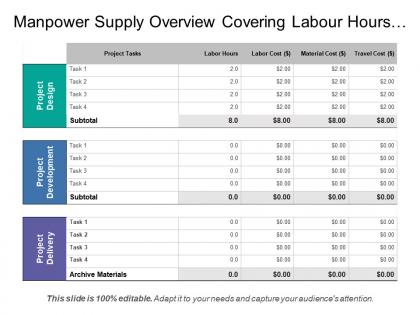
Manpower supply overview covering labour hours cost estimation and travel cost




Try Before you Buy Download Free Sample Product
 Impress Your
 Audience
 100%
100% Editable
 Save Hours
 of Time


Our Manpower Supply Overview Covering Labour Hours Cost Estimation And Travel Cost believe in a clutter free approach. Their excellent graphics are a great example.
People who downloaded this PowerPoint presentation also viewed the following :
Manpower supply overview covering labour hours cost estimation and travel cost with all 5 slides:
Impress folks enough to be considered a favorite with our Manpower Supply Overview Covering Labour Hours Cost Estimation And Travel Cost. You will emerge as a dark horse.




FAQs for Manpower supply overview covering labour hours cost estimation
Key factors include labor rates by skill level, project duration, resource availability, overhead costs, and geographic location variations. These elements work together to determine accurate budgeting, with many organizations finding that incorporating benefits, training expenses, and potential overtime significantly impacts total project costs, ultimately enabling more precise financial planning and competitive pricing strategies.
Project scope directly influences manpower cost estimation by determining required skill sets, project duration, resource allocation, and task complexity levels. Larger scopes in industries like construction or software development demand specialized teams, extended timelines, and additional coordination efforts, while well-defined boundaries enable more accurate forecasting, ultimately delivering better budget control and resource optimization.
Manpower cost estimation commonly utilizes workforce analytics platforms, historical data analysis, skills-based costing models, project management software, and benchmarking tools. These methods enhance accuracy by incorporating real-time labor rates, productivity metrics, and resource allocation patterns, with many organizations finding that strategic combinations deliver significantly improved budget forecasting and competitive project pricing.
Historical data improves manpower cost estimation accuracy by revealing actual labor patterns, seasonal variations, skill requirements, and productivity rates from past projects. Through analyzing previous performance metrics, organizations can identify cost drivers, refine budget allocations, and adjust for market fluctuations, ultimately delivering more precise forecasts and better resource planning for future initiatives.
Skill level significantly impacts manpower costs through salary differentials, training requirements, productivity rates, and market availability. Higher-skilled professionals, such as software architects or specialized engineers, command premium salaries while delivering accelerated project timelines and superior outcomes, with many organizations finding that strategic investment in skilled talent ultimately reduces overall project costs through enhanced efficiency.
Indirect costs significantly impact manpower estimation by adding 20-50% to direct salary expenses through benefits, training, facilities, equipment, and administrative overhead. These hidden expenses, including healthcare, workspace costs, and HR management, often catch organizations off-guard during budget planning, with many companies finding that comprehensive indirect cost tracking ultimately delivers more accurate project forecasting and better resource allocation decisions.
Common pitfalls in manpower cost estimation include underestimating indirect costs, failing to account for productivity variations, ignoring seasonal fluctuations, overlooking compliance requirements, and neglecting skill-based wage differentials. These estimation errors can significantly impact project budgets and timelines, with many organizations finding that comprehensive workforce planning, including benefits calculations and performance metrics, ultimately delivers more accurate forecasting and enhanced operational efficiency.
Labor market trends significantly impact manpower cost projections through supply-demand dynamics, wage inflation rates, skill availability, and regional compensation variations. Economic shifts, technological adoption, and demographic changes create fluctuations in talent costs, with industries like healthcare and technology experiencing pronounced variations, ultimately requiring organizations to build flexibility into their workforce budgeting and strategic planning processes.
Time tracking provides critical data for accurate manpower cost estimation by recording actual hours worked, productivity rates, task completion times, and resource allocation patterns across different projects and roles. This detailed information enables organizations to calculate precise labor costs, identify efficiency gaps, optimize staffing levels, and develop more reliable future project budgets, ultimately delivering better cost control and competitive pricing strategies.
Industries approach manpower cost estimation through specialized methodologies tailored to their operational demands, with manufacturing focusing on production cycles and efficiency metrics, healthcare emphasizing skill-based compensation and patient ratios, and technology sectors prioritizing project-based allocations. These industry-specific approaches enable organizations to optimize resource allocation, control operational expenses, and maintain competitive advantage while adapting to sector-specific labor market dynamics and regulatory requirements.
Strategies include automation of routine tasks, cross-training employees for versatility, implementing flexible scheduling, outsourcing non-core functions, and leveraging remote work capabilities. Through strategic workforce optimization, organizations in manufacturing, retail, and financial services streamline operations while maintaining service quality, with many finding that technology integration and skills development ultimately deliver cost efficiency and competitive advantage.
Technology enhances manpower cost estimation through automated data analysis, predictive modeling, real-time resource tracking, and integration with HR and project management systems. AI-powered platforms enable organizations to analyze historical patterns, forecast labor demands, and optimize resource allocation across projects, while many construction firms and consulting companies find that these tools significantly reduce estimation errors and accelerate project planning cycles.
**INPUT**: What are the best practices for revising manpower cost estimates throughout a project lifecycle? **OUTPUT**: Best practices include establishing regular review checkpoints, monitoring actual versus projected hours, incorporating scope changes immediately, and adjusting for skill level variations. These approaches enhance accuracy by tracking performance metrics, updating resource allocation based on real-time data, and maintaining stakeholder transparency, ultimately delivering better budget control and project profitability across organizations.
Outsourcing significantly affects manpower cost estimation by transforming fixed internal salaries into variable external contracts, changing benefit calculations, and introducing vendor management costs. While outsourcing often reduces direct labor expenses through access to lower-cost markets, it requires estimating additional factors like contract negotiations, quality control, and coordination overhead, ultimately delivering cost predictability with enhanced budget flexibility for growing organizations.
Key metrics include variance percentage between estimated and actual costs, resource utilization rates, project completion timelines, budget adherence ratios, and productivity benchmarks across different teams and departments. These tracking mechanisms enable organizations to refine their estimation models by identifying patterns in cost overruns, optimizing resource allocation, and enhancing forecasting accuracy, ultimately delivering more reliable budgets and competitive project pricing.
-
Best Representation of topics, really appreciable.
-
Best Representation of topics, really appreciable.