


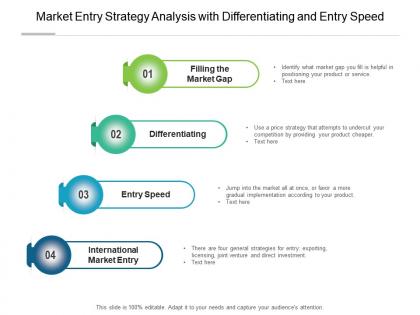
Market entry strategy analysis with differentiating and entry speed




Try Before you Buy Download Free Sample Product
 Impress Your
 Audience
 100%
100% Editable
 Save Hours
 of Time


Get folks to forget grudges with our Market Entry Strategy Analysis With Differentiating And Entry Speed. Encourage them to aim for an amicable existence.
People who downloaded this PowerPoint presentation also viewed the following :
Market entry strategy analysis with differentiating and entry speed with all 5 slides:
Encourage folks to aim for an amicable existence with our Market Entry Strategy Analysis With Differentiating And Entry Speed. Get them to forget grudges.




FAQs for Market entry strategy analysis with differentiating
Key factors include market size and growth potential, competitive landscape analysis, regulatory environment, cultural compatibility, and resource requirements for successful entry. These considerations help organizations assess market attractiveness by evaluating demand patterns, identifying differentiation opportunities, and understanding operational complexities, with many companies finding that thorough market research ultimately delivers strategic positioning and sustainable competitive advantage.
Cultural understanding significantly influences market entry strategy by determining distribution channels, partnership requirements, marketing approaches, and operational models. Companies entering culturally distinct markets often find that joint ventures or acquisitions with local partners deliver better market penetration and customer acceptance than standalone entries, ultimately enabling faster adaptation and sustainable competitive advantage.
Competitive analysis provides critical insights into market dynamics, competitor positioning, pricing strategies, customer preferences, and potential gaps or opportunities within the target market. Through comprehensive competitor evaluation, businesses can identify differentiation opportunities, avoid saturated segments, and develop strategic positioning that leverages competitors' weaknesses, ultimately enabling more informed entry decisions and sustainable competitive advantage.
Businesses can effectively assess potential barriers by analyzing regulatory requirements, competitive landscape intensity, capital investment needs, customer acquisition costs, and distribution channel accessibility. Through comprehensive market research, financial modeling, and competitor analysis, organizations evaluate entry feasibility across sectors like healthcare, financial services, and retail, ultimately determining strategic viability and resource allocation priorities.
Direct export involves selling products straight to foreign customers through your own sales team, distributors, or online platforms, while indirect export uses intermediaries like export management companies, trading houses, or domestic buyers who resell internationally. Direct export offers greater control, higher profit margins, and deeper market knowledge but requires significant investment and expertise, whereas indirect export minimizes risk and resource commitment while providing market access through established networks, with many companies starting indirect before transitioning to direct approaches.
The choice of entry mode significantly impacts long-term sustainability by determining resource allocation, risk exposure, operational control, and market adaptability. Strategic entry decisions, whether through partnerships, acquisitions, or organic expansion, ultimately shape competitive positioning, scalability potential, and financial resilience, with many organizations finding that flexible, well-capitalized approaches enable sustained growth in increasingly dynamic markets.
Businesses should evaluate market entry success through revenue growth, market share acquisition, customer acquisition costs, brand awareness levels, and competitive positioning metrics. These indicators work together by measuring financial performance, market penetration, and operational efficiency, with many organizations finding that tracking customer lifetime value and time-to-profitability ultimately delivers comprehensive insights into strategic market positioning.
Partnerships facilitate market entry by providing local market knowledge, established distribution networks, regulatory expertise, shared financial resources, and reduced operational risks. Through strategic alliances, companies can leverage partner relationships with suppliers and customers, accelerate time-to-market, and minimize initial investment requirements, while gaining credibility and competitive positioning in unfamiliar markets.
Local market knowledge is critically important for successful market entry, serving as the foundation for informed decision-making, risk mitigation, and strategic positioning. Through comprehensive understanding of consumer behaviors, regulatory requirements, and competitive landscapes, businesses can adapt their offerings, optimize pricing strategies, and build meaningful partnerships, with many organizations finding that deep local insights ultimately deliver faster market penetration and sustainable competitive advantage.
Franchising risks include brand control dilution, franchisee management challenges, potential legal disputes, revenue sharing requirements, and market adaptation difficulties. While franchising enables rapid expansion with reduced capital investment, businesses must balance growth opportunities with maintaining quality standards, especially in diverse markets like retail and food services, where inconsistent franchisee performance can ultimately impact overall brand reputation and customer experiences.
Companies can leverage digital platforms for international market entry through e-commerce marketplaces, social media marketing, localized websites, digital payment systems, and data analytics tools. These platforms enable businesses to test market demand, reach global customers cost-effectively, and adapt offerings based on regional preferences, with many organizations finding significantly reduced entry costs and faster market penetration compared to traditional expansion methods.
Common pitfalls include insufficient market research, underestimating regulatory requirements, poor competitor analysis, inadequate resource allocation, and neglecting local cultural nuances. These oversights can derail expansion efforts, with many organizations finding that thorough preparation, strategic partnerships, and phased implementation approaches ultimately deliver stronger market positioning and sustainable competitive advantage.
Businesses adapt product offerings through comprehensive market research, cultural customization, localized pricing strategies, and regional partnership development. Companies like McDonald's modify menus for local tastes, while tech firms adjust features for regional regulations, ultimately delivering enhanced customer acceptance and competitive advantage in diverse markets.
Regulatory compliance serves as a foundational element in market entry planning, determining product specifications, operational procedures, licensing requirements, marketing restrictions, and distribution channels. Through comprehensive compliance frameworks, companies navigate complex regulatory landscapes while minimizing legal risks, ensuring smoother market penetration, and building stakeholder trust, with many organizations finding that proactive compliance strategies ultimately deliver competitive advantages and sustainable growth opportunities.
Businesses effectively communicate their brand in new markets through localized messaging, culturally adapted visual identity, strategic partnership development, and targeted digital campaigns that resonate with local preferences. Through comprehensive market research and cultural sensitivity training, companies streamline brand positioning while maintaining core values, ultimately delivering authentic connections and competitive market penetration across diverse consumer segments.
No Reviews