

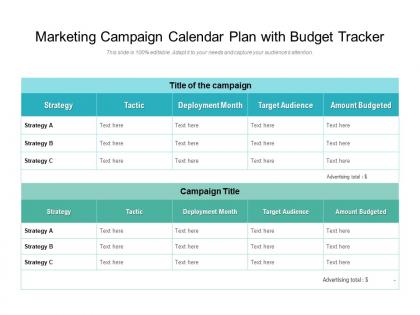
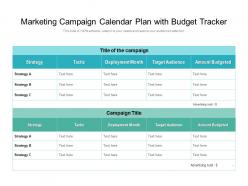
Marketing campaign calendar plan with budget tracker




Try Before you Buy Download Free Sample Product
 Impress Your
 Audience
 100%
100% Editable
 Save Hours
 of Time


Get forces to combine with our Marketing Campaign Calendar Plan With Budget Tracker. Bring all the focus to bear on goals.
People who downloaded this PowerPoint presentation also viewed the following :
Marketing campaign calendar plan with budget tracker with all 2 slides:
Bring all the forces to bear on goals with our Marketing Campaign Calendar Plan With Budget Tracker. Get all the forces to combine.
FAQs for Marketing campaign calendar plan
A marketing campaign calendar budget tracker should include allocated budgets by channel, actual spend tracking, campaign timelines, ROI metrics, and variance analysis. These elements enable marketing teams to monitor spending across digital advertising, content creation, and events in real-time, while identifying budget overruns early, ultimately delivering better financial control and campaign optimization for maximum return on investment.
Businesses can effectively allocate marketing budgets by analyzing historical performance data, setting clear channel-specific KPIs, diversifying across digital and traditional platforms, and implementing regular performance monitoring. Through strategic combination of high-performing channels like social media, email marketing, and targeted advertising, organizations streamline resource allocation while maximizing ROI, ultimately delivering measurable growth and competitive advantage.
**INPUT**: What tools or software are most effective for creating a marketing campaign calendar budget tracker? **OUTPUT**: Effective tools include Microsoft Excel, Google Sheets, Asana, Monday.com, and specialized platforms like CoSchedule or HubSpot's campaign management suite. These solutions streamline budget allocation, timeline tracking, and resource planning by enabling real-time collaboration, automated reporting, and integrated analytics, with many marketing teams finding that centralized platforms ultimately enhance campaign ROI and operational efficiency. **Word count**: 58 words
Marketing campaign budgets should be reviewed weekly during active campaigns, with major adjustments considered bi-weekly or monthly based on performance data, market conditions, and ROI metrics. This strategic approach enables marketing teams to reallocate resources from underperforming channels to high-converting ones, optimize ad spend in real-time, and capitalize on unexpected opportunities, ultimately delivering improved campaign effectiveness and maximized return on investment.
Marketing campaign budget trackers can monitor cost per acquisition, conversion rates, customer lifetime value, return on ad spend, and lead generation costs. These metrics enable organizations to optimize resource allocation across channels, identify high-performing campaigns, and demonstrate measurable business impact, with many marketing teams finding that comprehensive tracking ultimately delivers improved campaign efficiency and strategic competitive advantage.
Businesses can estimate digital advertising costs by analyzing historical campaign performance, researching platform-specific pricing models, and factoring in audience size, competition levels, and seasonal fluctuations. Through systematic tracking of cost-per-click, conversion rates, and customer acquisition costs, organizations can develop accurate forecasting models that enable strategic budget allocation, ultimately delivering better ROI and more predictable marketing outcomes.
Seasonality significantly influences marketing budget allocation by determining peak demand periods, consumer behavior patterns, and competitive intensity throughout the year. Retailers typically allocate higher budgets during holiday seasons, while B2B companies may increase spending during industry conference periods, with many organizations finding that strategic seasonal planning delivers up to 30% better ROI and enhanced campaign effectiveness.
Teams can collaborate efficiently on budget tracking through shared digital platforms, real-time data access, defined roles and approval workflows, and regular budget review meetings. Cloud-based budget tracking systems enable marketing teams, finance departments, and project managers to monitor campaign spending simultaneously, update allocations instantly, and maintain transparency across all stakeholders, ultimately delivering better cost control and strategic resource allocation.
Effective marketing campaign budget trackers typically use spreadsheet formats with sections for planned versus actual spending, campaign categories, timeline tracking, and ROI calculations. Many marketing teams find that templates incorporating automated formulas for budget variance analysis, monthly breakdowns by channel, and real-time expense monitoring deliver enhanced visibility and control, ultimately enabling more strategic resource allocation and campaign optimization.
Common pitfalls include underestimating costs, failing to track spending in real-time, not allocating contingency funds, overlooking hidden expenses, and poor communication between teams. These issues often lead to budget overruns and missed opportunities, with many organizations finding that implementing systematic tracking tools and regular budget reviews enhances campaign effectiveness while maintaining financial control.
Historical data informs future budget allocations by revealing which channels, campaigns, and time periods delivered the highest ROI, customer acquisition rates, and engagement metrics. Through performance analytics, marketing teams can identify seasonal trends, optimize spend distribution across digital and traditional media, and reallocate resources from underperforming initiatives, ultimately maximizing campaign effectiveness and reducing acquisition costs.
Contingency planning in marketing budget trackers ensures campaigns can adapt to unexpected opportunities, market shifts, and performance variations without derailing overall strategy. By allocating 10-15% buffer funds and tracking real-time spending against projections, marketers can pivot quickly during seasonal spikes, competitive responses, or viral moments, ultimately maintaining campaign momentum while protecting against budget overruns and missed opportunities.
Integrating marketing KPIs into budget tracking involves connecting performance metrics like cost-per-acquisition, conversion rates, return on ad spend, and customer lifetime value directly to expenditure categories within your tracking system. This strategic combination enables marketing teams to monitor spending efficiency in real-time, identify high-performing channels, and reallocate resources dynamically, ultimately delivering improved ROI and data-driven budget optimization.
A well-structured marketing budget tracker enables small businesses to optimize resource allocation by monitoring spend per channel, tracking ROI metrics, identifying high-performing campaigns, and eliminating wasteful expenditures. Through detailed tracking, businesses can reallocate funds from underperforming social media ads to successful email campaigns or local partnerships, ultimately maximizing every marketing dollar while maintaining competitive market presence.
Marketing budget control strategies include setting clear spending limits per campaign, implementing approval workflows for expenses, conducting weekly budget reviews, using automated tracking tools, and establishing contingency reserves. These approaches streamline financial oversight by enabling real-time monitoring, preventing overspend through systematic checkpoints, and maintaining fiscal discipline, with many organizations finding that consistent tracking and approval processes ultimately deliver better ROI and enhanced campaign performance.
No Reviews