


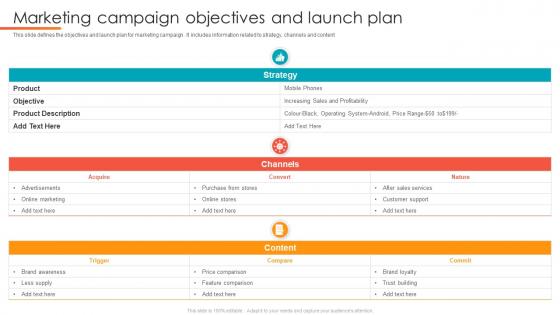
Marketing Campaign Objectives And Launch Plan




Try Before you Buy Download Free Sample Product
 Impress Your
 Audience
 100%
100% Editable
 Save Hours
 of Time


This slide defines the objectives and launch plan for marketing campaign. It includes information related to strategy, channels and content.
People who downloaded this PowerPoint presentation also viewed the following :
Marketing Campaign Objectives And Launch Plan with all 6 slides:
Use our Marketing Campaign Objectives And Launch Plan to effectively help you save your valuable time. They are readymade to fit into any presentation structure.





FAQs for Marketing Campaign Objectives
Effective marketing campaign strategies include clear target audience identification, compelling messaging, multi-channel distribution, budget allocation, timeline planning, and performance metrics. These components work together by ensuring consistent brand communication across platforms, optimizing resource investment, and enabling real-time adjustments, with many organizations finding that strategic integration ultimately delivers higher engagement rates and measurable ROI growth.
Businesses measure marketing campaign success through key performance indicators like conversion rates, return on investment, customer acquisition costs, engagement metrics, and revenue attribution tracking. These analytics enable companies to optimize budget allocation, refine targeting strategies, and demonstrate measurable impact, with many organizations finding that comprehensive measurement frameworks ultimately deliver improved campaign performance and competitive market positioning.
Target audience segmentation enables marketers to create personalized messaging, optimize resource allocation, select appropriate channels, and develop relevant content that resonates with specific customer groups. Through demographic, behavioral, and psychographic segmentation, companies across retail, healthcare, and financial services deliver higher conversion rates, improved ROI, and enhanced customer engagement, ultimately gaining competitive advantage in increasingly crowded markets.
Social media platforms enhance marketing strategies by enabling targeted audience segmentation, real-time customer engagement, and cost-effective content distribution across multiple channels. Through strategic social media integration, businesses streamline brand awareness campaigns, accelerate customer acquisition, and deliver personalized experiences, with many retailers and service providers finding that consistent cross-platform messaging ultimately drives higher conversion rates and competitive advantage.
Creative campaign objective-setting approaches include audience journey mapping, competitor gap analysis, micro-moment targeting, brand sentiment benchmarking, and cross-channel attribution modeling. These strategic methods enable marketers to establish measurable goals through behavioral insights, competitive positioning, and customer touchpoint optimization, with many organizations finding that data-driven objective frameworks ultimately deliver higher ROI and more targeted engagement outcomes.
A unique value proposition is critical for marketing campaign success, as it differentiates your brand, clarifies customer benefits, and drives purchasing decisions in competitive markets. Through strategic positioning, companies enhance brand recognition, increase conversion rates, and build customer loyalty, with many organizations finding that campaigns with distinct value propositions deliver significantly higher ROI and sustainable competitive advantage.
Marketing ROI metrics include conversion rates, customer acquisition costs, lifetime value, attribution tracking, and revenue attribution across channels. These measurements enable businesses to optimize budget allocation, identify high-performing campaigns, and eliminate underperforming initiatives, with many organizations finding that comprehensive tracking ultimately delivers 15-30% improved campaign efficiency and strategic competitive advantage.
A/B testing improves marketing campaign effectiveness by comparing different versions of content, messaging, design elements, and targeting approaches to identify what resonates best with audiences. Through systematic testing of headlines, visuals, and call-to-action buttons, marketers can optimize conversion rates, reduce acquisition costs, and enhance customer engagement, ultimately delivering measurable improvements in campaign ROI and performance.
Storytelling can be integrated through brand narratives, customer success stories, product origin tales, social media content, and video campaigns that connect emotionally with audiences. Companies like Nike and Coca-Cola leverage storytelling across multiple touchpoints, creating authentic connections that enhance brand loyalty, differentiate from competitors, and ultimately drive higher engagement and conversion rates.
Selecting the right marketing channels involves analyzing your target audience demographics, budget constraints, campaign objectives, competitive landscape, and content format requirements. Through strategic channel combination, businesses streamline resource allocation, enhance customer reach, and maximize ROI, with many organizations finding that diversified approaches across digital and traditional platforms ultimately deliver broader market penetration and sustainable competitive advantage.
Digital marketing and traditional marketing combine effectively through integrated campaigns that leverage each channel's strengths, synchronized messaging across platforms, and cross-channel data tracking for unified customer experiences. This strategic combination enables businesses to maximize reach through television and print while enhancing engagement through social media and email, ultimately delivering broader audience coverage and improved ROI.
Marketing campaigns should prioritize transparency, truthfulness, data privacy protection, cultural sensitivity, and avoiding manipulative tactics that exploit vulnerable populations. These ethical foundations enhance brand credibility, build sustainable customer relationships, and minimize regulatory risks, with many organizations finding that ethical marketing strategies ultimately deliver stronger customer loyalty and competitive advantage.
Consumer feedback shapes future marketing strategies by revealing customer preferences, identifying pain points, and highlighting successful messaging approaches that resonate with target audiences. Through social media analytics, survey data, and purchase behavior patterns, companies can refine their campaigns, optimize channel selection, and develop more personalized content, ultimately delivering higher engagement rates and improved ROI across marketing initiatives.
Current trends shaping marketing campaigns include personalized automation, omnichannel integration, influencer partnerships, interactive content formats, and data-driven attribution models. These approaches streamline customer engagement by delivering targeted messaging, optimizing touchpoint experiences, and measuring campaign effectiveness across platforms, with many organizations finding that strategic combination of these trends ultimately enhances conversion rates and competitive positioning.
Companies maintain brand consistency across campaigns by establishing comprehensive brand guidelines, implementing centralized approval processes, and using standardized templates and messaging frameworks. Through strategic coordination and regular audits, organizations streamline their marketing efforts while ensuring uniform visual identity, tone, and messaging, ultimately delivering stronger brand recognition and customer trust across all touchpoints.
-
Their professional templates are very impressive, even my manager was curious about the source. I am very grateful.
-
Innovative and Colorful designs.