

Marketing challenges in business services




Try Before you Buy Download Free Sample Product
 Impress Your
 Audience
 100%
100% Editable
 Save Hours
 of Time


Get folks to improve their conduct with our Marketing Challenges In Business Services. It will influence folks to change.
People who downloaded this PowerPoint presentation also viewed the following :
Marketing challenges in business services with all 5 slides:
Handle bad influences with our Marketing Challenges In Business Services. Caution folks to guard against dangerous habits.



FAQs for Marketing challenges
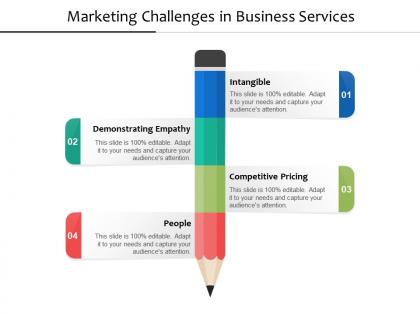
Business services present unique marketing challenges including intangibility, customization requirements, high client involvement, longer sales cycles, and relationship dependency. These characteristics complicate traditional marketing approaches by requiring extensive trust-building, complex value demonstrations, and personalized messaging, with many service providers finding that prospects need multiple touchpoints and detailed consultations before making purchasing decisions.
Service providers can demonstrate intangible value through case studies showcasing measurable outcomes, client testimonials highlighting specific results, detailed ROI projections, and interactive demonstrations or pilot programs. Financial services firms and consulting agencies increasingly use data visualization tools, before-and-after comparisons, and industry benchmarking to quantify benefits, ultimately transforming abstract concepts into tangible business advantages that resonate with decision-makers.
Customer feedback plays a pivotal role in shaping marketing strategies by revealing service gaps, identifying competitive advantages, highlighting customer pain points, and uncovering messaging opportunities that resonate with target audiences. Through systematic feedback collection, business services companies can refine their value propositions, optimize service delivery approaches, and develop more targeted campaigns, with many organizations finding that customer-driven insights significantly enhance conversion rates and client retention.
Businesses build trust and authority through consistent, educational content that addresses client pain points, showcases industry expertise, demonstrates successful case studies, and provides actionable insights. Professional services firms, consulting agencies, and financial institutions increasingly leverage thought leadership articles, client success stories, and expert commentary to differentiate themselves, ultimately delivering enhanced credibility and stronger client relationships.
Best practices for identifying and targeting niche markets include conducting detailed market research, analyzing competitor gaps, leveraging customer feedback, defining specific pain points, and utilizing data analytics to uncover underserved segments. Through strategic market segmentation, business services companies enhance client acquisition, reduce marketing costs, and build specialized expertise, with many consulting firms and professional services finding that focused positioning ultimately delivers higher profit margins and stronger client relationships.
Digital marketing for business services emphasizes thought leadership, relationship building, and trust through LinkedIn campaigns, content marketing showcasing expertise, webinars addressing industry challenges, and targeted account-based marketing. These strategies streamline lead generation by demonstrating specialized knowledge, nurturing longer sales cycles, and building credibility with decision-makers, ultimately delivering qualified prospects and stronger client relationships.
Businesses face challenges including unclear value propositions, limited brand recognition, pricing pressures, complex buyer journeys, and difficulty communicating intangible benefits. These obstacles create competitive disadvantage by reducing client acquisition, extending sales cycles, and commoditizing services, with many professional firms finding that strategic positioning and targeted messaging ultimately deliver market differentiation and sustainable growth.
Branding is crucial in business services marketing as it builds trust, differentiates offerings, establishes credibility, and creates emotional connections with clients who cannot physically evaluate intangible services. Effective strategies include consistent visual identity across touchpoints, thought leadership content, client testimonials, strategic partnerships, and industry-specific messaging, with many professional service firms finding that strong branding ultimately reduces sales cycles and commands premium pricing.
Business service providers should track lead quality scores, conversion rates from marketing qualified leads to sales qualified leads, customer acquisition cost, lifetime value ratios, and pipeline velocity metrics. These measurements enable organizations to optimize resource allocation, refine targeting strategies, and demonstrate ROI across channels, with many finding that combining behavioral analytics with revenue attribution ultimately delivers more strategic marketing decisions and sustainable growth.
Relationship marketing builds long-term client loyalty through personalized communication, consistent value delivery, proactive support, and strategic partnership development. By implementing regular check-ins, customized service offerings, and dedicated account management, business services firms enhance client satisfaction, increase retention rates, and generate referrals, ultimately delivering sustainable revenue growth and competitive differentiation in increasingly crowded markets.
Artificial intelligence, marketing automation platforms, predictive analytics, customer data platforms, and conversational AI are revolutionizing business services marketing. These technologies streamline lead qualification, personalize client communications, and optimize campaign performance, with consulting firms, financial services, and professional agencies finding that automated nurturing sequences and AI-driven insights ultimately deliver higher conversion rates and enhanced client experiences.
Business services companies can effectively utilize social media by creating thought leadership content, engaging in industry-specific LinkedIn groups, sharing client success stories, and leveraging targeted advertising based on professional demographics. These strategies enable companies to build credibility, generate qualified leads, and establish meaningful connections with decision-makers, while many finding that consistent educational content ultimately drives higher conversion rates than traditional promotional approaches.
Common pitfalls include insufficient market research, unclear value propositions, targeting overly broad audiences, underestimating implementation timelines, and neglecting competitive differentiation. These strategic missteps often result in diluted messaging, wasted resources, and poor market penetration, with many service organizations finding that focused positioning and comprehensive customer validation ultimately deliver stronger market entry and sustainable competitive advantage.
Economic downturns significantly impact business service marketing through reduced client budgets, extended sales cycles, and heightened price sensitivity, forcing companies to demonstrate clear ROI and value propositions. Strategic mitigation includes focusing on cost-saving services, leveraging digital channels for efficiency, emphasizing long-term partnerships over transactional relationships, and showcasing measurable outcomes, with many firms finding that recession-focused messaging around operational efficiency ultimately strengthens client retention and competitive positioning.
Service providers can leverage joint webinars, co-branded content creation, shared industry events, cross-referral partnerships, and collaborative thought leadership initiatives. These strategic collaborations enable businesses to pool resources, expand market reach, and enhance credibility within their sectors, with many consulting firms, agencies, and professional services finding that partnerships ultimately deliver broader audiences and reduced marketing costs.
No Reviews