

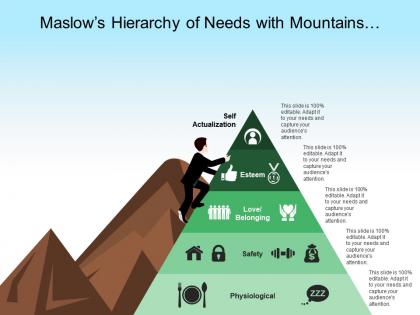
Maslows hierarchy of needs with mountains and person climbing




Try Before you Buy Download Free Sample Product
 Impress Your
 Audience
 100%
100% Editable
 Save Hours
 of Time


Instill a bit of humility in individuals with our Maslows Hierarchy Of Needs With Mountains And Person Climbing. Be able to correct the irreverent.
People who downloaded this PowerPoint presentation also viewed the following :
Maslows hierarchy of needs with mountains and person climbing with all 5 slides:
Display good calibre with our Maslows Hierarchy Of Needs With Mountains And Person Climbing. They will consider you a big gun.




FAQs for Maslows hierarchy of needs with mountains
So basically there's five levels - physiological stuff like food and shelter, then safety/security, love and belonging, esteem needs, and self-actualization at the top. It's like a pyramid where you generally can't focus on higher stuff if lower needs aren't met. Like, good luck caring about creative fulfillment when you're stressed about rent, you know? Here's what's useful though - if someone's stuck on basic needs, dangling recognition or "meaningful work" at them won't do much. You gotta figure out where people actually are first. It's not always perfectly step-by-step, but it gives you a decent framework for understanding what'll actually motivate someone versus what you think should motivate them.
So basically, smart companies layer their motivation strategies using Maslow's pyramid. Start with the foundation - decent pay and job security. Build up team culture stuff for belonging. Then add recognition programs and career growth opportunities. Here's where it gets cool though - the top level is all about creative projects and giving people real autonomy. Most companies totally blow it by only focusing on one area. I'd map out what you're already doing against each level first, see what's missing. Then design programs that actually help people move up naturally. Makes way more sense than throwing random perks at the wall, you know?
Yeah, Maslow's pyramid definitely shows up everywhere, but it gets weird when you dig deeper. Food and safety? Universal - obviously everyone needs that stuff. The tricky part is the top levels though. Like in collectivist cultures, "self-actualization" isn't about climbing the corporate ladder or whatever. It's more about how much you're helping your family or community succeed. Kind of flips the whole individual achievement thing on its head, right? So when you're thinking about this framework, just consider what "fulfillment" actually looks like where you are.
So Maslow's physiological needs are literally the base of everything. When you're hungry or thirsty, your brain doesn't give a damn about feeling accomplished or whatever - it just wants survival mode. Food, water, sleep, shelter have to be handled first. Only after that can people focus on safety, relationships, all the higher stuff. I learned this the hard way during finals week when I was surviving on like 3 hours of sleep - couldn't think straight about anything else. If you're trying to motivate someone, always check their basics first. Can't build motivation on an empty stomach.
Start with the basics - decent pay and job security hit those foundation needs. Team-building and making people feel included comes next for the social stuff. Most companies totally bomb this step and then act shocked when everyone quits. After that, recognition programs and growth opportunities feed the ego needs. The self-actualization thing is where you give people meaningful work and creative challenges. Oh, and you can't just jump around - if someone's stressed about getting laid off, they won't give a damn about your cool innovation projects.
So basically, check if your client's got the basics covered first - food, shelter, safety stuff. Makes total sense, right? If they're worried about where they'll sleep tonight, therapy about self-actualization is gonna be pretty useless. I'd sequence things by starting with stabilizing their foundation needs, then work up to belonging and self-esteem issues. The hierarchy's more like... guidelines than actual rules though. Clients bounce around between levels all the time. Sometimes you think they're doing great with confidence work, then boom - housing crisis and you're back to square one.
Here's what I've noticed - once people feel valued and can work on stuff that actually matters to them, their performance goes through the roof. They're not just clocking in for a paycheck anymore. Creativity jumps up, problem-solving gets way better, and honestly? They actually give a damn about the work. People start owning their projects and looking for bigger challenges when they feel recognized. It's wild how much difference it makes. Oh, and development opportunities are huge too - like, don't underestimate how much people want to grow. Focus on those things and you'll see what your team's really capable of.
Yeah, so basically everyone calls out Maslow's theory for being way too rigid and culturally narrow. It assumes we all follow this neat little ladder - survival first, then safety, social stuff, etc. But that's not how people actually work, right? Like you'll see broke artists pouring everything into their craft while barely eating ramen. People chase meaning and creativity even when their "basic needs" aren't sorted. Plus the whole thing screams Western individualism - other cultures might prioritize community or family way differently. Researchers have moved toward more flexible models that actually account for cultural differences instead of this one-size-fits-all approach.
Honestly, kids can't learn if they're hungry or freezing in your classroom - fix that first. Build routines so they feel safe and know what to expect. The belonging piece is huge though (like, this is where magic happens) - make real connections and include everyone. Celebrate what each kid does well to boost their confidence. Then you can push them with creative, challenging stuff. I always do a quick mental scan of my room against these levels... usually find something I missed. It's basically impossible to skip steps, which is annoying but true.
Having people in your corner is honestly game-changing for personal growth. You're not stuck worrying about whether you belong or if you're safe - that mental energy goes toward building confidence and figuring out who you really want to become. Think of it like this: when you've got that safety net, you can actually take risks. Friends and family give you the feedback you need too, which helps you see your own potential (sometimes better than you can). I always tell people if they're feeling stuck, work on your relationships first. Sounds backwards maybe, but it usually opens doors.
Honestly, just think about Maslow's pyramid when building features. Your app has to actually work first - like, basic functionality without crashes. After that's solid, add social stuff - sharing, comments, whatever gets people connecting. LinkedIn nailed this by basically turning networking into a game with all those skill endorsements and post reactions. Recognition features come next - badges, profiles, anything that makes users feel accomplished. Then you can get fancy with creative tools or personalization for that self-actualization vibe. Don't jump ahead though - nobody's gonna customize their profile if your core features are broken.
Okay so basically Maslow's thing is you can't expect people to worry about self-improvement when they're literally struggling to eat or find housing. Makes total sense, right? Like trying to teach painting while someone's house burns down - which sounds dramatic but honestly that's how it feels. Policy should start with the basics first. Food, shelter, safety. Then you build up to social stuff, and finally those higher-level programs like arts or entrepreneurship. I always think community development works way better when you map out where the biggest gaps actually are in your area first. Don't jump straight to the fancy stuff if people need basic services.
You know how Maslow's pyramid works? Same thing applies to emotional intelligence, honestly. When you're freaking out about rent or feeling totally alone, there's no way you can focus on reading people's emotions or managing your own reactions. Your brain's too busy with survival mode stuff. But once you've got the basics covered - decent job, some friends, whatever - suddenly you have headspace for the deeper EI work. That's when you can actually tune into your feelings and get better at empathy. The top of the pyramid is where emotional intelligence really takes off. If you're struggling with this stuff, maybe check what foundation needs you're missing first.
Honestly, I think you've gotta start by figuring out what actually makes you excited - not what looks good on Instagram, you know? Once you find that thing, pour some real time into it. Journal if you're into that (I used to think it was BS but it actually helps). Push yourself with new stuff that scares you a little, but don't try to be someone you're not. Accept that you're gonna mess up sometimes - we all do. Build relationships with people who get the real you, not just the polished version. Most importantly? Do things because they matter to you, not because other people will be impressed.
So basically when you don't have your basic needs met, your brain gets stuck in panic mode. Food insecurity, crappy housing, loneliness - all that keeps you from focusing on bigger picture stuff like confidence or goals. You literally can't think about personal growth when you're wondering where your next meal comes from. Chronic stress from this mess leads to anxiety and depression. Here's what's wild though - sometimes people need help with rent or groceries before they need therapy. I know that sounds obvious but we forget it a lot. Your nervous system won't chill until survival stuff gets handled first.
-
The content is very helpful from business point of view.
-
Excellent work done on template design and graphics.