


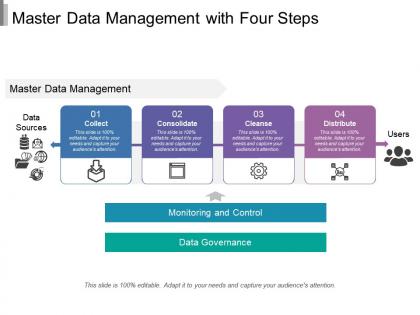
Master data management with four steps




Try Before you Buy Download Free Sample Product
 Impress Your
 Audience
 100%
100% Editable
 Save Hours
 of Time


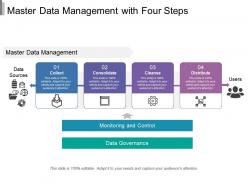
Are you searching for professional PPT graphics and images to create a presentation on master data management? Well if yes, then download our ready to use master data management with four steps PowerPoint template created by a group of presentation designers at SlideTeam. Use this data integration PPT slide to highlight the techniques utilized to explain and manage the critical information of a business to provide with information integration. Using this data warehousing presentation template design, you can represent a process of four steps such as collect, consolidate, cleanse, and distribute. Use this template design to showcase the concept of source identification, data collection, data transformation, rule administration, error detection and correction, data consolidation, data storage, data distribution, data classification, taxonomy services, item master creation, scheme mapping, product codification, data enrichment, and data governance. Our presentation designers have used professional graphics and symbol to make the template design more interesting and attention-grabbing. Ease your presentation work by downloading our editable four steps master data management presentation slide. Acquire inspiration from our Master Data Management With Four Steps. Feel that drive build up inside you.
People who downloaded this PowerPoint presentation also viewed the following :
Master data management with four steps with all 5 slides:
Our Master Data Management With Four Steps enable acute focus. Consider crucial factors from every angle.



FAQs for Master data management
You need data governance first - figure out who owns what data. Then focus on data quality management and building a centralized model for your golden records. Integration capabilities are huge for connecting all your systems together. Don't skip the security and access controls either, trust me on that one. Honestly though? The governance side usually determines if these projects succeed or totally crash and burn. I'd start by mapping your current data sources - see what's actually broken first. That way you can tackle the worst pain points instead of trying to fix everything at once. The tech platform matters but it's not everything.
MDM gives you one clean version of all your important data - customers, products, suppliers, whatever. No more hunting through different systems that all have slightly different info. It catches duplicates automatically and keeps everything consistent, which honestly saves so much headache. You won't be manually fixing the same errors over and over anymore. The tricky part? Getting everyone on board with the new way of doing things. If accounting keeps using their old spreadsheet while sales uses the new system, you're back to square one. But when it works, it really works.
So data governance is like the foundation for your whole MDM thing - it creates the rules and processes that control how master data flows through your company. Picture it as having a referee who makes sure everyone's using the same data definitions and quality standards. You can't really have consistent data without someone calling the shots, you know? Governance also figures out who's responsible for which data and sets up those stewardship roles. Oh, and start by picking your main data areas first and getting stewards assigned - that's honestly the most important step.
So MDM basically gives you one clean view of each customer instead of having their info scattered everywhere. Your sales and support teams stop stepping on each other because they're finally looking at the same data. No more "wait, didn't I already tell you this?" situations that make customers want to scream. The duplicate records get cleaned up automatically too, which honestly saves so much headache. I'd say start with whatever data mess is driving you the most crazy right now - probably where different departments can't talk to each other. That's where you'll see customers actually getting happier first.
Ugh, the politics are honestly the worst part - way worse than any technical stuff. Getting everyone to agree on basic definitions is like herding cats. Your data's gonna be scattered across different systems that don't talk to each other, and teams will push back hard on changing how they do things. Data cleaning always takes 3x longer than you think too. Oh, and once people see how messy everything actually is, they'll want to fix EVERYTHING at once. Don't fall for that trap. Pick one area like customers first, get a win, then expand from there.
Yeah, companies totally tailor MDM to what keeps them up at night. Healthcare gets paranoid about patient mix-ups and compliance stuff - imagine the lawsuits if they screw up patient records. Banks obsess over getting that complete customer picture and managing risk data. Retail focuses on product info and tracking customers across all their touchpoints. Manufacturing? They're all about supplier data and product specs. Honestly, the smart move is figuring out which data actually breaks your business if it's wrong, then build your governance around fixing those specific headaches first.
So the big names are Informatica MDM, IBM InfoSphere, and Microsoft MDS. Informatica's pretty much everywhere in enterprise - their CLAIRE AI stuff actually works well for data quality. IBM's solid if you're already using their other tools. Microsoft MDS is... fine for smaller setups, but honestly it feels like they phoned it in compared to their other products. There are some newer cloud options too like Stibo and Semarchy that aren't as clunky. I'd say pick 2-3 and run some proof of concepts based on what you're trying to do.
Track the technical stuff first - duplicate reduction, data completeness, accuracy scores. But honestly? The business side is what'll actually matter to your boss. Monitor how much faster reports get generated, less time spent on manual cleanup, better customer experience scores. Oh and definitely check adoption rates across departments because perfect data sitting unused is pretty pointless. Start measuring everything before you implement so you can show real ROI later. I learned this the hard way - leadership loves seeing those before/after numbers when budget season rolls around.
Think of data integration as the backbone that makes MDM actually work. You're pulling info from tons of different systems, cleaning it all up, then creating those golden records everyone can trust. Without decent integration, your master data just sits there doing nothing - which honestly defeats the whole point. The tricky part is handling both the initial mess of consolidating everything AND keeping it all synced afterward. Integration handles the heavy lifting so you can actually get clean customer and product records flowing back to where teams need them. It's not glamorous work, but you can't really have effective MDM without it.
So basically, MDM gives you one clean place for all your important stuff - customer data, financial records, whatever the regulators actually care about. When audit time rolls around (ugh, always fun), you'll have consistent data ready instead of frantically digging through random spreadsheets. Set up governance rules early - like who touches what data and how updates work. You get those audit trails too, showing exactly when stuff changed. Honestly? Just figure out which regulations hit your industry worst and tackle those with MDM first.
Don't try to fix everything at once - that's how teams crash and burn. Pick one area like customers or products first. The politics are brutal honestly, departments will literally fight over who controls what data. Get executive backing before you touch any tech stuff or you're screwed. Also resist building some massive system right away (I know it's tempting). Prove it works small scale first, then grow it out. Oh and define who owns what upfront - trust me on this one. Start narrow, show quick wins, expand later.
MDM basically creates one trusted version of your data so analytics teams aren't pulling their hair out. Like, you know when your customer reports show totally different numbers because one system counts prospects and another doesn't? Super annoying. With MDM, you get single, clean records for customers, products, suppliers - all that stuff. Your dashboards actually make sense then instead of showing contradictory nonsense. Honestly, I'd start by figuring out which data mess-ups are driving your reporting folks the most crazy right now. That's your biggest win.
Start with good governance from day one - define who owns what and set up standard processes. You'll need automated checks and one central system where all changes go through proper channels. I know governance sounds boring as hell, but that's honestly where most places screw up. Regular audits help, plus track where your data comes from so you can trace problems back. Create ways for people to flag issues fast. Don't treat this like a one-and-done project though - assign actual stewards and give them real power to make people follow the rules.
Oh man, cloud stuff totally messes with your MDM setup. Gone are the days when everything sat nicely in one place - now your master data's spread across different cloud services and SaaS apps everywhere. Governance becomes this massive headache, especially when you're dealing with compliance across multiple regions (which honestly nobody warns you about enough). But here's the thing - cloud-native MDM tools actually scale way better and sync in real-time. My take? Map out where all your critical master data lives right now across every cloud touchpoint first. Don't even think about next steps until you've got that figured out.
For MDM you'll want to nail the technical stuff first - SQL, data modeling, plus tools like Informatica or Talend. But honestly? The business side trips people up more. You're basically translating between IT folks and business teams all day, so understanding their processes is crucial. Communication skills are huge since you'll explain messy data concepts to people who just want simple answers. Analytical thinking helps too - you'll spot weird inconsistencies between systems constantly. I'd say pick one major MDM platform and get really comfortable with it. Also practice talking about data governance without sounding like a robot.
-
Great experience, I would definitely use your services further.
-
Graphics are very appealing to eyes.