

Medical Billing Invoice Process Flowchart




Try Before you Buy Download Free Sample Product
 Impress Your
 Audience
 100%
100% Editable
 Save Hours
 of Time


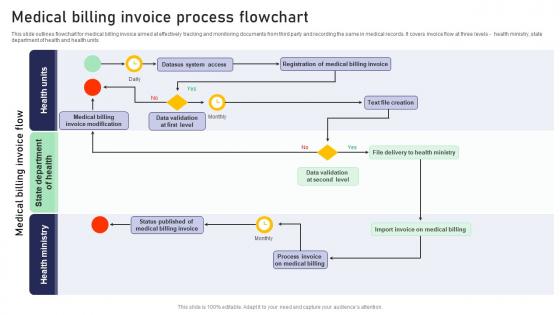
This slide outlines flowchart for medical billing invoice aimed at effectively tracking and monitoring documents from third party and recording the same in medical records. It covers invoice flow at three levels health ministry, state department of health and health units
People who downloaded this PowerPoint presentation also viewed the following :
Medical Billing Invoice Process Flowchart with all 6 slides:
Use our Medical Billing Invoice Process Flowchart to effectively help you save your valuable time. They are readymade to fit into any presentation structure.





FAQs for Medical Billing
The medical billing process includes patient registration, insurance verification, charge capture, claim submission, and payment posting. These components work together by ensuring accurate patient data collection, verifying coverage eligibility, and documenting services provided, ultimately streamlining revenue cycles for healthcare providers while minimizing claim denials and accelerating reimbursements.
The transition to EHR significantly streamlines medical billing by automating code generation, reducing manual data entry errors, and enabling real-time claim processing. Through integrated systems, healthcare providers achieve faster reimbursements, improved coding accuracy, and enhanced compliance tracking, while hospitals and clinics find that electronic workflows ultimately deliver reduced administrative costs and accelerated revenue cycles.
Coding serves as the foundational language of medical billing, translating diagnoses, procedures, and treatments into standardized alphanumeric codes like ICD-10, CPT, and HCPCS. Accurate coding ensures proper reimbursement, regulatory compliance, and streamlined claims processing, with healthcare organizations finding that precise coding reduces claim denials by up to 70% and accelerates payment cycles significantly.
Healthcare providers reduce billing discrepancies and denials by implementing automated coding systems, conducting regular staff training, and establishing comprehensive claim review processes before submission. These approaches streamline operations by minimizing human error, ensuring regulatory compliance, and accelerating reimbursement cycles, with many hospitals and clinics finding that systematic verification ultimately delivers faster revenue collection and improved financial stability.
Common medical billing challenges include claim denials, coding errors, insurance verification issues, patient data inaccuracies, and regulatory compliance complexities. These obstacles can significantly impact healthcare organizations by delaying reimbursements, increasing administrative costs, and reducing operational efficiency, with many practices finding that streamlined billing systems and staff training ultimately enhance revenue cycles and patient satisfaction.
Private insurance typically offers higher reimbursement rates than government programs like Medicare and Medicaid, with commercial payers often reimbursing 120-200% of Medicare rates depending on negotiated contracts. However, government programs provide more predictable payment schedules and standardized processes, while private insurers may offer faster reimbursement cycles, ultimately enabling healthcare providers to balance revenue optimization with operational efficiency.
Claim appeals are crucial for recovering denied payments and maximizing revenue recovery, involving systematic review of rejection reasons, documentation gathering, and resubmission with corrected information. Healthcare providers, from hospitals to specialty clinics, find that effective appeals processes can recover 15-30% of initially denied claims, ultimately improving cash flow and ensuring proper reimbursement for services rendered.
AI enhances medical billing accuracy by automating code verification, detecting billing errors in real-time, and cross-referencing patient data with treatment records. These technologies streamline claims processing by reducing human error, flagging potential compliance issues, and ensuring proper documentation, with many healthcare organizations finding that AI-powered systems deliver faster reimbursements and significantly lower claim rejection rates.
Medical billing legal and ethical considerations include HIPAA compliance for patient privacy, accurate coding to prevent fraud, transparent pricing practices, proper consent procedures, and adherence to Medicare/Medicaid regulations. Healthcare organizations must balance revenue optimization with patient protection, ensuring billing practices maintain trust while meeting regulatory standards, ultimately delivering ethical care and avoiding costly legal penalties.
Patient financial responsibility significantly impacts medical billing practices by requiring upfront cost estimates, flexible payment plans, enhanced transparency in pricing, and streamlined collection processes. Healthcare providers increasingly implement patient portals, automated payment systems, and financial counseling services to improve collection rates while maintaining positive patient relationships, ultimately reducing bad debt and enhancing operational efficiency.
Medical billing professionals can pursue certifications like Certified Professional Biller (CPB), Certified Medical Reimbursement Specialist (CMRS), and Certified Professional Coder (CPC), alongside specialized training in healthcare software systems and regulatory compliance. These programs enhance career prospects by delivering comprehensive knowledge of coding accuracy, claims processing, and industry standards, with many healthcare organizations finding that certified professionals streamline revenue cycles and reduce billing errors significantly.
Varying state regulations significantly impact medical billing through differing reimbursement rates, prior authorization requirements, documentation standards, and compliance protocols. Healthcare organizations must navigate these complexities by implementing state-specific billing procedures, maintaining updated regulatory databases, and training staff accordingly, with many practices finding that robust compliance systems ultimately streamline operations while minimizing costly billing errors.
**INPUT**: What trends are shaping the future of medical billing in healthcare? **OUTPUT**: Key trends include AI-powered automation, real-time claim processing, patient-centric billing portals, predictive analytics for denial prevention, and integrated EHR systems. These technologies streamline revenue cycles by reducing manual errors, accelerating reimbursements, and enhancing transparency, with many healthcare organizations finding that automated workflows ultimately deliver faster payments and improved patient satisfaction. [Word count: 54 words]
Patient demographics significantly influence medical billing strategies through insurance type variations, payment capability assessments, language accessibility requirements, and age-specific billing complexities. Healthcare organizations tailor their approaches by implementing multilingual billing systems, offering flexible payment plans for different economic segments, and adjusting collection strategies based on demographic patterns, ultimately enhancing revenue cycle efficiency while improving patient satisfaction across diverse populations.
Best practices that reduce billing errors include implementing automated coding systems, conducting regular staff training on current regulations, establishing multi-step verification processes, maintaining updated patient information, and performing routine audits. These approaches streamline accuracy by minimizing manual entry mistakes, ensuring compliance with evolving healthcare standards, and catching discrepancies early, with many medical facilities finding that comprehensive error-prevention protocols significantly reduce claim denials and accelerate reimbursement cycles.
-
Templates are beautiful and easy to use. An amateur can also create a presentation using these slides. It is amazing.
-
I can always count on your designs for my professional needs. I believe I found a one-stop-shop for PPTs.