


Medical Service Analysis Quarterly Action Plan




Try Before you Buy Download Free Sample Product
 Impress Your
 Audience
 100%
100% Editable
 Save Hours
 of Time


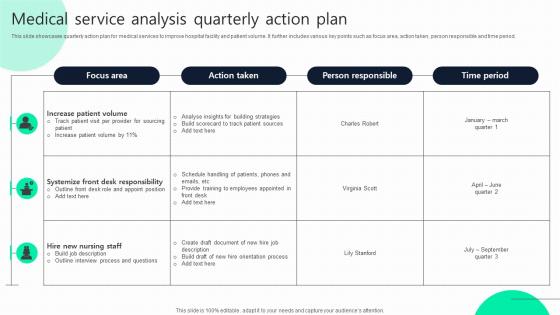
This slide showcases quarterly action plan for medical services to improve hospital facility and patient volume. It further includes various key points such as focus area, action taken, person responsible and time period.
People who downloaded this PowerPoint presentation also viewed the following :
Medical Service Analysis Quarterly Action Plan with all 9 slides:
Use our Medical Service Analysis Quarterly Action Plan to effectively help you save your valuable time. They are readymade to fit into any presentation structure.








FAQs for Medical Service Analysis
Key performance indicators for medical services include patient satisfaction scores, clinical outcome measures, readmission rates, average length of stay, and cost per patient episode. These metrics enable healthcare organizations to streamline operations, enhance patient care quality, and optimize resource allocation, with many hospitals finding that comprehensive KPI tracking ultimately delivers improved patient outcomes and competitive operational efficiency.
Patient satisfaction scores significantly influence healthcare providers' operational strategies by driving improvements in care delivery processes, staff training protocols, and facility management systems. These metrics enable hospitals and clinics to identify service gaps, streamline patient experiences, and enhance communication practices, with many healthcare organizations finding that higher satisfaction scores correlate with improved operational efficiency and competitive positioning.
Telemedicine bridges healthcare gaps in rural areas by providing remote consultations, specialist access, diagnostic support, and continuous monitoring capabilities. Through video conferencing and digital health platforms, rural hospitals and clinics deliver specialized care, reduce patient travel costs, and enable faster diagnoses, with many remote communities finding significantly improved health outcomes and reduced healthcare disparities.
Big data analytics enhances healthcare decision-making by providing predictive insights, real-time patient monitoring, resource optimization, and population health trends analysis. Through advanced algorithms, hospitals and clinics streamline treatment protocols, reduce readmission rates, and optimize staffing allocation, while enabling physicians to deliver more personalized care, ultimately improving patient outcomes and operational efficiency.
EHR integration challenges include data interoperability issues, varying system formats, privacy compliance requirements, staff training needs, and substantial implementation costs across different medical services. These obstacles often result in fragmented patient information, delayed care coordination, and reduced operational efficiency, with many healthcare organizations finding that strategic phased implementation and standardized protocols help streamline integration while maintaining data security.
Specialized medical services significantly enhance patient outcomes by providing targeted expertise, advanced diagnostic capabilities, and specialized treatment protocols tailored to specific conditions. These services enable faster diagnosis, more precise interventions, and reduced complications, with many healthcare systems finding that comprehensive specialty care ultimately delivers improved survival rates, shorter recovery times, and enhanced patient satisfaction across diverse medical conditions.
Ethical considerations include patient privacy protection, algorithmic bias prevention, informed consent requirements, data security compliance, and maintaining human oversight in clinical decisions. These frameworks ensure AI enhances diagnostic accuracy and streamlines healthcare delivery while preserving patient trust, with many hospitals finding that transparent AI implementation ultimately delivers better outcomes and stronger patient-provider relationships.
Patient feedback can be effectively gathered through digital surveys, mobile apps, real-time kiosks, focus groups, and social media monitoring. These methods streamline data collection by capturing immediate post-visit responses, enabling sentiment analysis, and identifying service gaps, with many healthcare organizations finding that systematic feedback analysis enhances patient satisfaction while reducing wait times and improving care quality.
**INPUT**: What are the trends in patient demographics that influence the demand for specific medical services? **OUTPUT**: Key demographic trends include aging populations driving chronic disease management, urbanization increasing specialized care access, rising health literacy demanding preventive services, and diverse ethnic communities requiring culturally tailored treatments. These shifts enable healthcare organizations to strategically optimize resource allocation, expand targeted service lines, and enhance patient experiences, with many hospital systems finding that demographic-driven planning ultimately delivers improved outcomes and competitive advantage. [Word count: 60 words]
Benchmarking against industry standards in medical service analysis enables healthcare organizations to identify performance gaps, optimize resource allocation, and enhance patient outcomes through comparative assessment. This strategic approach helps hospitals and clinics streamline operations, reduce costs, and improve service delivery, with many healthcare systems finding that standardized benchmarks ultimately deliver competitive advantages and measurable improvements in care quality.
Technological infrastructure enhances hospital service delivery by automating patient records, streamlining diagnostic processes, and enabling real-time communication between departments. Through electronic health systems and integrated platforms, hospitals reduce wait times, minimize administrative errors, and accelerate treatment decisions, while improving patient outcomes and operational efficiency across all service areas.
Healthcare policy changes significantly impact medical service accessibility through coverage expansions, reimbursement modifications, regulatory adjustments, and provider network alterations, while affordability shifts via premium structures and cost-sharing requirements. These policy transformations enable healthcare institutions to streamline resource allocation and enhance patient experiences, with many hospitals and clinics finding that strategic adaptation to regulatory frameworks ultimately delivers improved operational efficiency and broader community health outcomes.
Healthcare providers can measure ROI for new medical technologies by tracking cost reductions, patient throughput improvements, diagnostic accuracy gains, and operational efficiency metrics compared to implementation costs. Through detailed financial analysis, hospitals and clinics quantify savings from reduced readmissions, faster treatment times, and enhanced patient outcomes, ultimately delivering measurable competitive advantage in an increasingly cost-conscious healthcare landscape.
Medical service quality improvement strategies include regular patient feedback collection, clinical outcome monitoring, staff training programs, technology integration, and standardized care protocols. These approaches streamline operations by identifying service gaps, enhancing patient experiences, and reducing medical errors, with many healthcare institutions finding that systematic quality frameworks ultimately deliver better patient outcomes and operational efficiency.
Interdisciplinary collaboration enhances medical services by integrating diverse expertise, improving diagnostic accuracy, and streamlining patient care coordination across specialties. Through strategic team-based approaches, hospitals and healthcare systems deliver faster treatment decisions, reduce medical errors, and optimize resource allocation, while ensuring comprehensive patient outcomes that ultimately strengthen competitive positioning in an increasingly complex healthcare landscape.
-
“Ample and amazing variety of templates available, really helpful for making professional PPT for day to day workings.”
-
You guys are life-saver when it comes to presentations. Honestly I cannot do much without your services. Thank you!!!