

Metaverse Technologies Training Ppt




Try Before you Buy Download Free Sample Product
 Impress Your
 Audience
 100%
100% Editable
 Save Hours
 of Time


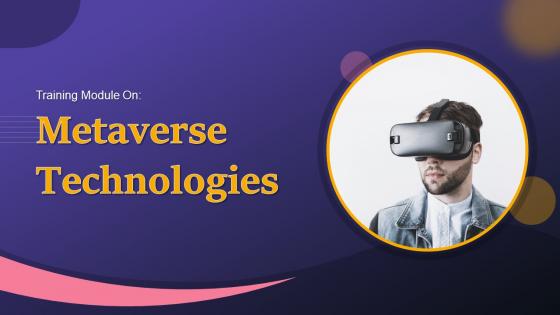
This training module, in detail, covers the multiple technologies that enable the metaverse, which are AR Augmented Reality, VR Virtual Reality, MR Mixed Reality, XR Extended Reality, Blockchain, Haptic Suits, Neurotech, and AR Lenses. It includes key takeaways and discussion questions related to the training topic. The deck also has PPT slides on about us, vision, mission, goal, 30-60-90 days plan, timeline, roadmap, and training completion certificate. It also contains energizer activities to engage the coaching session audience. It also includes a client proposal and assessment form for training evaluation.
People who downloaded this PowerPoint presentation also viewed the following :
Content of this Powerpoint Presentation
Slide 4
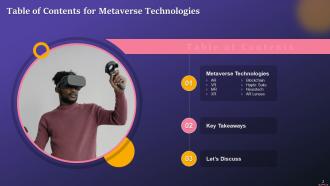
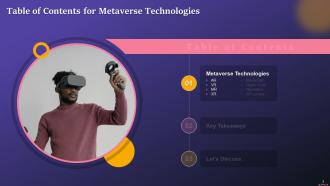
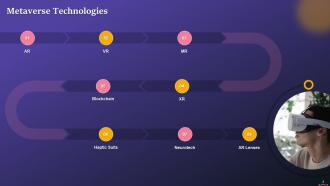
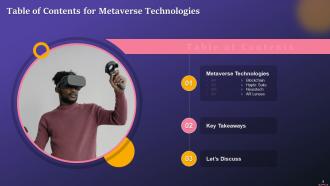
This slide depicts metaverse-enabled technologies, which are sure to make a material difference to our lives. The technologies are AR, VR, MR or XR, Blockchain, Haptic Suits, Neurotech, and AR Lenses.
Slide 5
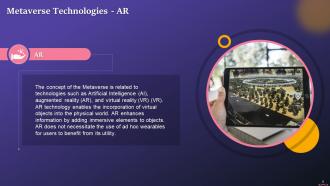
This slide depicts information regarding augmented reality (AR) in metaverse. It emphasizes that AR technology allows virtual objects to be integrated into the physical world. It even augments information by incorporating immersive elements into objects. AR does not require users to use ad hoc wearables to benefit from its utility.
Slide 6
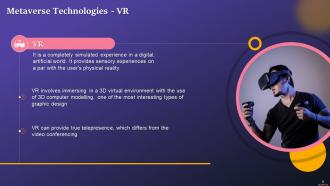
This slide depicts information regarding VR in metaverse. It states that virtual reality (VR) is a wholly-simulated experience in a digital, artificial world. It provides sensory experiences on a par with the user's physical reality. VR entails immersing oneself in a 3D virtual environment created with 3D computer modeling.
Slide 7
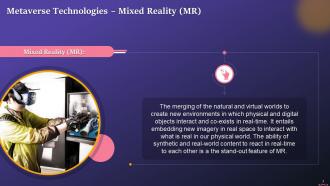
This slide depicts information on Mixed Reality (MR). It adds that MR is the merging of the natural and virtual worlds to create new environments in which physical and digital objects interact and co-exist in real-time. The ability of synthetic and real-world content to react in real-time to each other is a critical feature of MR.
Slide 8
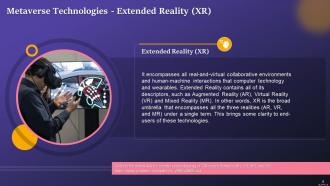
This slide provides information on Extended Reality in metaverse. It mentions that XR encompasses all real-and-virtual collaborative environments and human-machine interactions that computer technology and wearables enable. The XR technology encompasses all of its descriptors, such as Augmented Reality (AR), Virtual Reality (VR), and Mixed Reality (MR).
Slide 10
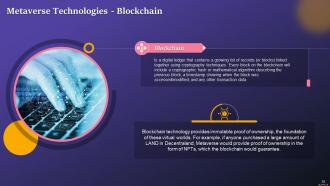
This slide depicts information about blockchain in metaverse. Blockchain is a digital ledger containing a growing list of records (or blocks) linked together using cryptography techniques. It also emphasizes that blockchain technology, which is the foundation of these virtual worlds, provides immutable proof of ownership. For example, if a large amount of LAND were purchased in Decentraland, metaverse would provide evidence of ownership in the form of NFTs, which the blockchain would attest to.
Slide 11
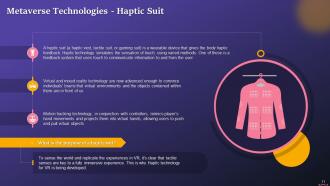
This slide illustrates information about Haptic Suit in metaverse. It highlights that a haptic suit (a haptic vest, tactile suit, or gaming suit) is a wearable device that gives the body haptic feedback. Haptic technology uses various mechanisms to simulate the sensation of touch. It also mentions that to sense the world and replicate the experiences in Virtual Reality (VR). Tactile senses are a critical component to feeling fully immersed. This is why Haptic technology for VR is being developed.
Slide 12
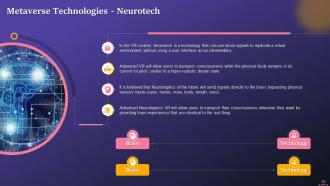
This slide depicts information about Neurotech in metaverse. It emphasizes that Neurotech is a technology that can completely replicate a virtual environment using brain signals without using a user interface as an intermediary. It also states that Neurohaptics of the future will send signals directly to the brain, bypassing physical sensory inputs (eyes, hands, nose, body, mouth, ears). Advanced Neurohaptics VR will enable users to transport their consciousness to any location they desire by providing brain experiences that are identical to the real thing.
Slide 13
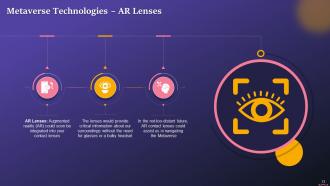
This slide illustrates information about AR Lenses in metaverse. It emphasizes that Augmented Reality (AR) could soon be integrated into your contact lenses. The lenses would provide critical information about our surroundings without the need for glasses or a bulky headset. It also mentions that in the not-too-distant future, AR contact lenses could assist us in navigating the metaverse.
Slide 14
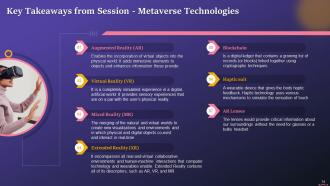
This slide illustrates the key takeaways from the session metaverse technologies.
Slide 15
This slide mentions various questions for discussion on the topic metaverse technologies.
Slide 28 to 43
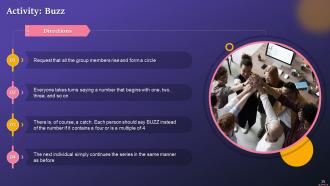
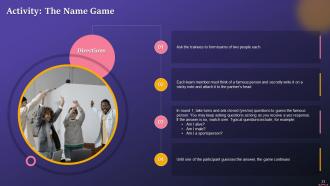
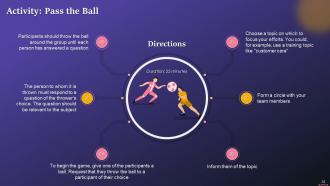
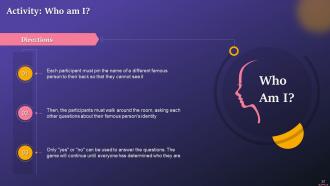
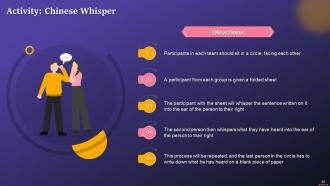
These slides depict energizer activities to engage the audience of the training session.
Slide 44 to 71
These slides contain a training proposal covering what the company providing corporate training can accomplish for the client.
Slide 72 to 74
These slides include a training evaluation form for instructor, content and course assessment.
Metaverse Technologies Training Ppt with all 79 slides:
Use our Metaverse Technologies Training Ppt to effectively help you save your valuable time. They are readymade to fit into any presentation structure.



















































FAQs for Metaverse
Metaverse development relies on virtual reality, augmented reality, blockchain, artificial intelligence, cloud computing, and 5G connectivity. These technologies work together by creating immersive environments, enabling secure digital transactions, and delivering real-time interactions, with many retail, gaming, and education organizations finding that strategic integration ultimately enhances customer engagement and competitive positioning.
Blockchain technology enhances virtual environment security through decentralized authentication, immutable transaction records, and cryptographic verification protocols. These mechanisms enable true digital ownership of virtual assets, preventing fraud and unauthorized modifications, with gaming platforms, virtual real estate markets, and digital art galleries finding that blockchain delivers transparent ownership verification and secure peer-to-peer transactions.
Augmented reality enhances metaverse experiences by enabling seamless transitions between virtual and physical environments, providing contextual information overlays, facilitating real-world object integration, and supporting hybrid social interactions. Through AR integration, organizations in retail, education, and healthcare can deliver more accessible metaverse applications while reducing hardware barriers, ultimately creating scalable digital experiences that bridge physical and virtual worlds.
AI serves as the foundational engine for metaverse interactivity, powering intelligent NPCs, real-time language translation, adaptive environments, personalized content curation, and behavioral prediction systems. Through machine learning algorithms, virtual worlds deliver customized experiences, seamless cross-platform interactions, and dynamic content generation, with gaming, retail, and education sectors finding that AI-driven personalization significantly enhances user engagement and retention.
Virtual reality reshapes education and training by creating immersive learning environments, enabling hands-on practice without real-world risks, and delivering personalized instruction at scale. Medical schools use VR for surgical simulations, while manufacturing companies train workers on complex machinery safely, ultimately reducing costs, accelerating skill development, and enhancing knowledge retention across traditional classroom limitations.
The metaverse transforms social interactions through immersive virtual environments, persistent digital identities, shared virtual spaces, real-time collaboration tools, and enhanced community engagement platforms. These technologies enable deeper connections across geographical boundaries, foster inclusive communities through customizable avatars, and create new networking opportunities, with many organizations finding that virtual events and collaborative workspaces ultimately deliver stronger team cohesion and expanded global reach.
User-generated content and assets create self-sustaining metaverse economies by enabling participants to build, trade, and monetize digital creations, reducing platform development costs while increasing engagement. Through blockchain-based ownership and creator marketplaces, users become stakeholders rather than consumers, with gaming platforms and virtual real estate sectors finding that community-driven content generates continuous revenue streams, ultimately delivering long-term ecosystem viability and competitive differentiation.
Data privacy and security challenges in metaverse platforms include extensive personal data collection, biometric tracking vulnerabilities, inadequate encryption protocols, cross-platform data sharing risks, and insufficient user consent mechanisms. These concerns present both regulatory compliance hurdles and user trust issues, with many organizations finding that implementing robust privacy frameworks and transparent security measures ultimately delivers competitive advantage and enhanced user confidence.
Businesses can leverage metaverse technologies for marketing through virtual showrooms, immersive product demonstrations, branded virtual events, interactive customer experiences, and gamified engagement campaigns. These digital environments enable companies to reach global audiences, reduce physical infrastructure costs, and create memorable brand interactions, with retail brands and automotive companies finding that virtual experiences significantly enhance customer engagement and drive purchase decisions.
The metaverse presents significant ethical considerations around digital identity, including privacy protection, identity verification, data ownership, consent management, and avatar representation authenticity. These challenges require careful balance between user freedom and safety protocols, with many technology companies and regulatory bodies finding that establishing transparent governance frameworks, robust security measures, and user control mechanisms ultimately delivers trusted virtual environments and sustainable digital experiences.
The metaverse revolutionizes remote work by creating immersive virtual environments that replicate in-person interactions, enabling real-time collaboration, virtual meetings, and shared digital workspaces. Through VR and AR technologies, organizations streamline communication, enhance team engagement, and deliver more dynamic project collaboration, with many companies finding that virtual offices ultimately reduce operational costs while maintaining productivity levels.
Gamification enhances metaverse engagement through reward systems, achievement badges, leaderboards, social challenges, and progress tracking mechanisms. These elements drive sustained interaction by creating competitive environments and meaningful progression paths, with retail brands and educational institutions finding that gamified experiences increase user retention rates, encourage collaborative behaviors, and ultimately deliver deeper platform loyalty and extended session times.
Digital currencies and NFTs create new economic models within metaverse environments, enabling virtual property ownership, digital asset trading, creator monetization, and decentralized marketplace functionality. These technologies streamline transactions by eliminating traditional payment barriers, establishing verifiable ownership of virtual goods, and creating revenue streams for content creators, with many gaming platforms and virtual worlds finding that blockchain-based economies ultimately enhance user engagement and deliver sustainable business models.
Accessibility improvements include adaptive interfaces, voice navigation systems, haptic feedback technologies, customizable visual settings, and multi-sensory interaction options. These enhancements streamline user experiences by accommodating disabilities, reducing technical barriers, and enabling personalized environments, with many organizations finding that inclusive design ultimately delivers broader user adoption and competitive advantage in digital engagement.
Metaverse technologies raise environmental concerns through significant energy consumption from data centers, blockchain operations, high-performance computing, and continuous server infrastructure required for immersive experiences. While these technologies present sustainability challenges, many organizations are increasingly adopting renewable energy sources, optimizing server efficiency, and implementing carbon offset programs, ultimately balancing innovation with environmental responsibility.
-
Requested a complete pitch deck. Delivered immediately and with high quality well researched content.
-
Like always a great experience with you guys. Always there on the drop of hat to help.