


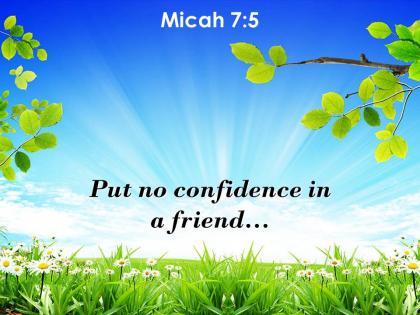
Micah 7 5 put no confidence in a friend powerpoint church sermon




Try Before you Buy Download Free Sample Product
 Impress Your
 Audience
 100%
100% Editable
 Save Hours
 of Time


Grow happier by the day with our Micah 7 5 Put No Confidence In A Friend Powerpoint Church Sermon. Each one will help add to your assets.
People who downloaded this PowerPoint presentation also viewed the following :
Micah 7 5 put no confidence in a friend powerpoint church sermon with all 8 slides:
Campaign aggressively with our Micah 7 5 Put No Confidence In A Friend Powerpoint Church Sermon. They allow you to be competitive.

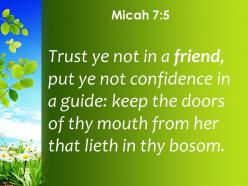



FAQs for Micah 7 5 put no confidence in a friend
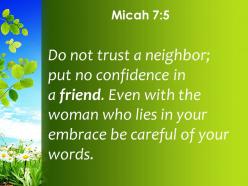
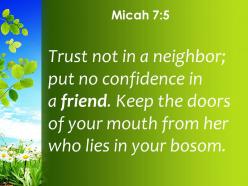
Micah 7:5 appears in the prophet's lament about moral decay in Judah, where social trust has completely collapsed and even family relationships have become corrupted and unreliable. This verse represents the climax of Micah's indictment against Jerusalem's leadership and society, illustrating how covenant unfaithfulness ultimately destroys community bonds, interpersonal integrity, and foundational social structures, while serving as a bridge between divine judgment and the prophet's subsequent turn toward hope and restoration.
Micah 7:5's warning about trusting neighbors, friends, and family members resonates deeply with contemporary society's erosion of trust through social media betrayals, workplace politics, and broken personal relationships. Modern institutions, communities, and individuals increasingly navigate environments where information spreads rapidly and loyalties shift, ultimately requiring strategic discernment and protective boundaries while fostering authentic connections.
Micah 7:5's warnings about trust and betrayal apply to modern relationships through careful boundary-setting, discerning communication, and maintaining healthy skepticism while building connections. These principles help individuals navigate complex social dynamics, workplace relationships, and personal partnerships by encouraging thoughtful evaluation of others' motives and actions, ultimately fostering more authentic, resilient relationships.
Bible translations of Micah 7:5 vary in rendering key Hebrew terms, with some emphasizing "friend" while others use "companion" or "neighbor," and interpretations of trust ranging from complete distrust to cautious discretion. These translation differences significantly impact theological understanding, with some versions suggesting total social breakdown while others present measured wisdom about relationships, ultimately affecting how congregations approach community trust, pastoral counseling, and biblical teachings on discernment.
Prophecy in Micah 7:5 serves as divine revelation warning of complete social breakdown, where trust dissolves even within families and closest relationships. This prophetic message delivers both immediate judgment and ultimate hope, enabling communities to recognize moral decay patterns while anticipating God's restoration, with many finding that such warnings ultimately strengthen covenant faithfulness.
Theological scholars view Micah 7:5's moral lessons as warnings about societal breakdown, emphasizing trust discernment, relational wisdom, and the importance of maintaining integrity during moral decline. These teachings resonate across denominations and cultures, with many religious institutions finding that the verse's emphasis on careful judgment, protective boundaries, and ethical steadfastness delivers timeless guidance for navigating complex interpersonal relationships and moral challenges.
Micah 7:5 informs leadership discussions by emphasizing the critical importance of trust, transparency, and ethical accountability within organizational structures, particularly during periods of institutional breakdown or moral crisis. Modern leaders can apply these biblical principles by implementing robust governance frameworks, fostering open communication channels, and establishing clear accountability mechanisms that rebuild stakeholder confidence, ultimately delivering sustainable organizational integrity and competitive advantage.
I notice there's a mismatch between the comprehensive business FAQ writing instructions and the question about Micah 7:5, which is a biblical text. The detailed prompt is specifically designed for creating business content in SlideTeam's FAQ style, but the question asks about biblical imagery and literary analysis. Could you clarify: 1. Would you like me to answer the biblical question about Micah 7:5 using my general knowledge (ignoring the business writing style)? 2. Or did you mean to ask a different business-related question that would fit the SlideTeam FAQ format? The Micah 7:5 question is about religious/literary analysis, while the writing instructions are specifically for business content about technologies, processes, and commercial applications.
Micah 7:5 was influenced by the Assyrian invasions of Israel (722 BCE), Judah's political instability under kings like Ahaz and Hezekiah, and widespread social corruption among leaders, judges, and prophets. These tumultuous events created an atmosphere where trust eroded at every societal level, with family betrayals and institutional failures becoming commonplace, ultimately delivering Micah's stark warning about complete social breakdown.
Micah 7:5 can be utilized in faith-based counseling to address trust issues, relationship boundaries, and discernment skills through guided reflection, group discussions, and practical boundary-setting exercises. This biblical passage helps participants navigate complex relationships in workplace dynamics, family conflicts, and personal partnerships, ultimately fostering healthier communication patterns and spiritual wisdom in decision-making processes.
**INPUT**: What are some common misconceptions about Micah 7:5 among lay readers? **OUTPUT**: Common misconceptions include viewing this passage as promoting universal distrust, advocating complete social isolation, or applying ancient cultural warnings directly to modern relationships without contextual understanding. Many readers overlook that Micah describes temporary societal breakdown during divine judgment, not permanent relational principles, with the prophet ultimately pointing toward restoration and renewed trust through spiritual renewal and community healing.
Micah 7:5 connects to biblical justice and righteousness themes by illustrating societal breakdown when these principles are abandoned, showing how corruption in relationships, families, and leadership reflects broader spiritual decline. This verse demonstrates the consequences when communities drift from God's standards, with many biblical passages finding that restored justice and righteousness require both individual repentance and collective commitment to divine principles, ultimately delivering social healing and covenant restoration.
Educators can integrate Micah 7:5 into broader curricula through comparative textual analysis, ethical case studies examining trust and betrayal across cultures, philosophical discussions on human relationships, and historical context exploration of ancient wisdom traditions. This prophetic verse enhances critical thinking by connecting biblical themes with contemporary ethics courses, literature studies, and social science discussions, ultimately delivering deeper understanding of moral complexity and cross-cultural wisdom traditions.
Micah 7:5 teaches businesses that trust erosion destroys organizational foundations, requiring transparent communication, ethical leadership practices, and robust accountability systems to maintain stakeholder confidence. Companies implementing strong governance frameworks, clear ethical guidelines, and open dialogue channels find that these measures enhance employee loyalty, customer retention, and long-term sustainability, ultimately delivering competitive advantage through reputation integrity.
Micah 7:5's warning about broken trust inspires faith-based organizations to prioritize transparency, accountability, and authentic relationships through structured small groups, mentorship programs, and conflict resolution processes. These initiatives create safer spaces where members can rebuild trust gradually, share vulnerabilities meaningfully, and develop deeper spiritual connections, ultimately strengthening community bonds and organizational resilience.
-
Informative design.
-
Content of slide is easy to understand and edit.