

Microservices Powerpoint Presentation Slides




Try Before you Buy Download Free Sample Product
 Impress Your
Audience
 100%
Editable
 Save Hours
of Time


Grab our efficiently designed Microservices PowerPoint presentation that briefly explains microservices, their importance, market analysis, architecture, working, components, and design patterns. In this Microservices Architecture PPT, we have covered the microservices features, benefits, importance in the DevOps environment, and comparison with other technologies. In addition, this Micro-architectures PPT contains the microservices architecture, working process steps, and components, such as APIs, containers, services mesh, SOA, and cloud services. Also, the Decomposed Services PPT presentation includes the microservices design patterns, including design principles, behavioral design patterns, database implications, and message patterns. Furthermore, this Small-Scale Services template caters to the tools and technologies used in microservices, deployment steps, implementation challenges, and best practices. Moreover, this Task-Oriented Services deck comprises a checklist for effective microservices deployment, training program, training, and implementation budget. Lastly, this Microservices PowerPoint Presentation contains the 30 60 90 days plan, timeline, roadmap, and performance monitoring dashboard. It also includes the applications, use cases, and case studies of microservices deployment. Download our 100 percent editable and customizable template, which is also compatible with Google Slides.
People who downloaded this PowerPoint presentation also viewed the following :
Content of this Powerpoint Presentation
Slide 1: This slide introduces Microservices. State your company name and begin.
Slide 2: This slide states Agenda of the presentation.
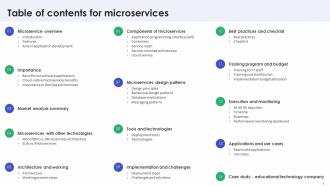
Slide 3: This slide shows Table of Content for the presentation.
Slide 4: This slide highlights title for topics that are to be covered next in the template.
Slide 5: This slide shows Microservices architecture introduction in application development.
Slide 6: This slide presents Salient features of microservices architecture and design.
Slide 7: This slide displays Role of microservices architecture in application development.
Slide 8: This slide highlights title for topics that are to be covered next in the template.
Slide 9: This slide represents Microservices architecture benefits for software applications.
Slide 10: This slide showcases Cloud-native microservices benefits for software applications.
Slide 11: This slide shows Importance of microservices architecture in DevOps environment.
Slide 12: This slide highlights title for topics that are to be covered next in the template.
Slide 13: This slide presents Microservices architecture market analysis summary.
Slide 14: This slide highlights title for topics that are to be covered next in the template.
Slide 15: This slide displays Comparison between monolithic and microservices architecture.
Slide 16: This slide represents Service-oriented architecture (SOA) vs. Microservices architecture.
Slide 17: This slide highlights title for topics that are to be covered next in the template.
Slide 18: This slide showcases Basic architecture of microservices based application.
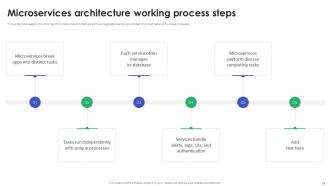
Slide 19: This slide shows Microservices architecture working process steps.
Slide 20: This slide highlights title for topics that are to be covered next in the template.
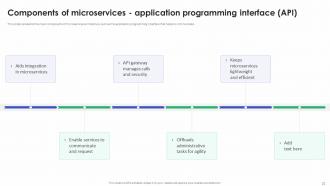
Slide 21: This slide presents Components of microservices - application programming interface (API).
Slide 22: This slide displays Components of microservices architecture - containers.
Slide 23: This slide represents Components of microservices architecture - service mesh.
Slide 24: This slide showcases Components of microservices – service oriented architecture.
Slide 25: This slide shows Components of microservices architecture – cloud service.
Slide 26: This slide highlights title for topics that are to be covered next in the template.
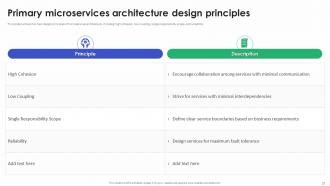
Slide 27: This slide presents Primary microservices architecture design principles.
Slide 28: This slide displays Primary microservices architecture design principles contd..
Slide 29: This slide represents Common microservices behavioral design patterns.
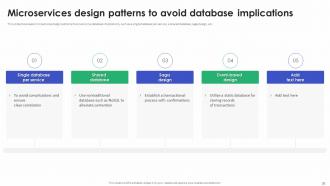
Slide 30: This slide showcases Microservices design patterns to avoid database implications.
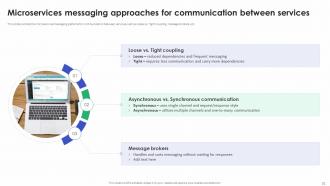
Slide 31: This slide shows Microservices messaging approaches for communication between services.
Slide 32: This slide highlights title for topics that are to be covered next in the template.
Slide 33: This slide presents Tools to deploy and manage microservices.
Slide 34: This slide displays Key enabling technologies for microservices architecture.
Slide 35: This slide highlights title for topics that are to be covered next in the template.
Slide 36: This slide represents Key steps to deploy microservices and avoid challenges.
Slide 37: This slide showcases Key steps to deploy microservices and avoid challenges contd..
Slide 38: This slide shows Challenges and solutions associated with microservices implementation.
Slide 39: This slide highlights title for topics that are to be covered next in the template.
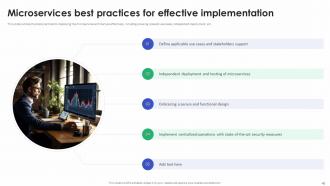
Slide 40: This slide presents Define applicable use cases and stakeholders support.
Slide 41: This slide displays Checklist to ensure optimal application performance.
Slide 42: This slide highlights title for topics that are to be covered next in the template.
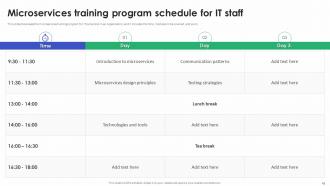
Slide 43: This slide represents Microservices training program schedule for IT staff.
Slide 44: This slide showcases Microservices architecture training cost distribution.
Slide 45: This slide shows Budget allocation for implementing microservices architecture.
Slide 46: This slide highlights title for topics that are to be covered next in the template.
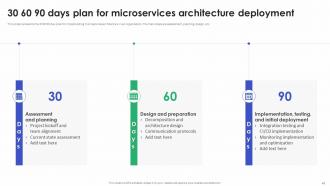
Slide 47: This slide presents 30 60 90 days plan for microservices architecture deployment.
Slide 48: This slide displays Timeline for microservices architecture design deployment.
Slide 49: This slide represents Roadmap to deploy microservices architecture design.
Slide 50: This slide showcases Microservices architecture performance monitoring dashboard.
Slide 51: This slide highlights title for topics that are to be covered next in the template.
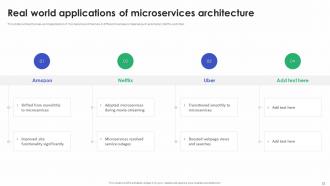
Slide 52: This slide shows Real world applications of microservices architecture.
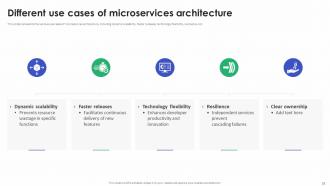
Slide 53: This slide presents Different use cases of microservices architecture.
Slide 54: This slide highlights title for topics that are to be covered next in the template.
Slide 55: This slide displays Case study - educational technology company.
Slide 56: This slide contains all the icons used in this presentation.
Slide 57: This slide is titled as Additional Slides for moving forward.
Slide 58: This slide shows Post It Notes. Post your important notes here.
Slide 59: This is a Timeline slide. Show data related to time intervals here.
Slide 60: This is a Financial slide. Show your finance related stuff here.
Slide 61: This slide presents Bar chart with two products comparison.
Slide 62: This slide presents Roadmap with additional textboxes.
Slide 63: This is Our Goal slide. State your firm's goals here.
Slide 64: This slide contains Puzzle with related icons and text.
Slide 65: This is a Thank You slide with address, contact numbers and email address.
Microservices Powerpoint Presentation Slides with all 73 slides:
Use our Microservices Powerpoint Presentation Slides to effectively help you save your valuable time. They are readymade to fit into any presentation structure.





























FAQs for Microservices
Honestly, the big wins are scalability, fault isolation, and letting teams do their own thing. When one service crashes, your whole app doesn't die - which has saved my butt more times than I can count. You can scale just the parts that need it instead of everything at once. Teams get to pick their own tech and deploy whenever, which makes everyone way happier. Testing gets easier too since you're dealing with smaller pieces. But real talk - you're basically trading simplicity for flexibility, so don't jump in unless your team can handle the distributed systems headache.
Honestly, microservices are a game-changer for CI/CD. You can update just your payment service without messing with user management or whatever else. Way less stress. Builds run faster too since you're dealing with smaller chunks of code. If something goes wrong? Just roll back that one piece instead of nuking everything. Though you definitely need solid testing and monitoring - learned that the hard way when we had like 6 services all acting up at once. But yeah, the independent deployments alone make it worth it.
Honestly, debugging becomes a total nightmare when you're chasing bugs across multiple services instead of one codebase. Data consistency is where most people get burned - no more simple database transactions to save you. Network calls between services will slow things down more than you expect. Your deployment process gets way more complicated too, which is annoying but unavoidable. Teams have to learn a bunch of new monitoring tools. I'd honestly just split into 2-3 services first and see how that goes before you tear apart everything.
So there's a few ways to handle service discovery. Most people use a service registry - Consul, Eureka, or etcd work well. Services just register themselves and look up others when needed. If you're already on Kubernetes, their built-in DNS is actually really nice and saves you the hassle. Client-side discovery is another route where each service keeps its own cache. Or server-side where your load balancer does the heavy lifting. Honestly though? I'd just start with whatever your platform already gives you. Way easier than bolting on another tool right off the bat.
So you know how microservices can turn into a total nightmare with all the different services trying to talk to each other? That's where API management comes in - it's like having one central hub that handles all the routing, authentication, and rate limiting stuff. Without it, you'll go crazy trying to track what's calling what or keep anything secure. Plus you get all the monitoring and performance data in one place, which honestly saves your sanity. Oh and it helps with API versioning too, which gets messy fast. I'd start with a basic API gateway if you're new to this whole microservices thing.
Dude, microservices are clutch for scaling - you only beef up the parts getting slammed instead of your whole app. Like if everyone's logging in at once, just spin up more auth instances. Way smarter than copying everything. Deployments get way faster too since teams aren't waiting around for each other to push code. Oh and you can pick whatever tech actually makes sense - Go for the heavy-hitting APIs, Python for ML nonsense. Honestly the hardest part is figuring out which components to break out first.
So basically start with centralized logging - ELK stack or Splunk work great for pulling logs from all your services into one spot. Trust me, trying to debug distributed stuff without this is absolute hell. Get some APM monitoring going too, like New Relic or Datadog. They'll track performance across your whole service chain. Oh and correlation IDs sound super boring but they're clutch when things break. Each request needs a unique ID that follows the entire call path. Set up health checks for everything and make sure your alerts actually work. Honestly wish someone had told me this earlier - you can't fix what you can't see.
Dude, go with the Saga pattern for handling data consistency across your microservices. Break your transactions into smaller steps that you can compensate for if shit hits the fan. Two-phase commit technically works but honestly it's a nightmare when networks get flaky - learned that one the hard way. Event sourcing is pretty clever too since you're just storing events instead of current state, makes rollbacks way cleaner. But yeah, start with Saga. Most teams can actually wrap their heads around it without losing their minds.
So the must-knows are API Gateway for routing and Circuit Breaker for when things inevitably break. Service Discovery is huge too - otherwise your services are just shouting into the void. CQRS and Event Sourcing come up constantly, though honestly CQRS can be a real headache at first. Database per Service keeps everything separate, which you'll thank yourself for later. Saga pattern handles distributed transactions, and Bulkhead isolates failures so one bad service doesn't tank everything. I'd start with API Gateway and Circuit Breaker - they'll save you from the most obvious disasters right away.
Honestly, pick tech your team already knows well - don't chase whatever's trending on Hacker News this week. Docker and Kubernetes are solid choices for containers and orchestration. You'll want service discovery and async messaging too. The whole polyglot thing looks awesome on paper but becomes a maintenance hell fast. HTTP APIs work great to start with, plus decent monitoring. I learned this the hard way at my last job lol. Build simple first, then add complexity when you actually need it. Way better than over-engineering from day one.
Dude, containerization is a game changer for microservices. Each service gets packaged with everything it needs, so you're done with those "works on my machine" disasters. Docker and Kubernetes basically do the heavy lifting - scaling, orchestration, all that stuff happens automatically. When something breaks, rollbacks are super quick. Plus containers are way more efficient since they share the OS kernel instead of spinning up full VMs. Honestly, I was skeptical at first but now I can't imagine going back. Just pick one service to containerize first and you'll see what I mean.
Start with mutual TLS between services - that's your foundation. API gateways help control who talks to what. Give each microservice its own auth instead of sharing creds (seriously, I've watched teams shoot themselves in the foot doing this). Get a proper secrets manager so you're not hardcoding API keys like an amateur. Network segmentation matters too. Zero-trust from the beginning will save you headaches later. Oh, and don't sleep on logging - you'll want visibility when things go sideways. Isolate everything and monitor security events across the board.
Start with simple HTTP calls between your services - don't overthink it at first. You'll need to decide on sync stuff (REST, GraphQL) or async messaging early on. Honestly? Async saves you from so many cascade failures later. API gateways are clutch for routing and auth. Document everything and version your APIs properly or future you will hate past you. Circuit breakers help when downstream services crap out. As things get complex, move toward event-driven patterns. Oh, and pick one messaging standard - having different teams use different approaches gets messy fast.
Mock your external dependencies for unit tests - way easier to test business logic in isolation. Pact is solid for contract testing between services without the headache of full environments. Integration and E2E tests are necessary but honestly such a pain to maintain. Service virtualization saves you when dependencies are flaky or unavailable. Stick with the test pyramid approach - tons of unit tests, some integration tests, just a few E2E ones. Trust me, this'll save you hours of debugging weird issues later. Oh and don't go overboard with the E2E stuff, they break constantly.
Honestly, microservices and DevOps go together like peanut butter and jelly. Your teams get to own their whole service from start to finish - no more waiting around for some massive deployment. Each service deploys on its own schedule, which is huge. The "you build it, you run it" thing actually makes sense here since your team just focuses on their one piece. Docker and CI/CD make juggling multiple services less of a nightmare than you'd think. My advice? Pick one service to split off first and let that team handle everything. You'll get it once you see how smooth it runs.
-
Time saving slide with creative ideas. Help a lot in quick presentations..
-
I was mind-blown by the services that SlideTeam provided me. Thanks a ton!