


Middleware Functioning Monotone Icon In Powerpoint Pptx Png And Editable Eps Format




Try Before you Buy Download Free Sample Product
 Impress Your
 Audience
 100%
100% Editable
 Save Hours
 of Time


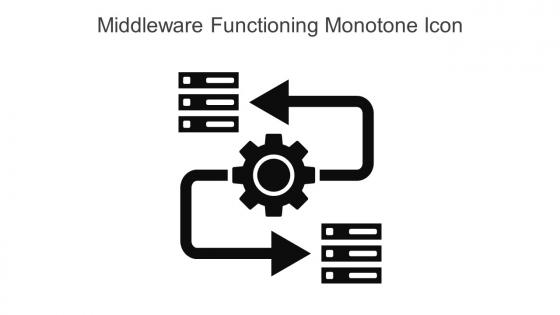
This Middleware functioning monotone icon in powerpoint pptx png and editable eps format is a 100 percent editable icon. The downloaded file will have this icon in EPS, PNG and Powerpoint pptx format and is perfect for your next project. It has a simple yet stylish design.
People who downloaded this PowerPoint presentation also viewed the following :
Middleware Functioning Monotone Icon In Powerpoint Pptx Png And Editable Eps Format with all 6 slides:
Use our Middleware Functioning Monotone Icon In Powerpoint Pptx Png And Editable Eps Format to effectively help you save your valuable time. They are readymade to fit into any presentation structure.





FAQs for Middleware Functioning Monotone Icon In Powerpoint Pptx Png And
Middleware's primary functions include managing communication between distributed applications, handling data transformation and routing, providing security and authentication services, enabling system integration, and facilitating load balancing. These technologies streamline enterprise operations by reducing development complexity, ensuring seamless data flow, and enabling scalable architectures, with many organizations finding that strategic middleware implementation ultimately delivers faster deployment times and enhanced operational efficiency.
Middleware facilitates communication between disparate systems by serving as an intermediary layer that translates protocols, manages data formats, and handles authentication across different platforms. It enables seamless integration through message queues, APIs, and service brokers, with organizations in banking, healthcare, and retail finding that middleware significantly reduces integration complexity while accelerating digital transformation initiatives.
Key middleware types include message-oriented middleware, database middleware, transaction processing middleware, web middleware, and application server middleware. These technologies differ in their specific functions, with message middleware facilitating communication between applications, database middleware managing data access, and transaction middleware ensuring reliable processing, ultimately enabling organizations to build scalable, integrated systems that streamline operations.
Middleware is essential for application development in distributed systems requiring database integration, API management, message queuing, authentication services, and cross-platform communication. Organizations building enterprise applications, microservices architectures, or cloud-native solutions rely on middleware to streamline data flow, enhance security protocols, and enable seamless system interoperability, ultimately delivering scalable infrastructure and reduced development complexity.
Middleware improves web application scalability by enabling load balancing, caching frequently accessed data, and managing connection pooling across multiple servers. Through strategic middleware implementation, organizations can distribute traffic efficiently, reduce database bottlenecks, and handle increased user loads seamlessly, with many enterprises finding that properly configured middleware delivers significantly enhanced performance and cost-effective resource utilization.
When using middleware, developers should prioritize authentication validation, data encryption, access control mechanisms, input sanitization, and secure API gateway configurations. These security layers streamline protection by preventing unauthorized access, minimizing data breaches, and ensuring regulatory compliance, with many financial services and healthcare organizations finding that robust middleware security ultimately delivers enhanced customer trust and operational resilience.
Middleware enables legacy system integration by providing translation layers, API gateways, and data format conversion that bridge communication gaps between old and new technologies. Through enterprise service buses and integration platforms, organizations streamline data flow, reduce development complexity, and extend legacy investments while modernizing operations, ultimately delivering seamless connectivity and accelerated digital transformation.
Middleware in cloud computing environments acts as a critical integration layer that connects applications, databases, and services across distributed systems, enabling seamless communication and data exchange. It streamlines cloud operations by providing API management, load balancing, and security protocols, with many enterprises finding that strategic middleware deployment significantly reduces integration complexity while enhancing scalability and operational efficiency.
Yes, middleware significantly enhances data management and workflow orchestration by providing seamless integration between disparate systems, automating data transformation processes, and enabling real-time synchronization across applications. Through enterprise service buses and API gateways, organizations streamline complex workflows, reduce data silos, and accelerate decision-making, with many financial services and healthcare institutions finding improved operational efficiency and faster customer services.
Popular middleware platforms include Apache Kafka for real-time data streaming, IBM WebSphere for enterprise integration, Oracle Fusion for cloud connectivity, Microsoft BizTalk for workflow automation, and MuleSoft for API management. These platforms enhance operational efficiency by streamlining data flow, automating business processes, and enabling seamless system integration, with many organizations finding that strategic middleware deployment delivers faster services and significant competitive advantage.
Middleware affects application performance by introducing processing overhead, network hops, and potential bottlenecks, while simultaneously optimizing resource allocation, caching frequently accessed data, and streamlining communication between systems. Through strategic implementation, organizations in banking, healthcare, and retail find that well-designed middleware architectures ultimately reduce overall latency and enhance scalability across distributed applications.
Middleware supports microservices architecture by enabling service discovery, load balancing, API gateway management, inter-service communication, and distributed monitoring across multiple independent services. Through strategic middleware implementation, organizations streamline service orchestration, enhance fault tolerance, and automate scaling decisions, while banks and e-commerce platforms increasingly find that middleware delivers seamless integration and operational efficiency.
Middleware significantly enhances data consistency and transaction management by providing centralized coordination, automated rollback mechanisms, and distributed transaction processing across multiple systems. Through message queuing and database abstraction layers, organizations streamline data synchronization, minimize conflicts, and ensure ACID compliance, with financial services and e-commerce platforms finding improved reliability and reduced data inconsistencies.
Developers choose middleware by evaluating application requirements, scalability needs, performance benchmarks, integration capabilities, and budget constraints. They assess factors like data throughput, security features, and compatibility with existing systems, with many development teams finding that strategic middleware selection significantly reduces development time, enhances system reliability, and delivers long-term operational efficiency.
Future middleware trends include cloud-native architectures, serverless computing, API-first development, microservices orchestration, and AI-powered automation capabilities. These technologies streamline application integration by enhancing scalability, reducing infrastructure costs, and accelerating deployment cycles, with many organizations finding that modern middleware platforms deliver faster time-to-market and improved operational efficiency.
-
The design is very attractive, informative, and eye-catching, with bold colors that stand out against all the basic presentation templates.
-
I joined SlideTeam last month and there’s no doubt that I tend to find our bond only strengthening over time. Best place to find world-class themes, templates, and icons.