

Mobile App User Acquisition Strategy Powerpoint Presentation Slides





Try Before you Buy Download Free Sample Product
 Impress Your
 Audience
 100%
100% Editable
 Save Hours
 of Time


Application user acquisition is a strategy that helps companies to increase app discoverability and downloads. The purpose of a user acquisition strategy is to gain new users and maximize profits. This PPT Mobile App User Acquisition Strategy provides an overview of customer acquisition along with objectives, best practices, emerging trends, journey models, and potential challenges the company faced during application marketing. It further covers multiple strategies such as SEO, social media organic marketing, content marketing, referral programs, paid advertising, etc. that increases mobile app install volume and revenue. Furthermore, it exhibits steps to develop customer acquisition strategies and advertisement approaches to boost awareness and goodwill. Additionally, it showcases the overall cost and budget to implement the above strategies. Moreover, this deck represents the impact to analyze the effectiveness of approaches and return on investment. Lastly, the PPT deck includes dashboards to track and measure business application performance. Download this deck now.
People who downloaded this PowerPoint presentation also viewed the following :
Content of this Powerpoint Presentation
Slide 1: This slide displays the title Mobile App User Acquisition Strategy.
Slide 2: This slide displays the title AGENDA.
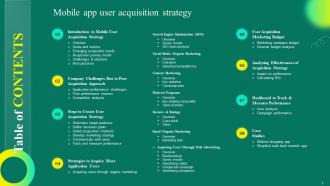
Slide 3: This slide exhibit table of content.
Slide 4: This slide showcase table of content that is to be discuss further.
Slide 5: The Following slide covers brief overview of user acquisition strategy that helps to increase application's customer base.
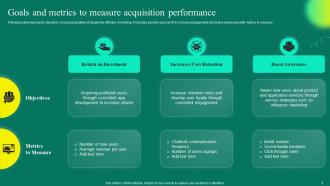
Slide 6: The following slide represents objectives of using acquisition strategies for effective marketing.
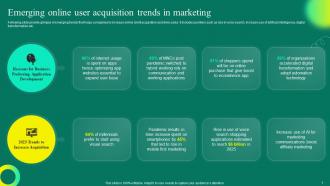
Slide 7: The following slide provide glimpse of emerging trends that helps companies to increase online client acquisition and drive sales.
Slide 8: Following slide exhibits funnel that defines series of user journey while operating application.
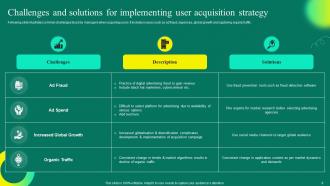
Slide 9: The following slide illustrates common challenges faced by managers when acquiring users.
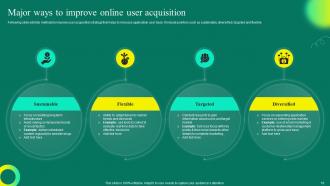
Slide 10: The following slide exhibits methods to improve user acquisition strategy that helps to increase application user base.
Slide 11: This slide showcase table of content that is to be discuss further.
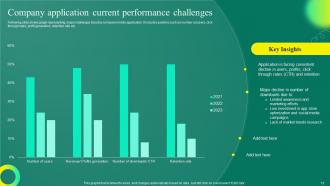
Slide 12: Following slide shows graph representing ,major challenges faced by company mobile application.
Slide 13: The following slide provide information about major reasons that results in application poor performance.
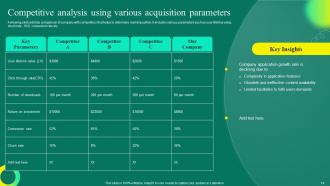
Slide 14: The following slide exhibits comparison of company with competitors that helps to determine market position.
Slide 15: This slide showcase table of content that is to be discuss further.
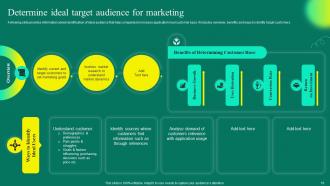
Slide 16: The following slide provides information about identification of ideal audience that help companies to increase application loyal customer base.
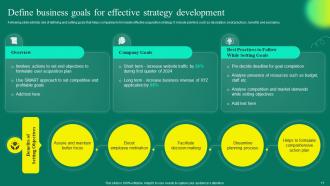
Slide 17: Following slide exhibits role of defining and setting goals that helps companies to formulate effective acquisition strategy.
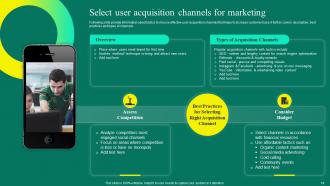
Slide 18: The following slide provide information about tactics to choose effective user acquisition channels that helps to increase customer base.
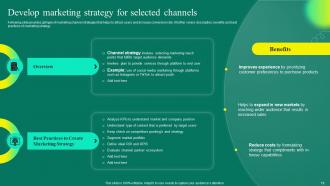
Slide 19: The following slide provides glimpse of marketing channel strategies that helps to attract users and increase conversion rate.
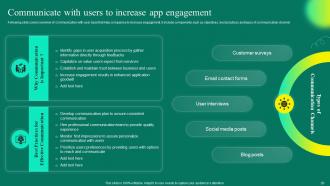
Slide 20: The following slide covers overview of communication with user base that help companies to increase engagement.
Slide 21: Following slide exhibits importance of tracking and measuring marketing strategy to assure sustainability in dynamic environment.
Slide 22: This slide showcase table of content that is to be discuss further.
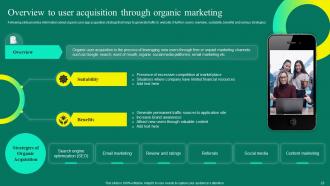
Slide 23: The following slide provides information about organic user app acquisition strategy that helps to generate traffic to website.
Slide 24: This slide showcase table of content that is to be discuss further.
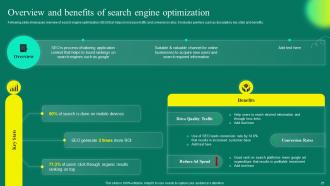
Slide 25: Following slide showcases overview of search engine optimization (SEO) that helps to increase traffic and conversion rates.
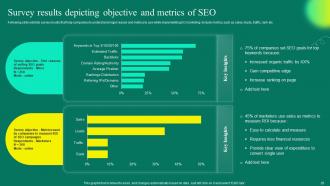
Slide 26: Following slide exhibits survey results that help companies to understand major reason and metrics to use while implementing EO marketing.
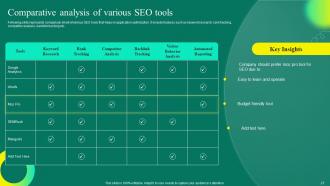
Slide 27: Following slide represents comparison sheet of various SEO tools that helps in application optimization.
Slide 28: This slide showcase table of content that is to be discuss further.
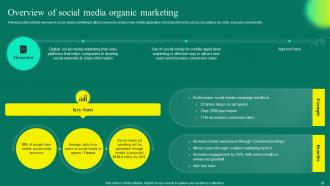
Slide 29: The following slide exhibits overview of social media marketing to attract new users and promote mobile application.
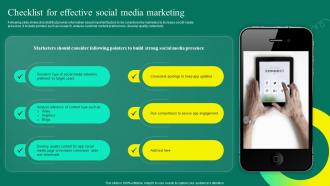
Slide 30: Following slide shows checklist that provide information about important factors to be considered by marketers to increase social media presence.
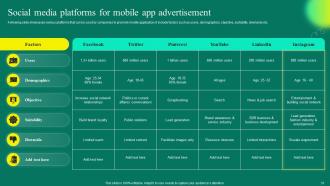
Slide 31: The following slide showcases various platforms that can be used by companies to promote mobile application.
Slide 32: This slide showcase table of content that is to be discuss further.
Slide 33: Following slide provide information about content marketing strategy to increase application organic traffic.
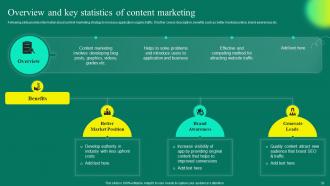
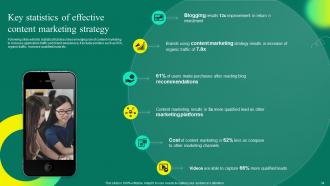
Slide 34: The following slide exhibits statistics that describes emerging role of content marketing to increase application traffic and brand awareness.
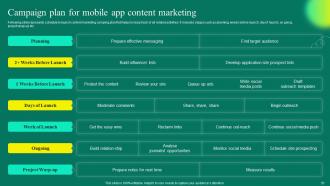
Slide 35: The following slide represents schedule to launch content marketing camping plan that helps to keep track of all related activities.
Slide 36: This slide showcase table of content that is to be discuss further.
Slide 37: Following slide exhibits overview of referrals marketing strategy that helps to generate goodwill and retain users.
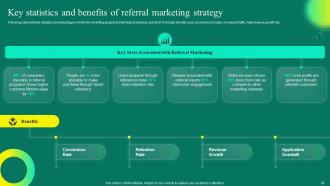
Slide 38: The following slide exhibits statistics and advantages of referral marketing programs that helps to develop user trust.
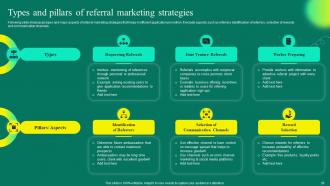
Slide 39: The following slide showcases types and major aspects of referral marketing strategies that helps in efficient application promotion.
Slide 40: This slide showcase table of content that is to be discuss further.
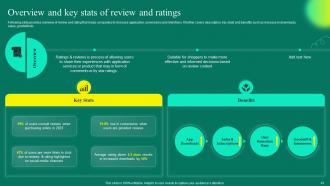
Slide 41: The following slide provides overview of review and rating that helps companies to increase application conversions and retentions.
Slide 42: Following slide showcases case study of banking app that uses review & rating strategy to increase application ranking and user base.
Slide 43: Following slide exhibits types of review questions that helps companies to increase mobile application user engagement.
Slide 45: Following slide exhibit overview of email marketing that increases application sign ups and number of downloads.
Slide 46: Following slide showcases email marketing campaign plan schedule that helps application marketers to increase conversion rates and brand awareness.
Slide 47: This slide showcase table of content that is to be discuss further.
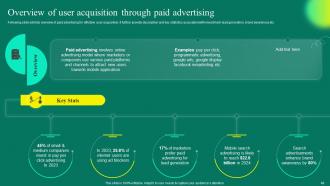
Slide 48: Following slide exhibits overview of paid advertising for effective user acquisition.
Slide 49: Following slide exhibits best practices of paid advertising to boost organic users and accelerate brand awareness.
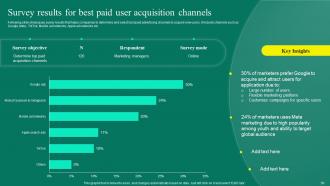
Slide 50: Following slide showcases survey results that helps companies to determine and select best paid advertising channels to acquire new users.
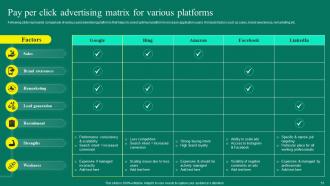
Slide 51: The following slide represents comparison of various paid advertising platforms that helps to select optimum platform to increase application users.
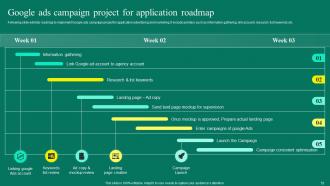
Slide 52: Following slide exhibits roadmap to implement Google ads campaign project for application advertising and marketing.
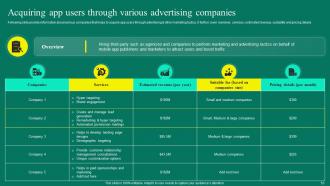
Slide 53: The following slide provide information about various companies that helps to acquire app users through advertising & other marketing tactics.
Slide 54: This slide showcase table of content that is to be discuss further.
Slide 55: Following slide exhibits budget allocation that helps to implement and manage various marketing strategies for user acquisition.
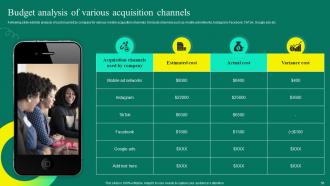
Slide 56: Following slide exhibits analysis of cost incurred by company for various mobile acquisition channels.
Slide 57: This slide showcase table of content that is to be discuss further.
Slide 58: Following slide exhibits impact of using user acquisition strategies for mobile application that results in revenue growth and high traffic.
Slide 59: The following slide showcases return on investment for various advertisement campaign implemented by company for better user acquisition.
Slide 60: This slide showcase table of content that is to be discuss further.
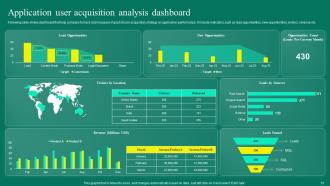
Slide 61: Following slide shows dashboard that help company to track and measure impact of user acquisition strategy on application performance.
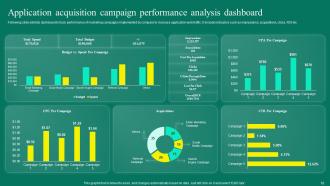
Slide 62: The following slide exhibits dashboard to track performance of marketing campaigns implemented by company to increase application web traffic.
Slide 63: This slide showcase table of content that is to be discuss further.
Slide 64: Following slide exhibits case study of apparel app that implements strategies to increase conversion rates.
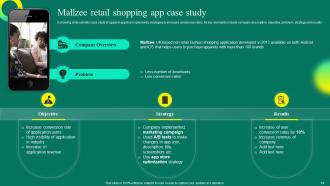
Slide 65: Following slide showcases case study of mobile shopping app that is able to reduce cost per install and increase users through effective strategies.
Slide 66: This is the icons slide.
Slide 67: This slide presents title for additional slides.
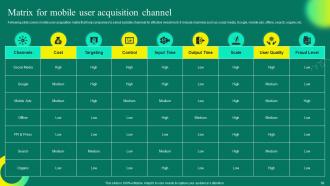
Slide 68: The following slide covers mobile user acquisition matrix that help companies to select suitable channels for effective investment.
Slide 69: The following slide shows comparison between customer and user acquisition. It include categories such as OTT, ecommerce, news , gaming etc.
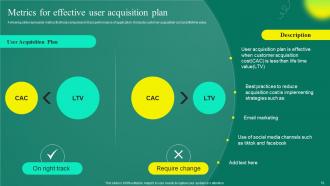
Slide 70: The following slide represents metrics that help companies to track performance of application.
Slide 71: Following slide shows checklist that can be used by companies to plan for user acquisition campaign.
Slide 72: This slide shows about your company, target audience and its client's values.
Slide 73: This slide presents your company's vision, mission and goals.
Slide 74: This slide exhibits ideas generated.
Slide 75: This slide depicts 30-60-90 days plan for projects.
Slide 76: This slide shows roadmap of company.
Slide 77: This slide shows puzzle for displaying elements of company.
Slide 78: This slide depicts posts for past experiences of clients.
Slide 79: This slide showcases financials of company.
Slide 80: This is thank you slide & contains contact details of company like office address, phone no., etc.
Mobile App User Acquisition Strategy Powerpoint Presentation Slides with all 85 slides:
Use our Mobile App User Acquisition Strategy Powerpoint Presentation Slides to effectively help you save your valuable time. They are readymade to fit into any presentation structure.






































FAQs for Mobile App User Acquisition Strategy
Key metrics during mobile app user acquisition include cost per install (CPI), user lifetime value (LTV), retention rates, conversion rates from install to active user, and return on ad spend (ROAS). These metrics enable marketers to optimize campaign performance, identify high-value user segments, and allocate budgets strategically, with many app developers finding that tracking LTV-to-CPI ratios ultimately delivers sustainable growth and competitive advantage.
Social media platforms enable effective user acquisition through targeted advertising, influencer partnerships, organic content marketing, community building, and viral campaign strategies. These approaches streamline customer reach by leveraging demographic data, social proof mechanisms, and engagement analytics, with many app developers finding that strategic cross-platform campaigns ultimately deliver higher conversion rates and reduced acquisition costs.
Target audience segmentation enables precise user acquisition by identifying specific demographics, behaviors, interests, and usage patterns that align with your app's value proposition. Through segmented campaigns, mobile app marketers can craft personalized messaging, optimize ad spend across relevant channels, and deliver targeted experiences that resonate with distinct user groups, ultimately increasing conversion rates and reducing acquisition costs while building a more engaged, long-term user base.
Influencers enhance mobile app user acquisition by providing authentic product demonstrations, accessing targeted audience segments, and creating engaging content that drives organic downloads. Through strategic partnerships with niche influencers, app developers can leverage trusted voices to showcase app functionality, generate user-generated content, and achieve higher conversion rates than traditional advertising, ultimately delivering cost-effective growth and improved user engagement.
The most effective paid advertising channels for mobile app user acquisition include Facebook Ads, Google Ads, Apple Search Ads, TikTok Ads, and programmatic networks like Unity Ads. These platforms streamline targeting through advanced algorithms, demographic precision, and behavioral data analysis, with many app developers finding that strategic combination across channels delivers lower acquisition costs, higher-quality users, and ultimately enhanced ROI in increasingly competitive mobile markets.
App store optimization significantly enhances user acquisition by improving app visibility through strategic keyword optimization, compelling descriptions, high-quality screenshots, and positive review management. Through effective ASO, mobile apps can achieve higher search rankings and conversion rates, with many developers finding that optimized listings deliver 30-50% increases in organic downloads, ultimately reducing customer acquisition costs while expanding market reach.
Best practices for compelling mobile app ad creatives include showcasing actual gameplay or app functionality, using clear value propositions, incorporating eye-catching visuals with minimal text, and creating urgency through limited-time offers. These approaches enhance user engagement by demonstrating real benefits, reducing cognitive load, and driving immediate action, with many app marketers finding that authentic, benefit-focused creatives deliver significantly higher conversion rates and lower acquisition costs.
Referral programs drive organic acquisition by incentivizing existing users to share apps through rewards, social sharing features, and personalized referral codes. These programs leverage trusted relationships and word-of-mouth marketing, with companies like Dropbox and Uber finding that referred users demonstrate higher retention rates, lower acquisition costs, and increased lifetime value, ultimately delivering sustainable growth through authentic user advocacy.
A strong landing page serves as the critical conversion bridge between marketing campaigns and app downloads, directly impacting user acquisition costs and conversion rates. It enhances user trust through clear value propositions, reduces friction with streamlined messaging, and enables precise A/B testing, with many mobile apps finding that optimized landing pages increase conversion rates by 20-40% while significantly lowering customer acquisition costs.
User retention strategies complement acquisition by creating sustainable growth loops through enhanced onboarding experiences, personalized engagement campaigns, and loyalty programs that reduce churn rates. These approaches work synergistically with acquisition efforts, as retained users generate higher lifetime value, provide valuable referrals, and create positive app store reviews, ultimately reducing acquisition costs while maximizing initial investment returns.
Budget considerations for user acquisition include cost-per-acquisition targets, lifetime value calculations, channel-specific spending allocation, seasonal campaign adjustments, and competitive bidding reserves. Strategic budget distribution across organic and paid channels enables companies to optimize acquisition costs while maintaining growth momentum, with many mobile businesses finding that diversified spending approaches deliver sustained user growth and improved return on advertising investment.
iOS and Android platforms require distinct acquisition approaches due to different user behaviors, demographics, and monetization patterns. iOS users typically demonstrate higher spending power and in-app purchase rates, making premium positioning effective, while Android's broader global reach and price-sensitive user base often benefits from freemium models and localized campaigns, ultimately enabling businesses to optimize their acquisition investments across diverse market segments.
User acquisition tracking tools include attribution platforms like Adjust and AppsFlyer, analytics solutions such as Google Analytics and Mixpanel, ad management systems, A/B testing frameworks, and cohort analysis software. These technologies streamline campaign optimization by providing real-time performance insights, automating bid adjustments, and enabling precise audience targeting, with many mobile app companies finding that integrated tracking delivers significantly improved ROI and user lifetime value.
Partnerships enhance user acquisition through cross-promotion opportunities, shared user bases, referral programs, and integrated marketing campaigns that expand reach beyond organic channels. These strategic collaborations enable apps to access complementary audiences, reduce acquisition costs through shared marketing expenses, and build credibility through trusted brand associations, ultimately delivering faster growth and higher-quality users.
A/B testing provides insights into conversion rates, user engagement patterns, creative performance, audience targeting effectiveness, and cost per acquisition optimization across different campaigns. Through systematic testing of ad creatives, landing pages, and targeting parameters, companies can identify high-performing combinations, reduce acquisition costs, and improve user quality, ultimately delivering more efficient campaigns and better return on advertising spend.
-
Loved the fact that SlideTeam provides clean, high-definition, and professional PowerPoint products.
-
“Superb. What a great finding. Thankful for SlideTeam. We were paying people to make slides which went all in vain. We are so happy to have found you.”