


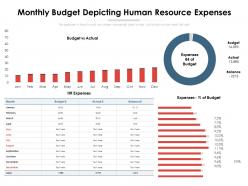
Monthly budget depicting human resource expenses





Try Before you Buy Download Free Sample Product
 Impress Your
 Audience
 100%
100% Editable
 Save Hours
 of Time


Our Monthly Budget Depicting Human Resource Expenses are explicit and effective. They combine clarity and concise expression.
People who downloaded this PowerPoint presentation also viewed the following :
Monthly budget depicting human resource expenses with all 2 slides:
Give your audience a fulfilling experience. They will find our Monthly Budget Depicting Human Resource Expenses elevating.

FAQs for Monthly budget depicting
Human resource expenses include salaries and wages, employee benefits, payroll taxes, training and development costs, and recruitment expenses. These components collectively represent an organization's investment in talent acquisition and retention, with many companies finding that strategic HR spending enhances productivity, reduces turnover, and ultimately delivers competitive advantage through stronger workforce capabilities.
Variable human resource expenses fluctuate based on business activity and include overtime pay, temporary staffing, performance bonuses, and commission-based compensation. Fixed HR expenses remain constant regardless of operational changes, such as base salaries, benefits premiums, and core administrative costs, with many organizations finding that balancing both enables greater workforce flexibility while maintaining operational stability.
Employee training and development represents a significant HR expense that includes program design, delivery costs, materials, external trainers, and employee time away from productive work. While these investments require substantial upfront costs, they ultimately deliver enhanced productivity, reduced turnover, improved employee satisfaction, and stronger competitive positioning, with many organizations finding that comprehensive development programs generate measurable returns through increased efficiency and retention.
Organizations can effectively budget for HR expenses by analyzing historical payroll data, forecasting headcount growth, accounting for benefits inflation, and incorporating recruitment costs, training investments, and compliance requirements. Through strategic workforce planning and regular budget reviews, companies streamline resource allocation while maintaining competitive compensation packages, ultimately delivering cost predictability and enhanced talent retention in an increasingly competitive market.
Investing in employee wellness programs delivers reduced healthcare premiums, lower absenteeism rates, decreased turnover costs, improved productivity metrics, and minimized workers' compensation claims. These strategic initiatives streamline HR expenses by enhancing employee retention, reducing recruitment costs, and boosting operational efficiency, with many organizations finding that comprehensive wellness programs ultimately generate significant cost savings while strengthening competitive advantage.
Benefits and compensation typically represent 60-80% of total human resource expenses, directly impacting organizational budgets through salary costs, health insurance, retirement contributions, and performance bonuses. Strategic compensation packages help companies attract top talent while controlling costs, with many organizations finding that competitive benefits reduce turnover expenses and ultimately deliver better ROI than frequent recruiting.
Cost reduction strategies include automating routine HR processes, implementing self-service employee portals, leveraging data analytics for workforce planning, outsourcing non-core functions, and adopting flexible work arrangements. These approaches streamline operations by minimizing administrative overhead, reducing recruitment expenses, and optimizing resource allocation, with many organizations finding that strategic automation and analytics ultimately deliver significant savings while enhancing employee experiences.
Technology integration significantly reduces human resource expenses by automating routine tasks, streamlining recruitment processes, and minimizing manual administrative work. Through AI-powered systems and digital platforms, organizations enhance payroll accuracy, accelerate candidate screening, and optimize resource allocation, with many companies finding that strategic HR technology delivers cost savings while improving employee experiences and operational efficiency.
Hidden costs associated with employee turnover include recruitment advertising, interviewer time allocation, onboarding training expenses, productivity loss during transition periods, and knowledge transfer disruptions. These often-overlooked expenses can represent 50-150% of an employee's annual salary, with many organizations finding that strategic retention initiatives, enhanced workplace culture, and competitive compensation packages ultimately deliver significant cost savings and improved operational continuity.
Companies can measure HR ROI through metrics like revenue per employee, turnover costs, time-to-fill positions, training effectiveness scores, and employee productivity improvements. By tracking these indicators alongside engagement surveys and performance data, organizations streamline talent management decisions, reduce hiring costs, and ultimately enhance operational efficiency while delivering measurable competitive advantages.
Compliance with labor laws affects human resource expenses through mandatory wage requirements, overtime regulations, benefits administration, payroll taxes, and workplace safety investments. While these compliance costs can significantly increase operational expenses, they also streamline HR processes, reduce legal risks, and enhance employee retention, with many organizations finding that proactive compliance ultimately delivers cost savings and competitive advantage.
Larger organizations typically face higher absolute HR costs but achieve lower per-employee expenses through economies of scale, centralized systems, and shared resources across departments. While smaller companies may spend proportionally more on recruitment, training, and compliance per person, enterprise-level organizations streamline operations through automation and strategic resource allocation, ultimately delivering cost efficiencies that enhance their competitive advantage in talent management.
Remote work technology investments, flexible benefits packages, mental health support programs, skills development initiatives, and enhanced recruitment costs are reshaping HR expenses post-pandemic. Organizations are reallocating budgets from traditional office overhead to digital infrastructure, employee wellness, and competitive compensation packages, with many companies finding that strategic investment in hybrid work capabilities and talent retention ultimately delivers improved productivity and reduced turnover costs.
Organizations can balance HR expenses while maintaining positive culture by prioritizing strategic investments in employee development, implementing cost-effective recognition programs, and leveraging technology to streamline administrative processes. Through flexible work arrangements, peer-to-peer feedback systems, and targeted wellness initiatives, companies enhance employee satisfaction while optimizing costs, with many finding that strategic HR spending ultimately delivers higher retention rates and improved productivity.
Key metrics for analyzing HR spending efficiency include cost-per-hire, employee turnover rate, revenue per employee, training ROI, and time-to-productivity ratios. These metrics enable organizations to streamline recruitment processes, enhance retention strategies, and optimize workforce investments, with many companies finding that strategic HR analytics ultimately delivers improved operational efficiency and competitive advantage.
No Reviews