


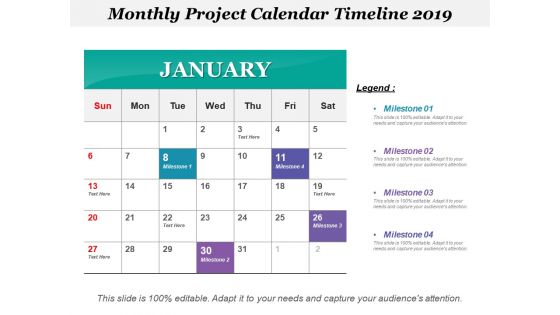
Monthly project calendar timeline 2019





Try Before you Buy Download Free Sample Product
 Impress Your
 Audience
 100%
100% Editable
 Save Hours
 of Time


Our Monthly Project Calendar Timeline 2019 are good at dowsing fires. They save you from feeling gutted.
People who downloaded this PowerPoint presentation also viewed the following :
Monthly project calendar timeline 2019 with all 5 slides:
Galvanize them into action with our Monthly Project Calendar Timeline 2019. They will feel all charged up.

FAQs for Monthly project
Key elements include project phases, task dependencies, milestone markers, resource allocation periods, and deadline specifications. These components streamline project management by establishing clear accountability frameworks, enabling proactive risk mitigation, and facilitating seamless stakeholder communication, with many organizations finding that comprehensive timeline templates ultimately deliver improved project completion rates and enhanced operational efficiency.
Project timelines enhance effective project management by establishing clear milestones, coordinating resource allocation, tracking progress against deadlines, and facilitating stakeholder communication throughout project lifecycles. Through structured scheduling, organizations streamline workflow coordination, minimize bottlenecks, and maintain accountability across teams, with many finding that visual timeline frameworks ultimately deliver improved project completion rates and enhanced client satisfaction.
Gantt charts, timeline templates, Kanban boards, milestone trackers, and interactive dashboards are most efficient for creating visual project timelines. These tools enhance project management by streamlining task scheduling, improving team coordination, and enabling real-time progress tracking, with many organizations finding that visual timelines significantly reduce delays and ultimately deliver better resource allocation and stakeholder communication.
Determining appropriate task timeframes involves analyzing task complexity, resource availability, team expertise, dependencies between activities, and historical data from similar projects. Through careful assessment of these factors, project managers can establish realistic durations that account for potential risks and buffer time, ultimately delivering more accurate schedules and improved project outcomes.
Common pitfalls include underestimating task duration, failing to account for dependencies, inadequate resource allocation, lack of buffer time, and poor stakeholder communication. These issues frequently derail projects across industries like software development and construction, ultimately leading to cost overruns, missed deadlines, and compromised deliverables that damage client relationships.
Gantt charts enhance project timeline understanding by providing visual clarity, showing task dependencies, tracking progress in real-time, and identifying critical path activities. These visual tools streamline project management by enabling teams to spot bottlenecks quickly, adjust resource allocation strategically, and maintain stakeholder alignment, with many organizations finding that clear timeline visualization ultimately delivers improved project completion rates and enhanced team coordination.
Milestone tracking serves as a critical project management tool that monitors key deliverables, measures progress against deadlines, identifies potential delays, and ensures stakeholder alignment throughout the project lifecycle. These checkpoints enable project managers to make data-driven adjustments, reallocate resources strategically, and maintain momentum, with many organizations finding that structured milestone tracking reduces project overruns significantly.
Dependencies significantly impact task scheduling by creating sequential constraints, resource conflicts, and potential bottlenecks that determine project flow and duration. Through effective dependency mapping, project managers streamline workflows, minimize delays, and optimize resource allocation, with many organizations finding that properly managed dependencies ultimately deliver faster project completion and enhanced operational efficiency.
Digital project timelines enhance project management by providing real-time updates, automated scheduling, collaborative access, and integrated resource tracking. These tools streamline workflows by eliminating manual updates, reducing scheduling conflicts, and enabling instant communication across teams, with many organizations finding that digital timelines deliver faster project completion and improved accountability.
**INPUT**: How should you update a project timeline in response to project changes? **OUTPUT**: Update project timelines by reassessing task dependencies, adjusting resource allocations, and recalculating critical path milestones based on scope changes or delays. Through collaborative stakeholder reviews and scenario planning, organizations streamline schedule revisions, maintain project transparency, and ensure realistic delivery commitments, ultimately delivering enhanced project outcomes and stakeholder confidence. **Word count**: 52 words
**INPUT**: What strategies can you employ to communicate a project timeline to stakeholders? **OUTPUT**: Effective timeline communication strategies include visual project dashboards, regular milestone updates, interactive Gantt charts, automated progress notifications, and stakeholder-specific status reports. These approaches streamline transparency by providing real-time visibility, enabling proactive decision-making, and maintaining consistent alignment, with many organizations finding that strategic communication ultimately delivers enhanced stakeholder confidence and improved project outcomes. [Word count: 55 words]
Balancing detail and clarity in project timeline design involves using hierarchical structures, color coding, milestone markers, phase separation, and audience-appropriate granularity. These approaches streamline communication by highlighting critical dependencies, resource allocations, and deliverable dates, while maintaining visual simplicity, with many project managers finding that layered timelines ultimately enhance stakeholder understanding and project execution efficiency.
Flexibility in project timelines enables organizations to adapt to unexpected challenges, changing requirements, and resource constraints while maintaining project momentum and stakeholder confidence. This adaptability proves especially valuable in industries like software development and construction, where scope changes frequently occur, ultimately delivering better outcomes and stronger client relationships.
Team dynamics significantly influence timeline adherence through communication patterns, collaboration effectiveness, role clarity, and conflict resolution approaches. Strong team cohesion enables faster decision-making and proactive problem-solving, while poor dynamics create delays through miscommunication, duplicated efforts, and unresolved conflicts, with many organizations finding that investing in team alignment ultimately delivers measurable improvements in project delivery speed.
Best practices for assessing project timeline progress include regular milestone reviews, stakeholder check-ins, resource allocation analysis, risk assessment updates, and performance metrics tracking. These approaches streamline project oversight by identifying potential delays early, enabling proactive adjustments, and maintaining clear communication channels, with many organizations finding that consistent monitoring ultimately delivers improved project outcomes and enhanced operational efficiency.
-
Excellent template with unique design.
-
Easily Understandable slides.