


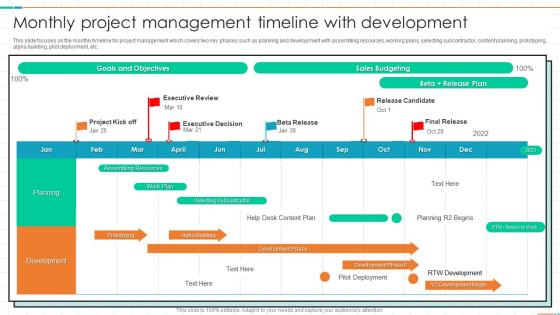
Monthly Project Management Timeline With Development




Try Before you Buy Download Free Sample Product
 Impress Your
 Audience
 100%
100% Editable
 Save Hours
 of Time


This slide focuses on the monthly timeline for project management which covers two key phases such as planning and development with assembling resources, working plans, selecting subcontractor, content planning, prototyping, alpha building, pilot deployment, etc.
People who downloaded this PowerPoint presentation also viewed the following :
Monthly Project Management Timeline With Development with all 6 slides:
Use our Monthly Project Management Timeline With Development to effectively help you save your valuable time. They are readymade to fit into any presentation structure.





FAQs for Monthly Project Management
So basically you need five main phases for your timeline. First is initiation - that's defining scope and getting everyone on board. Then planning, which is honestly where most projects succeed or fail because you're mapping everything out, allocating resources, assessing risks. The execution phase is where your team actually does the work and delivers stuff. You'll be monitoring throughout execution too, tracking how things are going and tweaking as needed. Closure wraps it all up with final deliverables and documenting what you learned. Oh, and definitely tailor these phases to fit your specific project first.
Dude, Gantt charts are game-changers for project planning. Think of them as turning your messy task list into actual visual bars on a timeline. Dependencies jump out immediately - no more guessing what blocks what. I used to hate them honestly, thought they were just extra work, but now I'm obsessed. Bottlenecks become obvious before they wreck your schedule. Plus your boss can finally see why things take as long as they do instead of asking "can't we just do everything faster?" Build one next time and you'll get it.
Honestly? Microsoft Project's solid if you need all the Gantt chart bells and whistles, but it can be a total pain sometimes. Asana's probably your sweet spot - decent timeline views, handles dependencies without being crazy complicated. Your team will actually use it too, which matters more than you'd think. Trello works fine for basic stuff if you add some power-ups. But here's the thing - whatever tool your people will consistently open is better than the "perfect" one they'll ignore. You can always level up later when things get messier.
So scope creep basically happens when stakeholders keep piling on "just one more feature" and suddenly your 2-week project becomes a month-long nightmare. First thing - nail down requirements upfront and document everything, even the obvious stuff. Then set up some kind of change process where new requests actually get reviewed instead of just dumped on you. Honestly, the hardest part is learning to push back without feeling like a jerk. When someone asks for additions, just walk them through how it'll affect the timeline. Trust me, saying no early beats explaining why you're three weeks late.
Focus on the big stuff first - kickoff, major deadlines, stakeholder reviews, and your final due date. Always build in extra time around reviews because people are slow with feedback (trust me on this one). Map out any external dependencies that could mess you up too. Oh, and don't skip testing phases if you need them - that's where projects usually go sideways. I like to get all the major milestones down first, then worry about the smaller tasks. Way less stressful than trying to plan everything at once.
Break everything down into bite-sized pieces first. Get your team involved in the guessing game - they know way more than you think and catch stuff you'll miss. Three-point estimation works great: best case, worst case, realistic case. Always pad your timeline because Murphy's law is real, especially on Tuesdays for some reason. Track what actually happens vs what you predicted so you're not just shooting in the dark forever. Oh, and document this stuff now or you'll hate yourself later when you're staring at a blank timeline wondering how long anything takes.
Dude, I can't stress this enough - talk to your stakeholders constantly or you're screwed. Nothing kills timelines like someone popping up halfway through saying "actually, we need it to do THIS instead." Regular updates are your best friend here. Flag issues early so people can make decisions fast. Here's the thing though - stakeholders are surprisingly chill about delays when they see them coming. It's the surprise ones that make them lose their minds. I watched a whole project implode once because the PM didn't tell the client about a two-week slip until the day before launch. Just brutal.
Dude, integration is seriously worth it. You get one place where all your timeline stuff lives instead of bouncing between random spreadsheets. Real-time updates mean you can actually see what everyone's doing and where things are getting stuck. Honestly, teams resist it at first but then wonder how they survived without it. No more of those painful status check meetings either - the automation handles most updates automatically. You'll catch problems way earlier and can shift people around when needed. Oh, and start small with just your main tools. Don't go crazy trying to connect everything right away.
Oh man, the classic mistakes? Don't pack your timeline too tight - Murphy's Law hits HARD in project management. Most people totally underestimate how long stuff actually takes. Also, you've gotta map out which tasks depend on others first, before setting any dates. Everyone forgets about buffer time for reviews and approvals (and scope creep, ugh). Plus team availability gets messy with holidays and competing projects. Honestly, I learned this the hard way - just add 20% padding to whatever you think it'll take.
Okay so first thing - don't freak out and start adding extra time to everything. That's honestly how projects get completely out of hand. Look at what's actually broken on your critical path before you touch any timelines. Figure out which tasks are really screwed vs just inconvenienced. Then see if you can run stuff in parallel or maybe cut some nice-to-have features. I'd tell your stakeholders what's up ASAP with solid reasons for any changes. Work backwards from realistic new milestones instead of just winging it. Being upfront about problems beats scrambling later every time.
Honestly, three things have saved my butt: regular team check-ins, staying on top of risks, and being flexible with resources. Do weekly status meetings - they catch problems early. I ignored this once and paid for it later lol. Keep watching your critical path and always have backup plans ready. When stuff gets stuck, move people around or cut scope instead of pushing deadlines. Daily standups are actually amazing for seeing what's coming. The whole point is getting ahead of issues rather than scrambling when things blow up.
So agile basically throws out that whole "plan everything for 6 months" approach. Instead you work in these 2-4 week chunks called sprints. Way less overwhelming honestly. Your timeline stays flexible so when things change (and they always do), you're not scrambling to rewrite some massive project plan. The weird part at first is not knowing exactly what you'll be doing in month 3, but you get used to it. Just figure out what makes sense for your first sprint and go from there. Everything builds on itself.
Ugh, resource allocation will totally mess with your timelines if you're not careful. Seriously, it's like the
-
Delighted to see unique and eye-catching PowerPoint designs that are so easy to customize.
-
Their professional templates are very impressive, even my manager was curious about the source. I am very grateful.