


MOOCs For Digital Transformation Of Education Industry Training Ppt




Try Before you Buy Download Free Sample Product
 Impress Your
 Audience
 100%
100% Editable
 Save Hours
 of Time


This set of slides in detail covers the role of MOOCs Massive Open Online Courses in the digital transformation of the education sector.
People who downloaded this PowerPoint presentation also viewed the following :
Content of this Powerpoint Presentation
Slide 1
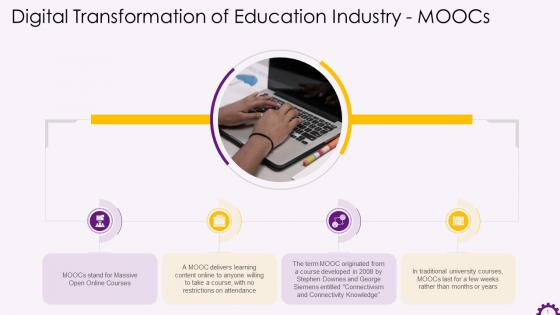
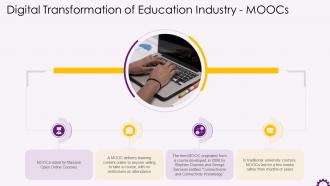
This slide explains the concept of MOOCs in digitalization of education. It states that MOOCs stand for massive open online courses, which deliver learning content online to anyone willing to take a course, with no restrictions on attendance.
Slide 2
This slide mentions the USP of MOOCs in education. It states facts like MOOCs deliver education in a modern video format, offer openly accessible learning resources, encourage online interactions between teachers and learners, and conduct regular online tests with certifications.
Slide 3
This slide mentions various providers of MOOCs worldwide. The most common providers of MOOCs are Coursera, EdX, Udacity, and Udemy.
MOOCs For Digital Transformation Of Education Industry Training Ppt with all 19 slides:
Use our MOOCs For Digital Transformation Of Education Industry Training Ppt to effectively help you save your valuable time. They are readymade to fit into any presentation structure.











FAQs for MOOCs For Digital Transformation Of Education
Honestly, the cost thing is huge - most are free or super cheap compared to regular classes. You can learn whenever works for you, which is clutch if you've got a busy schedule. What's wild is getting access to professors from like Harvard or MIT that you'd never meet otherwise. The communities are pretty awesome too - I've seen people discussing stuff with learners from literally everywhere. Sometimes I get distracted reading all the different perspectives, but whatever. You can zip through easy parts or take forever on hard concepts. Definitely try a free one first though - the format isn't for everyone.
So basically, MOOCs totally remove the usual roadblocks to education. No visa hassles, no crazy tuition fees, no moving across the country for classes. Most let you learn at your own pace too. I actually took a coding course during my lunch breaks last year - worked perfectly. The mobile apps make it super convenient, and lots have subtitles if English isn't your thing. What's cool is you'll find everyone from farmers in small towns to 70-year-olds learning photography. It really shows how many people want to learn but just can't access traditional schools.
Dude, seriously - jump into those discussion forums if you want to actually finish your MOOC. I know it feels weird at first, but engaging with other students makes such a huge difference. You'll understand stuff way better when you see different perspectives, plus the peer feedback is clutch for concepts that didn't click during lectures. Honestly, just watching videos by yourself gets boring fast (learned that the hard way lol). Courses with active forums have way higher completion rates. Even if you just reply to a few posts each week, you're golden. Trust me on this one.
Honestly, interactive stuff is where it's at for keeping people engaged. Weekly discussion questions work way better than just posting lectures and hoping for the best. Break videos into short chunks - like seriously, nobody's watching hour-long content anymore. I'd definitely try some gamification if possible, badges and progress bars are surprisingly motivating. Live Q&As are gold if you can manage them, even just 20 minutes weekly. Peer assessments where students review each other's work creates natural interaction too. The main thing is being visible in forums and giving actual personalized feedback, not generic responses.
Honestly, most people bail on MOOCs because they treat them like optional Netflix binges. Bad move. Pick a daily time slot - even 20 minutes works - and actually stick to it. Forums help tons since you're not suffering alone (misery loves company and all that). Break everything into tiny wins instead of waiting forever to feel accomplished. Here's the real game-changer though: immediately connect what you're learning to your actual job or goals. When I can see why I need this stuff, suddenly those dry lecture videos don't make me want to throw my laptop out the window. Apply concepts right away instead of just watching passively.
Look at completion rates first - that's your baseline. Assessment scores and engagement stuff like how long people actually watch videos matter too. Post-course surveys tell you if they retained anything, which is kinda the whole point. Certificate earnings are easy to track, but honestly the career outcome data is usually pretty sketchy. Discussion forums and assignment submissions are goldmines though - people who participate there tend to actually learn. Don't just rely on numbers. Combine the data with real feedback from students to see what's actually happening.
Honestly, MOOCs are pretty decent at adapting to different learning styles. There's videos, transcripts, quizzes, discussion boards - basically covers visual, auditory, and hands-on learners. You can replay stuff as much as you want, which literally saved my butt in that data science course I took. The discussion forums are clutch too because other people ask questions you didn't even think of. Oh, and don't just binge-watch all the videos like I did at first. Actually try the different features early on to figure out what works for your brain.
So first things first - get a decent camera, good lighting, and clear audio. That stuff's not optional. For screen recording, try Camtasia or OBS (honestly, OBS is free and works great). You'll need an LMS too - Moodle or Canvas are solid choices for managing everything. Basic video editing makes such a difference, even if you're not going fancy with it. Grab some interactive tools like H5P for quizzes. Oh, and analytics help track how people are doing. My advice? Start simple with the essentials, then build up from there.
Yeah, MOOCs totally work in formal education if you set them up right. Universities are already doing this - using them for prereqs or partnering with Coursera for actual credit. Blended models work well too, where you mix the online content with real classroom discussions. Honestly though, completion rates are pretty terrible, so you'll want solid assessment and faculty involvement to keep standards up. Quality control becomes huge when students are basically teaching themselves half the time. I'd say try a pilot course first and see how your students handle it before going all-in.
Honestly, the scale thing hits you first - keeping thousands of people engaged when you can't interact directly is wild. Dropout rates are absolutely brutal and will mess with your head. You're creating content for people with totally different backgrounds and learning styles, which is harder than it sounds. Technical problems never stop coming either. Assessment becomes this whole nightmare when you're dealing with that many students. My take? Don't go big right away. Build community features early - like, day one early. Oh and prep different content formats because people learn so differently it's not even funny.
Honestly, MOOCs are pretty solid for closing skills gaps. Companies like Google and IBM create courses for stuff they actually need filled - data analysis, digital marketing, project management, whatever. Way faster updates than regular schools too. The best part? You can do them while keeping your current job since they're mostly self-paced. I'd start by looking at job postings for roles you want and see what skills keep popping up. Then just search for those specific courses. It beats learning random outdated stuff that won't help you anyway.
Honestly, MOOCs are getting way better these days. They're ditching those marathon lecture videos (thank god) for shorter, skill-focused stuff you can actually use at work. Tech and data science courses are everywhere now, plus tons of professional certifications. The cool part? Most platforms now do live cohorts where you learn with other people, work on real projects together. Way more interactive than before. If you're gonna pick one, definitely go for something with hands-on projects and a community aspect. Those are the ones people actually finish - I learned that the hard way after abandoning like three courses last year.
MOOCs can totally help your career, but honestly it varies by company. Tech firms and startups are way more into them than old-school corporations. I know people who got hired just from showing Coursera certificates. Pick courses from good universities though - random platforms won't impress anyone. The real trick? Actually learn the stuff, don't just hoard certificates. You need to talk about specific projects you built or skills you picked up. Oh and definitely add them to LinkedIn, but be ready to explain why they matter for whatever job you're after.
Honestly, MOOCs have some sketchy ethical stuff going on. Yeah they're "free" but you still need decent internet and loads of time - which kinda defeats the purpose for people who need education most. Course quality is all over the place since there's barely any oversight. Completion rates suck too, like really bad. Oh and don't forget these platforms are totally mining your data while you learn for "free." If you're thinking about using them for work stuff, stick with the ones that offer actual credentials. Just factor in how much time you'll actually need - it's way more than they advertise.
Oh man, cultural differences totally change how MOOCs work in different places. Some students love group projects while others want to work alone. Communication styles vary too - direct feedback vs. more subtle approaches. The hierarchy thing is interesting - certain cultures expect formal teacher-student relationships, others want everyone participating equally. Don't forget practical stuff like internet speeds and whether people mostly use phones (super common in developing areas). Language barriers are obvious but still trip people up. Honestly, if you don't research your audience's learning preferences first, engagement will probably tank. It's way more complex than most people think.
-
Topic best represented with attractive design.
-
They helped us design the pamphlets for our church’s food drive! The people loved the design, and I’m happy to say it was successful. Thank you, SlideTeam!