


Mortgage underwriting process flowchart ppt powerpoint presentation inspiration




Try Before you Buy Download Free Sample Product
 Impress Your
 Audience
 100%
100% Editable
 Save Hours
 of Time


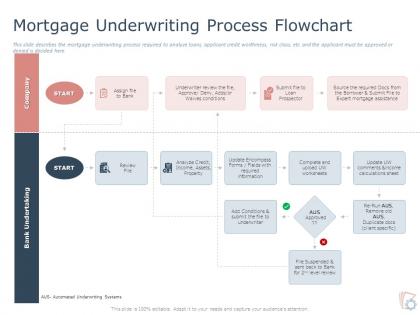
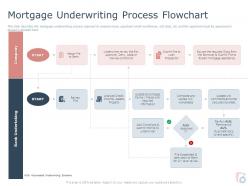
This slide describes the mortgage underwriting process required to analyze loans applicant credit worthiness risk class etc. and the applicant must be approved or denied is decided here.
People who downloaded this PowerPoint presentation also viewed the following :
Mortgage underwriting process flowchart ppt powerpoint presentation inspiration with all 2 slides:
Use our Mortgage Underwriting Process Flowchart Ppt Powerpoint Presentation Inspiration to effectively help you save your valuable time. They are readymade to fit into any presentation structure.
FAQs for Mortgage underwriting process flowchart ppt
The key stages in mortgage underwriting include application review, income and employment verification, credit assessment, property appraisal, and final approval decision. These stages streamline loan processing by evaluating borrower creditworthiness, confirming asset documentation, and assessing collateral value, with many financial institutions finding that systematic workflows reduce approval times while maintaining rigorous risk management standards.
Conventional loans require higher credit scores, larger down payments, and stricter debt-to-income ratios, while FHA loans accept lower credit scores, smaller down payments, and more flexible qualification criteria. Through automated underwriting systems, banks streamline both processes, with conventional loans typically closing faster due to fewer regulatory requirements, while FHA loans provide broader accessibility, ultimately enabling lenders to serve diverse customer segments and expand market reach.
Credit scoring serves as a foundational risk assessment tool in underwriting, providing lenders with standardized metrics to evaluate borrower creditworthiness, payment history, and default probability. These scores streamline decision-making by enabling automated preliminary approvals, setting interest rate tiers, and flagging applications requiring manual review, with many financial institutions finding that combining credit scores with income verification and debt-to-income ratios delivers faster loan processing and more accurate risk pricing.
Common mortgage underwriting documents include income verification (pay stubs, tax returns, W-2s), employment letters, bank statements, credit reports, property appraisals, and asset documentation. These comprehensive financial records enable lenders to assess borrower creditworthiness, debt-to-income ratios, and property values, ultimately streamlining approval decisions while minimizing lending risks and ensuring regulatory compliance.
LTV ratios significantly impact underwriting by determining risk assessment levels, required documentation depth, interest rate pricing, and approval likelihood, with higher ratios typically triggering more stringent review processes. Lenders use these ratios to streamline decision-making workflows, with many financial institutions finding that lower LTV applications move through automated systems faster, ultimately delivering quicker approvals and enhanced operational efficiency.
Underwriters evaluate borrowers' financial stability through credit scores, debt-to-income ratios, employment history, income verification, assets and savings, and payment history patterns. These comprehensive assessments enable mortgage institutions to minimize risk while streamlining approval processes, with many lenders finding that automated underwriting systems enhance decision accuracy and reduce processing times significantly.
The mortgage underwriting process requires self-employed borrowers to provide additional documentation including tax returns, profit and loss statements, bank statements, and business licenses to verify income stability. Unlike traditional W-2 employees, self-employed applicants face longer verification periods and stricter debt-to-income calculations, with lenders often requiring two years of consistent business income before approval.
Technologies streamlining mortgage underwriting include artificial intelligence, machine learning algorithms, automated valuation models, optical character recognition, and blockchain verification systems. These digital solutions enhance efficiency by accelerating document processing, improving risk assessment accuracy, and reducing manual review time, with many lenders finding that automated systems deliver faster loan approvals and significantly lower operational costs.
**INPUT**: What are the most common reasons for mortgage application denials during underwriting? **OUTPUT**: Common mortgage denial reasons include insufficient income verification, poor credit history, high debt-to-income ratios, inadequate down payments, and employment instability. These factors significantly impact loan approval decisions, with many financial institutions finding that comprehensive pre-qualification processes and transparent communication help borrowers address deficiencies early, ultimately streamlining approvals and enhancing customer experiences. [Word count: 53 words]
Underwriters assess property value through professional appraisals, automated valuation models (AVMs), comparative market analysis, and property inspection reports to ensure the loan amount aligns with actual market worth. These comprehensive evaluation methods enable lenders to minimize risk, verify collateral adequacy, and make informed lending decisions, while protecting both borrower and institutional interests in an increasingly competitive mortgage landscape.
The debt-to-income ratio is a critical underwriting metric that measures a borrower's monthly debt obligations against their gross monthly income, helping lenders assess repayment capacity and default risk. This ratio enables financial institutions to streamline loan approval decisions, minimize lending risks, and ensure regulatory compliance, with most conventional loans requiring DTI ratios below 43% to qualify for favorable terms.
Interest rate changes significantly impact mortgage underwriting by altering debt-to-income ratio calculations, loan-to-value assessments, and borrower qualification thresholds. When rates rise, lenders typically tighten credit standards and require higher credit scores, while falling rates often streamline approvals and expand borrower pools, with many financial institutions finding that rate volatility necessitates more frequent policy adjustments and risk model updates.
Lenders can improve underwriting efficiency by implementing automated document verification, standardized risk assessment frameworks, integrated credit scoring systems, streamlined communication channels, and real-time application tracking. These practices significantly reduce processing times, minimize manual errors, and enhance decision accuracy, with many financial institutions finding that strategic automation delivers faster loan approvals while maintaining rigorous compliance standards.
Regulatory compliance significantly shapes mortgage underwriting by mandating comprehensive income verification, debt-to-income assessments, and anti-discrimination protocols throughout the approval process. These requirements ensure lenders follow standardized evaluation criteria, maintain detailed documentation trails, and implement fair lending practices, ultimately delivering greater transparency and consumer protection while streamlining institutional risk management across financial services organizations.
Automated underwriting revolutionizes modern mortgage lending by streamlining loan evaluations, reducing processing times from weeks to hours, and minimizing human error through algorithmic risk assessment. Through AI-powered systems, lenders enhance accuracy in creditworthiness analysis, accelerate approval decisions, and lower operational costs, while maintaining regulatory compliance, ultimately delivering faster customer experiences and competitive advantages in an increasingly digital marketplace.
-
The content is very helpful from business point of view.