


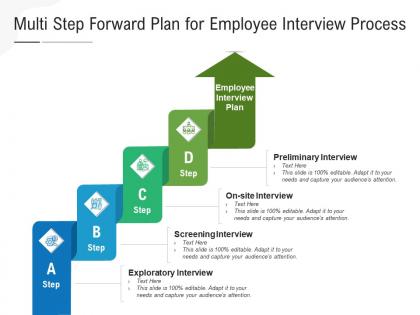
Multi step forward plan for employee interview process




Try Before you Buy Download Free Sample Product
 Impress Your
 Audience
 100%
100% Editable
 Save Hours
 of Time


Our Multi Step Forward Plan For Employee Interview Process are topically designed to provide an attractive backdrop to any subject. Use them to look like a presentation pro.
People who downloaded this PowerPoint presentation also viewed the following :
Multi step forward plan for employee interview process with all 2 slides:
Use our Multi Step Forward Plan For Employee Interview Process to effectively help you save your valuable time. They are readymade to fit into any presentation structure.
FAQs for Multi step forward plan for
Key qualities assessed during interviews include technical competency, communication skills, cultural fit, problem-solving ability, and adaptability to change. Through behavioral questions and scenario-based discussions, hiring managers evaluate candidates' collaboration skills, leadership potential, and alignment with organizational values, with many companies finding that comprehensive assessment approaches ultimately deliver stronger team performance and reduced turnover rates.
Structured interviews ensure consistency through standardized question sets, defined evaluation criteria, diverse interview panels, and documented scoring rubrics for each role. This systematic approach eliminates bias by providing equal assessment opportunities across candidates, with many organizations finding that structured processes reduce hiring time, improve candidate quality, and enhance legal compliance while delivering more accurate talent selection.
Company culture significantly influences interview questions by shaping inquiries about values alignment, work style preferences, team collaboration approaches, and behavioral scenarios that reflect organizational priorities. Questions often explore how candidates handle conflict, demonstrate core values, and adapt to company-specific environments, with many organizations finding that culture-focused interviews ultimately deliver better employee retention and stronger team cohesion.
Evaluating soft skills involves behavioral interview questions, role-playing scenarios, group discussions, situational judgment tests, and peer interaction assessments. These techniques enable recruiters to observe communication abilities, problem-solving approaches, and teamwork dynamics in real-time, with many organizations finding that structured behavioral assessments significantly enhance hiring accuracy and reduce employee turnover.
A diverse interview panel is crucial for reducing unconscious bias, bringing multiple perspectives to candidate evaluation, and ensuring fair assessment across different backgrounds and experiences. This approach enhances decision-making quality by incorporating varied viewpoints, helps identify the best talent more objectively, and demonstrates organizational commitment to inclusion, ultimately strengthening team dynamics and competitive advantage.
Effective bias reduction strategies include structured interviews with standardized questions, diverse interview panels, blind resume screening, behavioral-based questioning, and unconscious bias training for hiring managers. These approaches streamline evaluation consistency across candidates while enhancing objectivity, with many organizations finding that implementing multiple strategies simultaneously delivers more equitable hiring outcomes and ultimately stronger, more diverse teams.
Technical skills assessment works best through scenario-based questions, coding challenges, problem-solving exercises, system design discussions, and hands-on demonstrations of relevant tools or technologies. These approaches enable hiring managers to evaluate real-world application rather than memorized knowledge, with many organizations finding that practical assessments reveal candidates' actual capabilities, critical thinking abilities, and collaborative approaches to complex technical challenges.
When a candidate's experience doesn't align with their credentials, conduct deeper behavioral interviews focusing on specific examples, verify claims through detailed questioning, and assess transferable skills that demonstrate actual competency. Many organizations find that skills-based assessments, reference checks with former colleagues, and scenario-based evaluations reveal true capabilities beyond paper qualifications, ultimately delivering more accurate hiring decisions.
Behavioral interview questions assess candidates' past performance to predict future behavior, focusing on specific situations, actions taken, and measurable results achieved. They help organizations evaluate soft skills, cultural fit, and problem-solving abilities through structured STAR method inquiries, ultimately delivering more accurate hiring decisions and reducing turnover costs.
Assessing problem-solving abilities involves presenting hypothetical scenarios, case studies, behavioral questions about past challenges, and real-time problem-solving exercises relevant to the role. Through structured situational interviews, technical assessments, and collaborative problem-solving discussions, hiring managers can evaluate analytical thinking, creativity, and decision-making approaches, ultimately identifying candidates who deliver innovative solutions.
Remote interview methods include video conferencing platforms, structured behavioral questioning, virtual skills assessments, collaborative document reviews, and multi-stage panel discussions. These approaches enable organizations to evaluate candidates comprehensively through screen sharing, real-time problem-solving exercises, and team interaction simulations, ultimately delivering efficient hiring processes while maintaining assessment quality and candidate engagement.
Team members can participate through panel interviews, technical assessments, culture-fit evaluations, peer discussions, and follow-up feedback sessions. Their involvement delivers diverse perspectives on candidates' technical skills, team dynamics, and cultural alignment, while enhancing buy-in for hiring decisions, with many organizations finding that collaborative interviewing significantly improves retention rates and team cohesion.
Feedback serves as a critical mechanism for identifying bottlenecks, bias patterns, interviewer effectiveness gaps, and candidate experience pain points throughout your hiring workflow. Through systematic collection from candidates, hiring managers, and interviewers, organizations streamline their processes, enhance decision-making accuracy, and improve employer branding, ultimately delivering faster hiring cycles and better talent acquisition outcomes.
Interviews can be designed to reflect real-world scenarios through role-playing exercises, case study presentations, situational problem-solving tasks, and collaborative team simulations that mirror actual job responsibilities. These assessment methods enable organizations to evaluate candidates' practical skills, decision-making abilities, and cultural fit more effectively, with many companies finding that scenario-based interviews significantly improve hiring accuracy and reduce employee turnover.
Red flags include inconsistent information across responses, vague answers lacking specific examples, negative commentary about previous employers, gaps in employment without reasonable explanations, and responses that don't align with stated qualifications. These warning signs help hiring managers identify candidates who may struggle with accountability, professionalism, or cultural fit, ultimately enabling organizations to make more strategic hiring decisions and reduce costly turnover rates.
-
Easy to edit slides with easy to understand instructions.
-
Awesome use of colors and designs in product templates.
-
Presentation Design is very nice, good work with the content as well.
-
Topic best represented with attractive design.