


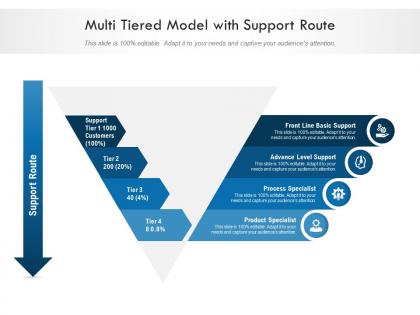
Multi tiered model with support route




Try Before you Buy Download Free Sample Product
 Impress Your
 Audience
 100%
100% Editable
 Save Hours
 of Time


Our Multi Tiered Model With Support Route are topically designed to provide an attractive backdrop to any subject. Use them to look like a presentation pro.
People who downloaded this PowerPoint presentation also viewed the following :
Multi tiered model with support route with all 2 slides:
Use our Multi Tiered Model With Support Route to effectively help you save your valuable time. They are readymade to fit into any presentation structure.
FAQs for Multi tiered model
Multi-tiered support models deliver faster resolution times, improved resource allocation, enhanced customer satisfaction, reduced operational costs, and better agent specialization across support levels. Organizations implementing these frameworks streamline issue escalation, optimize staffing efficiency, and enable specialized expertise application, with many companies finding that strategic tier separation ultimately enhances service quality while significantly reducing support expenses.
A multi-tiered support model improves customer satisfaction by routing inquiries to appropriate expertise levels, reducing resolution times, and ensuring complex issues receive specialized attention. This structured approach enables faster first-contact resolutions for basic queries, while escalating technical problems to expert agents, ultimately delivering more personalized service experiences and higher satisfaction rates across diverse customer needs.
Organizations face challenges including staff resistance to role changes, complex workflow redesigns, inconsistent service quality across tiers, and initial productivity dips during training periods. While implementing tiered structures requires significant coordination and resource allocation, many companies find that systematic change management, comprehensive staff training, and gradual rollout ultimately delivers improved efficiency and enhanced customer experiences.
Organizations can effectively train staff by implementing role-specific curricula, cross-functional shadowing programs, ongoing certification requirements, and escalation pathway simulations. Financial services and healthcare institutions find that combining technical skill development with customer service training, regular knowledge base updates, and tier-advancement mentorship programs significantly enhances support quality while reducing resolution times and improving customer satisfaction.
Key metrics for evaluating multi-tiered support effectiveness include first-call resolution rates, average response times, escalation rates, customer satisfaction scores, and cost per ticket. These metrics enable organizations to assess operational efficiency, identify bottlenecks between tiers, and optimize resource allocation, with many companies finding that tracking tier-specific performance ultimately delivers improved customer experiences and reduced support costs.
Technology streamlines multi-tiered support models by automating ticket routing, enabling seamless escalation workflows, and providing unified dashboards for tracking customer interactions across all support levels. Through AI-powered chatbots and knowledge management systems, organizations deliver faster initial responses, reduce agent workload, and maintain consistent service quality, ultimately enhancing customer satisfaction while optimizing operational costs.
Common pitfalls include unclear escalation criteria, inadequate tier-one training, poor knowledge transfer between levels, inconsistent communication protocols, and insufficient performance metrics tracking. These issues create customer frustration, longer resolution times, and operational inefficiencies, with many organizations finding that proper tier definition, comprehensive staff training, and seamless handoff processes ultimately deliver faster resolutions and enhanced customer satisfaction.
Organizations ensure seamless communication between support tiers through standardized ticketing systems, detailed escalation protocols, comprehensive knowledge bases, and regular cross-tier training sessions. These systems streamline information handoffs by maintaining complete case histories, establishing clear communication channels, and providing real-time updates, ultimately reducing resolution times and enhancing customer experiences across all service levels.
A multi-tiered support model significantly improves response times by routing issues to appropriate expertise levels, while enhancing resolution rates through specialized knowledge at each tier. Through strategic escalation pathways, organizations streamline customer interactions, reduce bottlenecks, and deliver faster first-contact resolutions, with many service providers finding that tier-based approaches ultimately boost customer satisfaction and operational efficiency.
Feedback loops can be integrated through automated ticket routing systems, real-time customer satisfaction surveys, agent performance analytics, escalation pattern tracking, and cross-tier knowledge sharing sessions. These mechanisms enable organizations to identify bottlenecks, optimize resource allocation, and enhance service quality across all support levels, with many companies finding that systematic feedback integration reduces resolution times while improving customer experiences and operational efficiency.
Self-service significantly reduces burden on higher support tiers by enabling customers to resolve common issues independently through knowledge bases, FAQs, chatbots, and automated troubleshooting tools. This strategic approach filters out routine inquiries before they reach human agents, allowing Tier 2 and Tier 3 specialists to focus on complex technical problems, ultimately delivering faster resolution times and improved resource allocation across organizations.
Organizations can tailor their multi-tiered support model by analyzing customer complexity patterns, regulatory requirements, product specifications, and service expectations unique to their sector. Financial services might emphasize compliance expertise at higher tiers, while healthcare organizations focus on clinical knowledge escalation, and manufacturing companies prioritize technical troubleshooting capabilities, ultimately delivering more targeted resolutions and enhanced customer satisfaction.
Best practices for documenting processes and protocols in multi-tiered support models include creating standardized escalation procedures, detailed knowledge bases, role-specific workflows, incident categorization matrices, and clear handoff protocols. These documentation frameworks streamline operations by reducing resolution times, minimizing miscommunication between tiers, and ensuring consistent service delivery, with many organizations finding that comprehensive documentation ultimately enhances both agent efficiency and customer satisfaction across all support levels.
Multi-tiered support models address diverse customer segments by offering specialized service levels, dedicated expertise channels, escalation pathways, and tailored communication preferences based on customer value and complexity. This strategic approach enables organizations to deliver premium experiences for high-value clients while maintaining efficient, cost-effective support for broader segments, ultimately enhancing satisfaction across all tiers.
Innovative tools enhancing multi-tiered support models include AI-powered chatbots, omnichannel ticketing systems, knowledge management platforms, predictive analytics software, and automated routing technologies. These solutions streamline issue resolution by enabling intelligent ticket classification, providing self-service options, and delivering real-time insights, with many organizations finding significantly improved response times and enhanced customer satisfaction across all support tiers.
-
Informative design.
-
Use of icon with content is very relateable, informative and appealing.
-
Top Quality presentations that are easily editable.