


Multi tiered technical support showing service task ticket




Try Before you Buy Download Free Sample Product
 Impress Your
 Audience
 100%
100% Editable
 Save Hours
 of Time


Our Multi Tiered Technical Support Showing Service Task Ticket make conditions favorable. People choose to follow your advice.
People who downloaded this PowerPoint presentation also viewed the following :
Multi tiered technical support showing service task ticket with all 5 slides:
Get the bread and butter from our Multi Tiered Technical Support Showing Service Task Ticket. They contain all the applicable basic data.
FAQs for Multi tiered technical support showing
Multi-tiered technical support delivers enhanced efficiency, faster resolution times, cost optimization, improved customer satisfaction, and strategic resource allocation across support teams. This structured approach enables organizations to streamline operations by routing issues appropriately, reducing escalation bottlenecks, and maximizing expertise utilization, with many enterprises finding that tiered systems ultimately enhance service quality while minimizing operational costs.
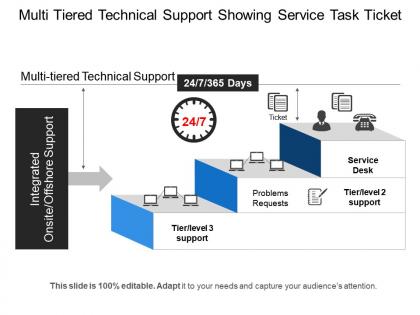
Multi-tiered support structures distribute technical issues by complexity, with Tier 1 handling basic inquiries and password resets, Tier 2 addressing software troubleshooting and system configurations, and Tier 3 managing complex integrations and critical infrastructure problems. This strategic escalation model enables organizations to streamline resolution times, optimize resource allocation, and deliver faster customer experiences while maintaining cost efficiency across support operations.
**INPUT**: What criteria should be used to determine which support tier a user is directed to? **OUTPUT**: User routing criteria include issue complexity, technical expertise required, product area affected, customer priority level, and resolution time expectations. These factors enable organizations to streamline support workflows by matching simple queries to tier-one agents, escalating technical problems to specialists, and prioritizing enterprise clients, ultimately delivering faster resolution times and enhanced customer experiences.
Automation and AI enhance multi-tiered technical support by streamlining ticket routing, enabling intelligent problem diagnosis, and providing real-time resolution recommendations across support levels. These technologies deliver faster response times, reduce manual workload through automated escalations, and improve first-call resolution rates, with many organizations finding that AI-powered chatbots and predictive analytics ultimately minimize operational costs while enhancing customer satisfaction.
Technical support staff require tier-specific competencies, with Tier 1 focusing on communication skills, basic troubleshooting, and ticket management, while Tier 2 demands deeper technical knowledge, system administration, and analytical thinking. Tier 3 specialists need advanced expertise in network architecture, database management, and complex problem resolution, with many organizations finding that continuous training in emerging technologies and cross-functional collaboration ultimately delivers faster resolution times and enhanced customer satisfaction.
Customer satisfaction typically increases across support tiers, with Tier 1 handling basic inquiries efficiently, Tier 2 resolving complex technical issues, and Tier 3 delivering specialized expertise for critical problems. While higher tiers generally achieve better resolution rates, organizations find that streamlined escalation processes and consistent communication across all levels ultimately enhance overall customer experiences and reduce resolution times.
Key performance metrics for multi-tiered support include first-call resolution rates, average handling time, escalation percentages, customer satisfaction scores, and ticket backlog levels for each tier. These metrics enable organizations to identify bottlenecks, optimize resource allocation, and streamline support workflows, with many companies finding that tier-specific tracking ultimately delivers faster resolutions and enhanced customer experiences.
Organizations ensure seamless communication between support tiers through integrated ticketing systems, standardized escalation protocols, shared knowledge bases, real-time collaboration tools, and regular cross-tier training sessions. These systems enable faster issue resolution, reduce customer wait times, and maintain service consistency, with many companies finding that clear handoff procedures and unified communication platforms ultimately deliver improved customer satisfaction and operational efficiency.
Documentation serves as the foundation for multi-tiered support systems by standardizing processes, enabling knowledge transfer between tiers, reducing resolution times, and ensuring consistent service quality across all support levels. Through comprehensive knowledge bases and detailed procedures, organizations streamline escalations, enhance first-call resolution rates, and empower support teams with instant access to solutions, ultimately delivering faster customer experiences and operational efficiency.
Feedback loops can be established through automated survey systems after ticket resolution, regular customer advisory panels, escalation pattern analysis, and cross-tier knowledge sharing sessions. These mechanisms enable support teams to identify recurring issues, refine processes, and enhance service delivery, with many organizations finding that structured feedback collection ultimately delivers improved customer satisfaction and operational efficiency.
Common challenges include staff skill gaps across tiers, inconsistent escalation protocols, knowledge base maintenance, customer frustration with transfers, and resource allocation imbalances. These implementation hurdles can be streamlined through comprehensive training programs, standardized workflows, and integrated communication systems, with many organizations finding that strategic tier structuring ultimately delivers faster resolution times and improved customer satisfaction.
Cultural differences significantly influence technical support design through varying communication styles, hierarchy expectations, problem-solving approaches, and technology adoption rates across regions. Global companies increasingly adapt their tiered structures by incorporating local language capabilities, culturally appropriate escalation protocols, and region-specific training methodologies, ultimately delivering more effective customer experiences and enhanced operational efficiency.
**INPUT**: What technologies are most effective in facilitating multi-tiered technical support? **OUTPUT**: Effective multi-tiered technical support technologies include ticketing systems, knowledge management platforms, remote desktop tools, AI-powered chatbots, and escalation management software. These technologies streamline issue resolution by automating initial responses, enabling seamless tier transitions, and providing comprehensive case tracking, with many organizations finding that strategic integration ultimately delivers faster resolution times and enhanced customer satisfaction. [Word count: 58 words]
Multi-tiered support systems reduce operational costs by routing simple queries to junior staff, escalating complex issues to specialists, and automating routine responses through self-service portals. This strategic approach enables businesses to optimize resource allocation, minimize response times, and enhance customer satisfaction, with many organizations finding that tiered structures deliver up to 40% cost savings while maintaining service quality.
Self-service options significantly reduce workload across support tiers by deflecting routine inquiries, password resets, and basic troubleshooting from Tier 1 agents, while enabling higher tiers to focus on complex technical issues. This strategic redistribution enhances operational efficiency, reduces response times, and improves customer satisfaction, with many organizations finding 40-60% query reduction at entry levels.
-
Unique and attractive product design.
-
Good research work and creative work done on every template.