


Multichannel Communication Marketing Funnel




Try Before you Buy Download Free Sample Product
 Impress Your
 Audience
 100%
100% Editable
 Save Hours
 of Time


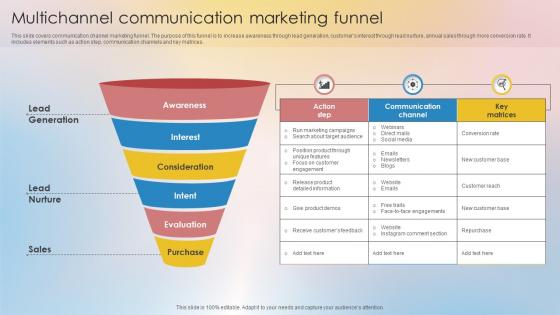
This slide covers communication channel marketing funnel. The purpose of this funnel is to increase awareness through lead generation, customers interest through lead nurture, annual sales through more conversion rate. It includes elements such as action step, communication channels and key matrices.
People who downloaded this PowerPoint presentation also viewed the following :
Multichannel Communication Marketing Funnel with all 6 slides:
Use our Multichannel Communication Marketing Funnel to effectively help you save your valuable time. They are readymade to fit into any presentation structure.





FAQs for Multichannel
So first, map out where you're currently reaching people - that's your starting point. Customer data integration is huge, plus you need consistent messaging but don't just copy-paste everything across platforms. Each one has different strengths, ya know? Smart channel selection matters too - go where your audience actually is, not where you think they should be. Oh and unified tracking is a total pain to set up (took us like 3 months honestly) but you'll thank yourself later. The real game-changer? One source of truth for customer data. Otherwise your email, social, and paid ads people are basically working against each other without realizing it.
Honestly, get a brand guide first - messaging, tone, visuals, the whole thing. Then actually make your teams use it! Social, email, ads, everyone needs the same playbook. I've seen so many companies just... skip this part somehow? Set up regular check-ins between teams to catch weird inconsistencies before they happen. Templates help too, plus some kind of approval process for big campaigns. Otherwise you'll have your Instagram sounding totally different from your emails. The trick is making it super easy for people to stay on-brand instead of just crossing your fingers.
Think of customer personas as your cheat sheet for figuring out where to spend your marketing time. A busy working mom probably scrolls Instagram during lunch breaks, not LinkedIn. So that's where you'd focus your efforts. Each channel needs tweaked messaging but the same core idea - personas help you nail that balance. I learned this the hard way after wasting months posting everywhere with zero strategy (ugh). Map out your top personas first, see where they actually hang out online, then build from there. Way better than just posting randomly and hoping something sticks.
Honestly, data analytics is a game-changer for figuring out what's actually working vs what's just eating your budget. You can see exactly where people drop off in their customer journey and which touchpoints matter most. The attribution modeling gets kind of complex (fair warning), but you'll spot weird patterns - like how your Instagram ads barely convert but somehow make your email campaigns way more effective later. Oh, and timing optimization is huge too. Best part? You don't have to wait until a campaign bombs to shift money around. Real-time budget reallocation saves so much waste.
Data silos are gonna be your worst enemy - marketing doesn't know what sales is doing, customer service is clueless about your latest campaign promises. Budget gets weird too since you're splitting money everywhere. Honestly, tracking who came from where becomes impossible when people jump between your website, emails, and social. Oh, and your systems probably won't talk to each other at first, which is super annoying. Start small though - pick like 2-3 channels max, fix your data mess first, then add more later. Don't try to dominate everything right away.
Dude, you NEED customer feedback - like seriously. We made this huge mistake pushing email campaigns when people actually wanted SMS updates. Total facepalm moment. Feedback tells you where customers want to hang out and what actually clicks with them. Your internal data? It's missing huge blind spots that only real people can point out. Some touchpoints feel smooth, others are just clunky messes. Set up feedback collection everywhere important and watch for patterns. Don't overthink the system - just make it simple enough that you'll actually use it.
So I'd start with something like HubSpot, Marketo, or even Mailchimp - they'll handle your email and social stuff pretty well. Segment or Salesforce are solid for getting all your customer data in one place instead of having it scattered everywhere (which is honestly such a headache). Here's the thing though - integration matters way more than all the bells and whistles. Map out what channels you're using first, then just pick one platform that fixes your biggest problem. Don't try to automate everything right away or you'll go crazy. Oh, and Zapier's great if you want to connect your current tools without starting over completely.
Okay so here's the thing - social media isn't just another marketing channel anymore, it's literally the hub where everything connects. People browse Instagram, text their friends about what they found, then buy it on your actual website. Wild, right? The platforms themselves are basically stores now too. Your social posts need to flow with your emails and website stuff so it all feels connected. I'd start by tracking how your followers actually move between different places when they shop. Don't treat social like it's separate from everything else because customers definitely don't see it that way.
Honestly, I'd start with customer lifetime value and attribution modeling - way more useful than vanity metrics. Cross-channel conversion rates tell the real story too. Last-click attribution is basically useless when you're running multiple channels (learned that the hard way). Track how your channels actually influence each other instead of looking at them separately. ROI per channel matters, but see how they work together. Brand awareness is tricky to measure but you can't ignore it. Get your tracking set up properly first - that's like half the battle. Then dig into which channel combos are bringing in your best customers.
Honestly, personalization is what stops your marketing from feeling like scattered spam across different channels. You want people to feel like you actually get them, not like you're just blasting the same boring ad everywhere they scroll. Pull in their purchase history, what they've clicked on before - that kind of stuff - then tailor what they see on email, social, whatever. I mean, I personally hate when brands show me the exact same thing on Instagram that I just ignored in my inbox, you know? Sync up your customer data first though, otherwise you're just shooting in the dark. When you nail it, people actually engage instead of hitting unsubscribe.
Dude, you HAVE to nail mobile or your whole multichannel thing falls apart. Most people browse on phones now, so when they tap your Instagram ad and land on some clunky desktop-only site? Gone. They're bouncing faster than you can say conversion rate. What's crazy is how it breaks everything else too - not just your mobile sales. People expect to browse on their phone during lunch, then maybe finish buying later on their laptop at home. The whole journey needs to flow. Honestly, I'd just go through every step a customer takes on mobile and fix whatever makes you want to throw your phone across the room first.
Don't treat email like it's doing all the heavy lifting alone - connect it with your social media and website stuff. I segment my lists based on where people found me (Instagram followers who haven't bought anything yet vs. actual customers). Mobile optimization is huge since everyone's glued to their phones anyway. The cool part? You can use emails to boost your social campaigns and drive people back to your site. Honestly, mapping out how one customer moves between email and maybe two other channels is the best place to start. It's way less overwhelming that way.
Honestly, AI is what finally makes multichannel marketing not feel like juggling flaming torches. It tracks customers everywhere they go and personalizes stuff automatically - which is huge because who has time to do that manually? The predictive stuff is where it gets really good though. You'll know which channels work best for different people without all the guessing games. Plus it syncs up your messaging timing across email, social, SMS, all of it. My advice? Don't go crazy right away. Start with one attribution tool, see how much clearer things get, then add more. Trust me on this one.
Your brand needs to look and feel the same everywhere - website, store, social media, all of it. Drive people back and forth between online and offline with email promos for in-store events, QR codes on receipts, that kind of thing. Customer data is massive here. When someone buys something online, your store staff should have access to that info for better service. Honestly, inventory sync is probably the most annoying part but super important - you can't sell stuff online that's sitting in some other warehouse. Oh, and create unified customer profiles so you can actually see their whole shopping journey. Makes everything way smoother.
Look at Nike's "Just Do It" - they nail it by connecting TV ads, social media, their app, and store experiences so it all feels like one brand. Starbucks kills it too with that loyalty program that works everywhere, whether you're ordering on the app or in person. But honestly? Disney's probably the best example (I'm totally biased though). They tie everything together - movies, parks, merch, Disney+ - it's all connected. Here's what I'd do: find 3-4 places where your people actually spend time and make sure you're not just throwing random messages everywhere. Keep it cohesive.
-
I didn’t expect such a good service for the money I am paying. But, they exceed my expectations. Great work SlideTeam.
-
“I required a slide for a board meeting and was so satisfied with the final result !! So much went into designing the slide and the communication was amazing! Can’t wait to have my next slide!”