


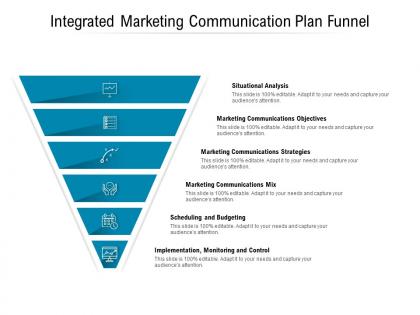
Integrated marketing communication plan funnel




Try Before you Buy Download Free Sample Product
 Impress Your
 Audience
 100%
100% Editable
 Save Hours
 of Time


Our Integrated Marketing Communication Plan Funnel are great for evolving businesses. Familiarize folks with your facilities.
People who downloaded this PowerPoint presentation also viewed the following :
Integrated marketing communication plan funnel with all 2 slides:
Our Integrated Marketing Communication Plan Funnel familiarize folks with your business. They will become aware of facilities available.
FAQs for Integrated marketing
The Integrated Marketing Communication Funnel includes awareness, interest, consideration, intent, evaluation, and purchase stages, with coordinated messaging across all touchpoints throughout each phase. Unlike traditional funnels that operate in silos, this approach synchronizes content marketing, social media, email campaigns, and advertising channels simultaneously, ensuring consistent brand messaging while enabling seamless customer transitions between stages, ultimately delivering higher conversion rates and stronger customer relationships.
Brands can effectively measure IMC Funnel success through stage-specific metrics including awareness tracking, engagement rates, conversion analytics, customer lifetime value, and retention measurements. Companies like Coca-Cola and Nike utilize multi-touch attribution models, social listening tools, and CRM integration to assess performance across touchpoints, while retailers increasingly combine online analytics with in-store data, ultimately delivering comprehensive ROI insights and strategic optimization opportunities.
Customer segmentation enables precise message targeting, channel optimization, content personalization, budget allocation, and timing strategies throughout the integrated marketing communication funnel. By categorizing audiences based on demographics, behaviors, and preferences, companies like retail brands and financial services deliver more relevant experiences at each funnel stage, ultimately increasing conversion rates and marketing ROI.
Digital channels excel in the IMC Funnel through precise targeting, real-time analytics, and interactive engagement, while traditional media delivers broad reach, credibility, and sustained brand awareness. The strategic combination enables organizations to capture attention through television and print advertising, then nurture prospects through social media and email marketing, ultimately delivering seamless customer journeys and measurable conversion optimization.
Marketers should track awareness metrics like reach and impressions, consideration metrics including engagement rates and click-through rates, conversion metrics such as lead generation and sales attribution, and retention metrics like customer lifetime value and repeat purchase rates. These comprehensive measurements enable organizations to optimize messaging at each funnel stage, identify bottlenecks in customer journeys, and allocate resources strategically, ultimately delivering improved ROI and stronger customer relationships across all touchpoints.
Companies leverage social media through awareness campaigns on platforms like Facebook and Instagram, consideration-building content on LinkedIn and YouTube, and conversion-focused retargeting on Twitter and Pinterest. These platforms enable targeted advertising, interactive content, and real-time customer engagement, with many organizations finding that strategic social integration across funnel stages delivers higher conversion rates, improved customer relationships, and measurable ROI growth.
Common pitfalls include inconsistent messaging across channels, siloed teams lacking coordination, inadequate budget allocation, and poor data integration between platforms. Many brands struggle with maintaining unified brand voice while adapting content for different touchpoints, ultimately leading to fragmented customer experiences and reduced campaign effectiveness in an increasingly competitive marketplace.
Storytelling enriches IMC Funnel experiences by creating emotional connections, building brand narratives across touchpoints, personalizing customer journeys, and establishing consistent messaging throughout awareness, consideration, and conversion stages. Through compelling narratives, companies like Nike and Coca-Cola deliver memorable brand experiences, enhance customer engagement, and drive deeper loyalty, ultimately transforming transactional interactions into meaningful relationships.
Emerging technologies like AI and personalization significantly enhance IMC Funnel effectiveness by enabling targeted messaging, predictive analytics, automated customer journeys, and real-time optimization across all touchpoints. These technologies streamline content delivery, personalize experiences at scale, and provide deeper insights into customer behavior, with many organizations finding that AI-driven personalization increases conversion rates while reducing acquisition costs throughout the funnel.
Businesses can nurture leads through targeted content marketing, personalized email sequences, retargeting campaigns, social media engagement, and progressive profiling to gather insights at each funnel stage. These strategies work by delivering relevant messaging that addresses specific pain points, building trust through consistent touchpoints, and ultimately converting prospects into customers, with many organizations finding that this systematic approach increases conversion rates while reducing acquisition costs.
Content marketing serves as the strategic backbone across all IMC funnel stages, delivering awareness-building blog posts and social content, consideration-stage whitepapers and case studies, conversion-focused product demonstrations, and retention-oriented newsletters. Through targeted content distribution, organizations enhance customer engagement, streamline buyer journeys, and accelerate sales cycles, with many finding that strategic content alignment ultimately delivers higher conversion rates and stronger customer relationships.
Organizations align internal teams through cross-functional workshops, unified brand guidelines, shared performance metrics, and centralized content calendars that ensure consistent messaging across all touchpoints. Through regular alignment meetings and collaborative planning sessions, marketing, sales, customer service, and product teams streamline communication strategies, minimize conflicting messages, and ultimately deliver cohesive customer experiences that enhance brand credibility and drive conversions.
Successful brands using IMC Funnels include Nike with consistent "Just Do It" messaging across digital, traditional, and experiential channels, Coca-Cola's unified holiday campaigns spanning social media, television, and retail partnerships, and Apple's seamless product launches coordinating PR, advertising, and retail experiences. These strategic approaches streamline brand messaging, enhance customer journey consistency, and ultimately deliver stronger brand recognition and conversion rates, with many companies finding that integrated campaigns generate significantly higher ROI than fragmented marketing efforts.
Businesses can adapt their IMC strategies by continuously monitoring consumer data, embracing omnichannel approaches, personalizing messaging across touchpoints, and remaining agile in campaign execution. Through real-time analytics and flexible content strategies, companies in retail, healthcare, and financial services streamline their communications, enhance customer engagement, and maintain competitive advantage while responding to evolving market demands and consumer preferences.
Feedback loops enable continuous refinement of the Integrated Marketing Communication Funnel by analyzing customer responses, engagement metrics, conversion rates, and behavioral data across all touchpoints. Through systematic feedback collection, organizations streamline messaging consistency, enhance channel effectiveness, and optimize resource allocation, with many companies finding that data-driven adjustments ultimately deliver improved customer experiences and significantly higher conversion rates.
No Reviews