


Multiple rank insignia of us marine corps




Try Before you Buy Download Free Sample Product
 Impress Your
 Audience
 100%
100% Editable
 Save Hours
 of Time


Our Multiple Rank Insignia Of US Marine Corps are topically designed to provide an attractive backdrop to any subject. Use them to look like a presentation pro.
People who downloaded this PowerPoint presentation also viewed the following :
Multiple rank insignia of us marine corps with all 2 slides:
Use our Multiple Rank Insignia Of US Marine Corps to effectively help you save your valuable time. They are readymade to fit into any presentation structure.

FAQs for Multiple rank insignia of
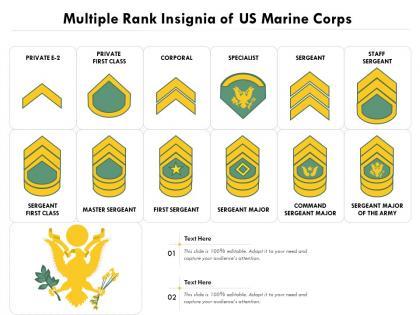
US Marine Corps rank insignia are organized into three main categories: enlisted ranks using chevrons and rockers, warrant officer ranks featuring distinctive globe and anchor designs, and commissioned officer ranks displaying various combinations of bars, oak leaves, eagles, and stars. These insignia systems differ in their visual elements and placement, with enlisted personnel wearing chevrons on their sleeves, while officers display their ranks on collars or shoulders, ultimately enabling clear command structure identification and military hierarchy recognition across all operational environments.
The Marine Corps rank insignia system is structured across three categories: enlisted personnel (chevrons and rockers), warrant officers (distinctive gold and red bars), and commissioned officers (bars, oak leaves, eagles, and stars). These ranks signify progressively increasing responsibility from individual task execution to squad leadership, company command, and strategic military operations, with higher ranks commanding larger units and making critical tactical decisions that affect thousands of Marines.
Marine rank insignia colors and designs reflect military heritage, functional requirements, and ceremonial traditions, with gold representing officer authority, silver indicating senior enlisted leadership, and chevrons symbolizing progressive responsibility levels. These distinctive elements enhance unit cohesion and operational effectiveness by providing instant visual recognition of command structure, while maintaining the Corps' proud traditions through designs rooted in centuries of military history and strategic organizational clarity.
Marine Corps rank insignia originated from British naval traditions in 1775, incorporating chevrons for enlisted personnel and distinctive officer insignia like the eagle, globe, and anchor emblem adopted in 1868. These symbols have evolved through major conflicts and organizational changes, with standardizations during World War I and II refining designs, adding new ranks like Sergeant Major of the Marine Corps in 1957, and ultimately delivering a hierarchical system that enhances command structure and unit cohesion across all Marine operations.
Marine Corps enlisted personnel wear chevrons and rockers on their sleeves, progressing from single chevrons for privates to complex combinations with stars for senior enlisted ranks. Officers display gold or silver bars, oak leaves, eagles, and stars on their collars and shoulders, with warrant officers using distinctive grid patterns, ultimately creating a clear visual hierarchy that enables immediate recognition of authority levels and chain of command across all operational environments.
Marine Corps promotion criteria include time in service, time in grade, physical fitness scores, rifle qualifications, professional military education completion, and performance evaluations. These requirements directly correlate with rank insignia progression, as each promotion milestone earned through meeting specific benchmarks enables Marines to wear higher insignia, ultimately delivering clear visual representation of achievement and leadership authority within the organizational structure.
Marine Corps rank insignia display varies during ceremonial occasions through specific uniform regulations, with dress blue uniforms featuring gold embroidered chevrons and rockers, while service uniforms display subdued cloth insignia. These ceremonial distinctions enhance military tradition, emphasize hierarchical respect, and showcase Marine Corps heritage, with formal events like weddings and parades requiring the most elaborate insignia presentations, ultimately delivering enhanced unit cohesion and pride.
Marine Corps Reserve ranks mirror active-duty counterparts exactly, featuring identical insignia from Private to General, including enlisted chevrons, NCO rockers, and officer stars or bars. Reserve Marines wear the same rank structure across all three categories—enlisted, non-commissioned officers, and commissioned officers—ensuring seamless integration during joint operations, with many organizations finding that this standardized approach enhances operational efficiency and maintains clear command hierarchy regardless of duty status.
Rank insignia establishes clear command authority, operational accountability, and decision-making protocols throughout Marine Corps units, ensuring seamless communication and tactical coordination during missions. These visual hierarchy markers enable rapid identification of leadership roles in high-pressure situations, streamline resource allocation and strategic planning, while fostering disciplined unit cohesion that ultimately delivers enhanced operational effectiveness and mission success.
US Marine Corps rank insignia shares similar enlisted chevron patterns with the Army but differs through distinctive features like crossed rifles for infantry and unique officer insignia placement on collars rather than shoulders. While the Navy uses completely different rate badges and the Air Force employs stripes with distinctive designs, Marines maintain traditional military heraldry with eagle, globe, and anchor symbolism, ultimately creating immediate visual distinction and fostering strong branch identity across joint military operations.
Marine Corps special qualification insignia include martial arts instructor tabs, aviation wings, parachutist badges, explosive ordnance disposal crabs, and reconnaissance pins, which display alongside traditional rank chevrons. These distinctive emblems enhance unit cohesion and operational effectiveness by immediately identifying specialized capabilities within formations, with many commands finding that visible expertise recognition streamlines tactical assignments and builds team confidence.
Marine Corps Order 1020.34H and the Marine Corps Uniform Regulations govern rank insignia wear, specifying proper placement, spacing, and alignment requirements for all uniform types. Common violations include incorrect chevron spacing, misaligned officer insignia, mixing metal finishes between subdued and bright insignia, and improper collar device positioning, with many units finding that regular uniform inspections significantly enhance overall appearance standards and military bearing.
Marines' experiences and rank insignia stories strengthen unit cohesion by creating shared narratives around promotion ceremonies, leadership transitions, and mentorship moments that reinforce Corps values. These personal accounts, from boot camp chevron ceremonies to senior NCO pinning traditions, build collective identity and pride while fostering respect for the rank structure, ultimately enhancing operational effectiveness and esprit de corps.
Marines face challenges including increased leadership responsibilities, adapting to new protocols, managing larger teams, and balancing mentorship with operational duties when advancing ranks. These transitions are reflected through progressively complex insignia designs, from simple chevrons for enlisted personnel to elaborate combinations of stars, eagles, and rockers for senior NCOs, with many Marines finding that the visual hierarchy helps clarify command structures and accountability across diverse operational environments.
Understanding rank insignia nuances enhances military protocol adherence, builds mutual respect through proper recognition, and streamlines command structure communication within Marine units. This knowledge enables Marines to navigate hierarchical interactions more effectively, demonstrate professionalism in joint operations, and foster unit cohesion, with many finding that precise rank recognition ultimately strengthens operational efficiency and maintains the disciplined culture essential for mission success.
-
Qualitative and comprehensive slides.