


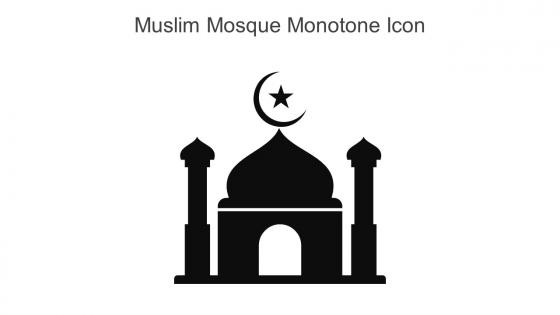
Muslim Mosque Monotone Icon In Powerpoint Pptx Png And Editable Eps Format




Try Before you Buy Download Free Sample Product
 Impress Your
 Audience
 100%
100% Editable
 Save Hours
 of Time


This Muslim mosque monotone icon in powerpoint pptx png and editable eps format is a 100 percent editable icon. The downloaded file will have this icon in EPS, PNG and Powerpoint pptx format and is perfect for your next project. It has a simple yet stylish design.
People who downloaded this PowerPoint presentation also viewed the following :
Muslim Mosque Monotone Icon In Powerpoint Pptx Png And Editable Eps Format with all 6 slides:
Use our Muslim Mosque Monotone Icon In Powerpoint Pptx Png And Editable Eps Format to effectively help you save your valuable time. They are readymade to fit into any presentation structure.





FAQs for Muslim Mosque Monotone Icon In Powerpoint Pptx Png And
Traditional Muslim mosque icons are defined by minarets, domes, prayer halls, mihrab niches, and geometric patterns or calligraphy. These architectural elements work together to create instantly recognizable symbols used across digital platforms, signage, and educational materials, with many organizations finding that incorporating authentic design details enhances cultural representation and community connection.
Different cultures influence mosque icons through architectural elements like minarets, domes, geometric patterns, and regional decorative motifs that reflect local artistic traditions. Islamic communities in Southeast Asia, the Middle East, and North Africa incorporate distinct cultural symbols, calligraphy styles, and structural designs into their mosque representations, ultimately creating diverse visual identities while maintaining core Islamic principles and spiritual symbolism.
Calligraphy serves as a fundamental decorative element in mosque icon design, replacing figurative imagery with sacred Arabic script, Quranic verses, and geometric patterns that enhance spiritual symbolism. These artistic representations enable designers, architects, and religious organizations to create culturally authentic visual communications while respecting Islamic artistic traditions, ultimately delivering meaningful religious iconography that resonates across diverse Muslim communities globally.
Mosque icons enhance educational presentations by serving as visual anchors for lessons on Islamic culture, world religions, architecture history, and cultural diversity topics. These symbols streamline complex concepts through immediate visual recognition, help students connect abstract religious studies to concrete imagery, and enable educators to create more engaging, culturally inclusive materials that ultimately deliver better learning outcomes and enhanced student comprehension.
Common misconceptions include viewing mosque architecture as monolithic across cultures, assuming minarets are purely decorative rather than functional for call to prayer, and misinterpreting geometric patterns as mere ornamentation instead of spiritual symbolism. These architectural elements actually reflect diverse regional influences, practical worship needs, and deep theological concepts, with many Islamic communities finding that understanding authentic design principles enhances interfaith dialogue and cultural appreciation.
Mosque icons reflect Islamic values through architectural symbolism featuring minarets representing the call to prayer, domes symbolizing unity under Allah, and geometric patterns emphasizing divine order and infinity. These visual elements communicate core beliefs like community gathering, spiritual devotion, and Islamic identity, with many organizations finding that mosque imagery effectively conveys religious heritage and cultural significance.
Mosque icons can be integrated into modern graphic design through minimalist geometric interpretations, cultural branding for halal businesses, architectural pattern elements, community event marketing, and contemporary logo designs. These design approaches enhance brand authenticity and cultural connection by combining traditional Islamic architectural elements with clean typography, modern color palettes, and scalable vector formats, ultimately delivering meaningful visual communication that resonates with diverse audiences while maintaining cultural respect.
**INPUT**: What historical events have shaped the evolution of mosque iconography? **OUTPUT**: Key historical events shaping mosque iconography include the early Islamic conquests, the Abbasid architectural revolution, the Crusades, Ottoman expansion, and colonial periods. These influences evolved through regional adaptations, technological advances, and cultural exchanges, with many contemporary religious institutions finding that traditional symbols combined with modern design elements effectively serve diverse communities while maintaining spiritual authenticity and architectural heritage. **Word count: 59 words**
Mosque icon variations typically reflect architectural traditions rather than sectarian differences, with design elements influenced by regional culture, historical periods, and local building materials more than religious divisions. While Sunni and Shia communities may favor certain architectural styles in specific regions, these preferences often overlap significantly, with many mosques sharing common features like minarets and domes regardless of sectarian affiliation, ultimately serving similar functional and spiritual purposes.
Color theory significantly enhances mosque icon design through symbolic representation, cultural authenticity, visual hierarchy, and emotional resonance. Green often symbolizes Islam and peace, while gold conveys spiritual significance, with many designers finding that strategic color combinations improve recognition, accessibility, and cultural respect, ultimately delivering more meaningful and effective visual communication across diverse digital platforms.
Mosque icons contribute to interfaith dialogue by promoting visual recognition, cultural awareness, and respectful representation across diverse communities. Through inclusive presentations, educational materials, and community outreach programs, organizations leverage these symbols to facilitate meaningful conversations, bridge cultural gaps, and foster mutual understanding, ultimately delivering enhanced community cohesion and interfaith collaboration.
Creating respectful mosque icons involves balancing architectural accuracy, cultural sensitivity, and diverse denominational representations while avoiding stereotypical or oversimplified designs. These challenges require careful consideration of regional architectural variations, proper proportions of minarets and domes, and consultation with Muslim communities, with many organizations finding that collaborative design processes ultimately deliver more authentic representations and broader acceptance across different cultural contexts.
Geographical differences significantly influence mosque iconography through regional architectural styles, local cultural motifs, climate-adapted designs, and indigenous artistic traditions. Middle Eastern mosques emphasize geometric patterns and calligraphy, while Southeast Asian mosques incorporate local materials and tropical adaptations, and African mosques blend Islamic principles with traditional building techniques, ultimately creating diverse visual representations that reflect both Islamic unity and cultural diversity across different regions.
Contemporary artists like Rashad Alakbarov, Faig Ahmed, and Lalla Essaydi are redefining mosque iconography through installations, digital art, geometric abstractions, and mixed media approaches that blend traditional Islamic architectural elements with modern artistic techniques. These artists enhance cultural dialogue by reimagining sacred spaces through contemporary lenses, with galleries and institutions increasingly finding that such works bridge historical reverence and modern expression, ultimately delivering fresh perspectives on spiritual architecture.
Studying mosque icons enhances understanding of Islamic art by revealing architectural symbolism, geometric patterns, calligraphic traditions, regional variations, and spiritual design principles that define Islamic aesthetics. These visual elements demonstrate how Islamic culture integrates faith with artistic expression across diverse societies, with museums and educational institutions finding that architectural iconography provides deeper insights into Islamic civilization's rich cultural heritage.
-
Wow! The design and quality of templates on SlideTeam are simply the best.
-
Really like the color and design of the presentation.