


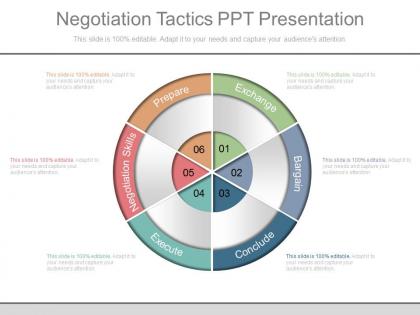
Negotiation tactics ppt presentation




Try Before you Buy Download Free Sample Product
 Impress Your
 Audience
 100%
100% Editable
 Save Hours
 of Time


Our Negotiation Tactics Ppt Presentation are ever evolving. They enjoy growing with you.
People who downloaded this PowerPoint presentation also viewed the following :
Negotiation tactics ppt presentation with all 4 slides:
Get ahead clearly with our Negotiation Tactics Ppt Presentation. Create a definite gap from your competition.



FAQs for Negotiation
Effective negotiation tactics with difficult personalities include active listening to understand underlying concerns, finding common ground through shared interests, remaining calm under pressure, asking open-ended questions to uncover motivations, and focusing on mutual benefits rather than positions. These approaches streamline discussions by building rapport, defusing tension, and creating collaborative solutions, with many negotiators finding that patience and empathy ultimately deliver better outcomes than aggressive tactics.
Understanding body language enhances negotiation skills by revealing unspoken concerns, identifying decision-making moments, and detecting resistance or agreement before verbal confirmation. Through careful observation of gestures, posture, and facial expressions, negotiators can adjust their approach in real-time, build stronger rapport, and ultimately secure more favorable outcomes while maintaining productive business relationships.
Active listening and empathy serve as foundational negotiation tactics that enable understanding underlying interests, building rapport, and identifying mutually beneficial solutions through careful attention to verbal and non-verbal cues. These approaches help negotiators uncover hidden concerns, reduce defensive responses, and create collaborative environments, with many business leaders finding that empathetic listening ultimately delivers stronger agreements and lasting partnerships.
Cultural negotiation preparation involves researching communication styles, decision-making hierarchies, relationship-building expectations, time orientations, and conflict resolution approaches specific to each culture. Through cultural intelligence training and local partnerships, organizations streamline cross-border deals, enhance stakeholder relationships, and minimize misunderstandings, with many multinational companies finding that culturally-adapted strategies ultimately deliver faster agreements and stronger long-term business outcomes.
Anchoring establishes a psychological reference point that influences the entire negotiation range, giving negotiators significant control over discussions and potentially securing more favorable outcomes. This tactic proves particularly effective in salary negotiations, contract pricing, and real estate deals, with many businesses finding that strategic anchoring reduces costs, accelerates agreement timelines, and ultimately delivers competitive advantages in commercial transactions.
Effectively handling objections involves active listening, acknowledging concerns genuinely, and reframing discussions around mutual value creation rather than positional arguments. Through strategic preparation and flexible counter-offer structuring, negotiators in sectors like real estate, procurement, and corporate partnerships transform resistance into collaborative problem-solving, ultimately delivering stronger agreements and lasting business relationships.
Creating win-win negotiations involves active listening, identifying mutual interests, brainstorming creative solutions, making strategic concessions, and maintaining transparent communication throughout discussions. These collaborative approaches enable negotiators to expand value rather than simply divide it, with businesses in sectors like partnerships, vendor relationships, and mergers finding that such tactics ultimately deliver stronger long-term relationships and sustainable competitive advantages.
Storytelling strengthens negotiation positions by creating emotional connections, illustrating consequences of decisions, and making abstract concepts tangible through relatable scenarios. Through compelling narratives, negotiators can demonstrate value propositions, build trust with counterparts, and frame outcomes more persuasively, with many finding that well-crafted stories ultimately influence decision-making more effectively than data alone.
Building rapport in negotiations involves active listening, finding common ground, demonstrating genuine interest in their perspective, mirroring communication styles, and maintaining consistent follow-through on commitments. These relationship-building techniques enhance trust by creating psychological safety, reducing defensive barriers, and establishing mutual respect, with many successful negotiators finding that stronger rapport ultimately delivers more collaborative outcomes and sustainable agreements.
Identifying negotiation biases involves recognizing anchoring bias, confirmation bias, overconfidence, and loss aversion through self-awareness, preparation, and seeking diverse perspectives before discussions. Successful negotiators overcome these biases by establishing objective criteria, conducting thorough market research, and implementing structured decision-making frameworks, with many organizations finding that bias-aware approaches deliver significantly better outcomes and stronger long-term partnerships.
Effective salary negotiation tactics include researching market rates, documenting achievements, timing requests strategically, presenting multiple compensation elements, and practicing collaborative dialogue. These approaches enhance outcomes by demonstrating value through specific metrics, leveraging performance reviews and industry benchmarks, while exploring flexible benefits, professional development opportunities, and equity options, ultimately delivering compensation packages that reflect true market worth.
Technology enhances virtual negotiations through video conferencing platforms, collaborative document sharing, real-time analytics, digital whiteboards, and AI-powered sentiment analysis tools. These solutions streamline communication by enabling seamless information exchange, tracking negotiation progress, and providing data-driven insights, with many organizations finding that virtual negotiations actually increase efficiency while reducing travel costs and scheduling constraints.
Effective team conflict resolution tactics include active listening, finding common ground, separating people from problems, focusing on interests rather than positions, and using collaborative brainstorming sessions. These approaches work by reducing defensiveness, encouraging open dialogue, and creating win-win solutions, with many organizations finding that structured mediation and regular team feedback sessions ultimately enhance collaboration and productivity.
BATNA enhances negotiation outcomes by providing leverage, confidence, and strategic flexibility during discussions. By clearly defining your best alternative beforehand, you can negotiate more assertively, recognize when to walk away, and avoid accepting unfavorable terms, with many business professionals finding that strong BATNAs ultimately deliver better deals and reduced settlement pressure.
High-stakes business negotiations benefit from thorough preparation, strategic concession planning, anchoring with favorable opening positions, leveraging time pressure, and building coalition support among stakeholders. These tactics enable negotiators to maintain control while creating value, with investment banks, merger transactions, and major procurement deals finding that systematic preparation and strategic patience ultimately deliver superior outcomes and competitive advantage.
-
Very well designed and informative templates.
-
Professional and unique presentations.