


Nestle Business Expansion And Diversification Strategic Report Powerpoint Presentation Slides Strategy CD V




Try Before you Buy Download Free Sample Product
 Impress Your
 Audience
 100%
100% Editable
 Save Hours
 of Time


Access our comprehensive Nestle Business Expansion and Diversification Strategic Report to analyze Nestles current business strategies, internal and external environments, and diversification efforts. The Business Overview deck provides insights into Nestles mission, vision, product offerings, partners, and company history. Moreover, the Market Positioning presentation includes external environment analysis through PESTLE analysis, industry analysis using Porters Five Forces model, and competitor analysis. Furthermore, the Nestle Products Powerpoint covers brand positioning, market segmentation, and BCG matrix analysis. Additionally, the Food and Beverages Processing Report PPT offers an in depth examination of Nestles internal environment, including shareholding structure, organizational structure, and SWOT analysis. Lastly, the Business Level Strategy Template showcases Nestles strategic pillars, sustainability initiatives, and financial statements. Gain instant access to this valuable resource covering business overview, market positioning, segmentation, diversification, global strategies, financial statements, and more.
People who downloaded this PowerPoint presentation also viewed the following :
Content of this Powerpoint Presentation
Slide 1: This slide introduces Nestle Business Expansion and Diversification Strategic Report.
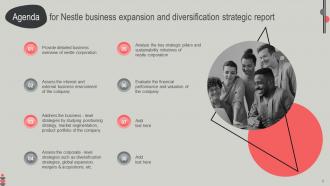
Slide 2: This slide depicts the Agenda of the presentation.
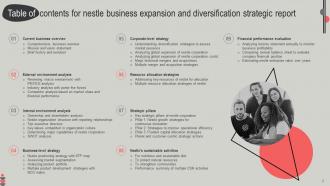
Slide 3: This slide includes the Table of contents.
Slide 4: This slide highlights the Title for the Topics to be covered further.
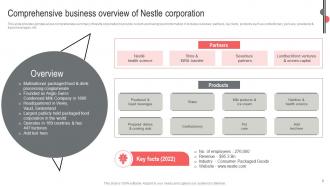
Slide 5: This slide provides glimpse about comprehensive summary of Nestle corporation to provide current and background information.
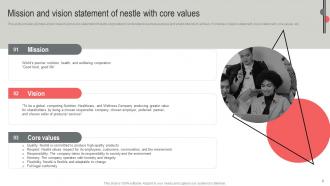
Slide 6: This slide showcases the Mission and vision statement of nestle with core values.
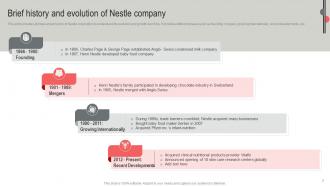
Slide 7: This slide provides glimpse about history of Nestle corporation to understand its evolution and growth over time.
Slide 8: This slide displays the Heading for the Contents to be covered in the following template.
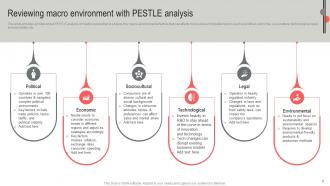
Slide 9: This slide talks about Reviewing macro environment with PESTLE analysis.
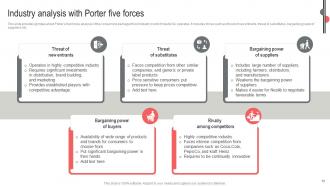
Slide 10: This slide reveals the Industry analysis with porter five forces.
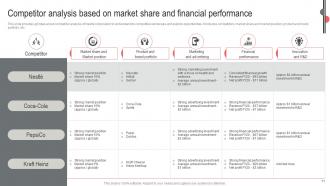
Slide 11: This slide shows the competitor analysis of Nestle corporation to understand its competitive landscape and explore opportunities.
Slide 12: This slide mentions the Title for the Ideas to be discussed in the next template.
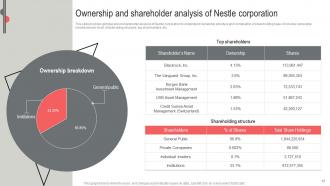
Slide 13: This slide deals with the Ownership and shareholder analysis of nestle corporation.
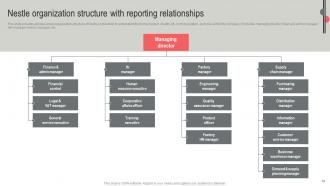
Slide 14: This slide illustrates the Nestle organization structure with reporting relationships.
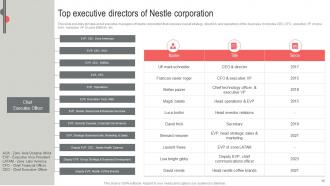
Slide 15: This slide portrays the Top executive directors of nestle corporation.
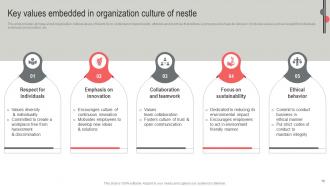
Slide 16: This slide highlights the Key values embedded in organization culture of nestle.
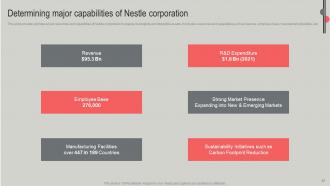
Slide 17: This slide provides glimpse about resources and capabilities of Nestle corporation to analyze its tangible and intangible assets.
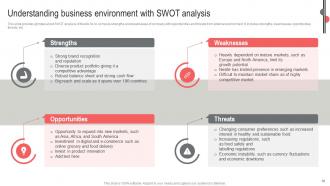
Slide 18: This slide talks about Understanding business environment with SWOT analysis.
Slide 19: This slide indicates the Heading for the Ideas to be covered in the upcoming template.
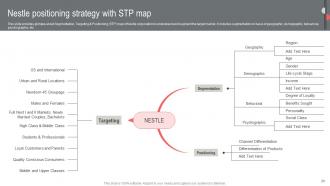
Slide 20: This slide talks about the Nestle positioning strategy with STP map.
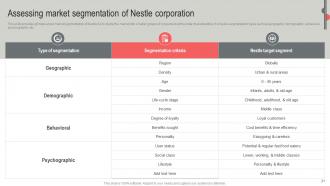
Slide 21: This slide emphasizes on Assessing market segmentation of nestle corporation.
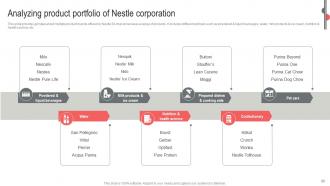
Slide 22: This slide provides a glimpse about multiple product brands offered by Nestle SA that showcases a range of products.
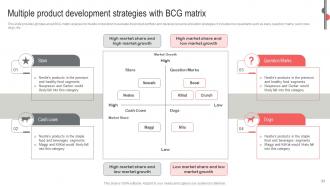
Slide 23: This slide illustrates the Multiple product development strategies with BCG matrix.
Slide 24: This slide presents the Title for the Contents to be discussed further.
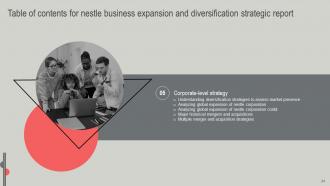
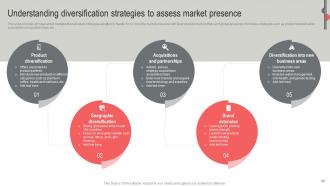
Slide 25: This slide focuses on Understanding diversification strategies to assess market presence.
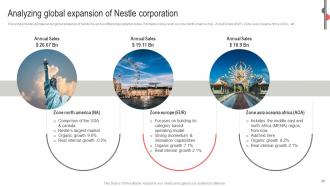
Slide 26: This slide showcases Analyzing global expansion of nestle corporation.
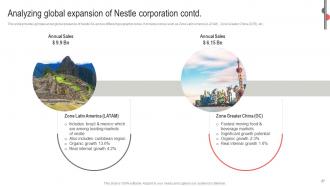
Slide 27: This slide continues Analyzing global expansion of nestle corporation.
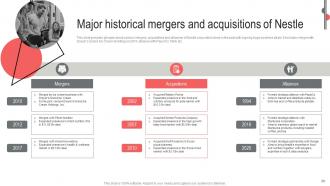
Slide 28: This slide exhibits the Major historical mergers and acquisitions of nestle.
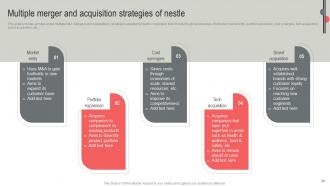
Slide 29: This slide depicts the Multiple merger and acquisition strategies of nestle.
Slide 30: This slide mentions about the Heading for the Topics to be covered in the following template.
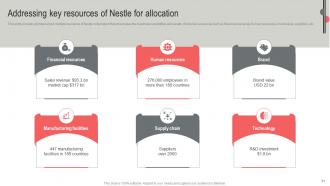
Slide 31: This slide provides glimpse about multiple resources of Nestle corporation that showcases the business capabilities and assets.
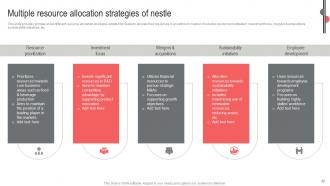
Slide 32: This slide represents the Multiple resource allocation strategies of nestle.
Slide 33: This slide highlights the Title for the Contents to be discussed further.
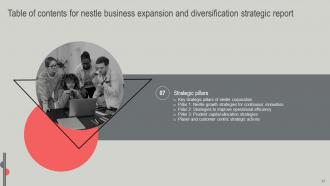
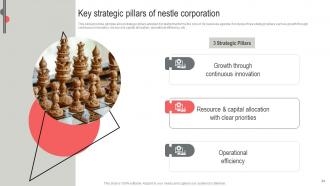
Slide 34: This slide provides glimpse about strategic pillars adopted by Nestle that forms the core of its business agenda.
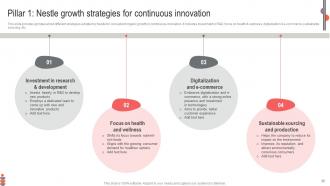
Slide 35: This slide states different strategies adopted by Nestle for consistent organic growth by continuous innovation.
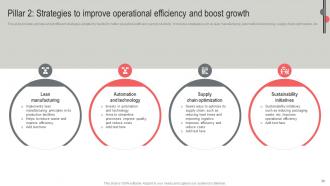
Slide 36: This slide provides glimpse about different strategies adopted by Nestle for better operational efficiency and productivity.
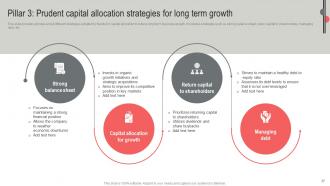
Slide 37: This slide mentions the different strategies adopted by Nestle for capital allocation to induce long term business growth.
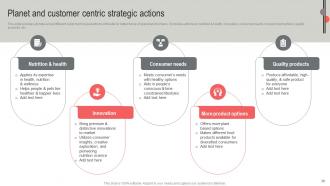
Slide 38: This slide shows the different customer focused actions of Nestle for better future of planet and humans.
Slide 39: This slide depicts the Heading for the Topics to be covered next.
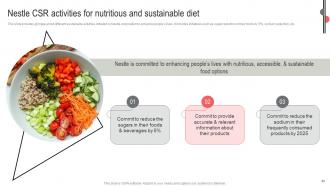
Slide 40: This slide provides glimpse about different sustainable activities initiated by Nestle corporation to enhance people’s lives.
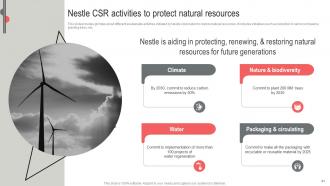
Slide 41: This slide talks about the Nestle CSR activities to protect natural resources.
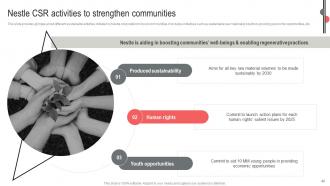
Slide 42: This slide provides glimpse about different sustainable activities initiated by Nestle corporation to boost communities.
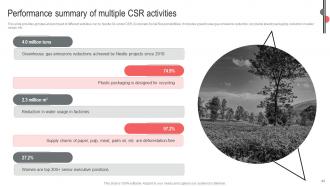
Slide 43: This slide illustrates the Performance summary of multiple CSR activities.
Slide 44: This slide mentions about the Title for the Topics to be discussed further.
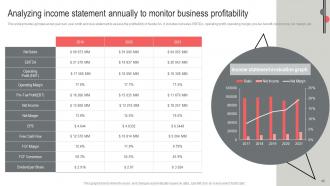
Slide 45: This slide deals with Analyzing income statement annually to monitor business profitability.
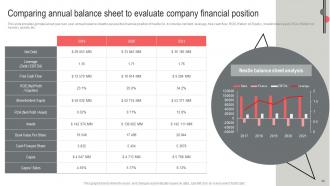
Slide 46: This slide provides glimpse about year over year annual balance sheet to assess the financial position of Nestle SA.
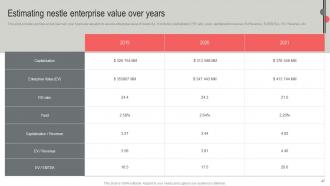
Slide 47: This slide showcases year over year business valuation to assess enterprise value of Nestle SA.
Slide 48: This is the Icons slide containing all the Icons used in the plan.
Slide 49: This slide is used for depicting some Additional information.
Slide 50: This slide incorporates the company's mission, Vision, and Goal.
Slide 51: This is the About Us slide. State your organization-related information here.
Slide 52: This is Meet our team slide for stating the team-related information.
Slide 53: This is Our target slide for showcasing the firm's targets.
Slide 54: This is the Idea Generation slide for encouraging fresh ideas.
Slide 55: This slide elucidates the Venn diagram.
Slide 56: This is the Quotes slide for motivation.
Slide 57: This is the Puzzle slide with related imagery.
Slide 58: This slide indicates the Pie chart.
Slide 59: This is the Column chart slide.
Slide 60: This slide displays teh organizational Timeline.
Slide 61: This is the Thank You slide for acknowledgement.
Nestle Business Expansion And Diversification Strategic Report Powerpoint Presentation Slides Strategy CD V with all 63 slides:
Use our Nestle Business Expansion And Diversification Strategic Report Powerpoint Presentation Slides Strategy CD V to effectively help you save your valuable time. They are readymade to fit into any presentation structure.








FAQs for Nestle Business Expansion And Diversification Strategic Report Powerpoint Presentation Slides
So Nestlé's going hard after emerging markets right now - mainly Asia-Pacific, Africa, and Latin America. China and India are huge focuses for them, plus a bunch of African countries where the middle class is exploding. Plant-based stuff is another big priority they're pushing in these regions. Honestly, it's pretty smart when you look at where all the population growth is happening. Those are the spots where people actually have more money to spend on food. If you're doing any competitive research in those markets, their moves are definitely worth tracking.
So Nestlé has these research teams that live in whatever market they're trying to enter. Smart move, honestly. They do focus groups and taste tests before launching anything new. Take India - they figured out different regions want totally different spice levels, so now their Maggi noodles aren't the same everywhere. They'll partner with local suppliers and even change package sizes based on what families can afford. Oh, and family size matters too apparently. Point is, they don't just dump their American products overseas and hope for the best.
Nestlé's basically making sustainability their whole expansion strategy now, not just some side thing. They're focusing on acquisitions that fit their regenerative agriculture stuff and net-zero goals. Smart move honestly - regulatory pressure's getting crazy worldwide. When they enter new markets, they're using their eco-friendly angle to stand out, especially where consumers actually care about that stuff. Oh and if you're watching their moves, check out their plant-based investments and sustainable supplier partnerships. That's where the real money's going. Makes sense from a business standpoint too.
So Nestlé basically does their homework big time before jumping into new markets - studying all the food safety rules, labeling stuff, import restrictions, you know the drill. Smart move is they team up with local companies who already get how things work there. Way less painful than figuring it out solo. They'll actually tweak their products for each region instead of just shoving the same thing everywhere. Oh and here's the thing - budget way more time and money for compliance than you think you'll need. Most companies totally underestimate how messy international regulations get. Trust me on that one.
So Nestlé's gotten really good at using data to figure out which markets are worth entering. They'll run analytics to spot opportunities, then use AI to understand what locals actually want before committing big money. Smart move, honestly. Their nutrition apps and online stores let them test demand without huge risks upfront. Plus they've got IoT tracking their supply chains now - makes expansion way smoother. If you're studying their strategy, definitely look at how they use digital tools to reduce risk when going global. That's basically become their secret weapon for scaling.
So Nestlé basically maps out all the players first - who's got what market share, how they distribute stuff, pricing strategies. But here's the thing, they don't just look at obvious competitors. Local brands can absolutely destroy you if people love them enough. They'll dig into regulations, supply chains, how consumers actually behave in that specific area. Distribution relationships matter huge too - like who already owns the shelf space and has those key partnerships locked down. It's not just about similar products, it's about who controls the whole ecosystem there.
Nestlé's partnership game is honestly pretty smart. The Starbucks deal was huge for their coffee business - like, they basically bought instant credibility in that space. They've also teamed up with Google Cloud for tech stuff and work with tons of local distributors in emerging markets. Oh, and they have this venture capital thing going where they partner with food tech startups to stay current. Makes sense, right? They're also big on sustainability partnerships to hit those ESG targets. What I think is clever is how they mix these massive global deals with really local market knowledge - that combo seems to work well for scaling fast.
Dude, Nestlé's brand recognition is honestly insane - people grab their stuff even when there's cheaper local options right next to it. When they enter new markets, consumers already trust them before trying anything. That cuts their marketing costs way down since they don't need to build awareness from zero. Retail partnerships happen faster too. Food safety is huge in developing countries, so that trust factor really pays off. Oh and they're smart about it - they'll partner with local companies and tweak products for regional tastes instead of just copying what works elsewhere.
So Nestlé basically standardizes everything globally - same recipes, same manufacturing processes across all their facilities. They're crazy strict about auditing suppliers too. What's interesting is they don't just bulldoze local brands they acquire. Instead they slowly work them into their quality system over time, which is probably why it actually works. They've got R&D centers that develop protocols for different markets, plus they train tons of local quality control people. The key thing if you're dealing with something similar? Get your repeatable systems locked down first. Don't try to scale until that part's bulletproof.
So Nestlé basically follows the money when it comes to demographics. They're going hard after younger populations in places like Southeast Asia and Africa - makes sense since those people are getting more spending power. Meanwhile in developed countries, they're pushing health foods for older folks but also convenience stuff for busy millennials. Honestly it's pretty brilliant how they don't just throw the same products at everyone. Like, they actually look at what each region's population wants based on age and lifestyle. Way smarter than the one-size-fits-all approach most companies used to do.
Nestlé's whole thing is going super local instead of forcing the same message everywhere. They'll completely change flavors, packaging, even how they position brands - Kit Kat becoming a good luck charm for Japanese students is honestly brilliant. Local market research is huge for them. They figure out what actually clicks with each culture, then switch up their ads, get different celebrities, even tweak the actual products. Oh and they're really good at mixing global brand power with local execution - probably why they've expanded so successfully. It's like thinking globally but acting totally local, you know?
So Nestlé basically buys their way into new markets instead of starting from zero - way faster that way. They'll snatch up companies that already have the tech or customer base they want. Like when they grabbed Blue Bottle Coffee or Gerber to own those categories. Smart move, honestly. They're super focused on health and wellness brands right now since that's what people actually want. Oh, and premium stuff too. Watch what they're buying - it shows you where they think the money's gonna be in a few years.
Look at how Nestlé does it - they call it "glocal" which sounds kinda cheesy but actually works. Core brand stays the same everywhere, but they tweak flavors and marketing for each region. KitKat's still KitKat, but you get green tea ones in Japan and different sizes based on local preferences. They set non-negotiable brand rules globally, then let regional teams adapt everything else. The trick is figuring out what's truly universal about your brand versus what needs local adjustment. Honestly, just research what people actually want in each market first - don't assume you know.
Honestly, Nestlé's biggest headaches with expansion are gonna be regulatory stuff in new countries - that's always messy. Currency swings can totally wreck their profit margins too. Then there's the whole cultural thing where products just flop because they don't get what locals actually want. Supply chain issues hit hard when they're moving fast into places they don't really know yet. Oh, and buying up local brands? That integration process is usually a disaster. Health scares or sustainability drama can kill a launch overnight - I've seen it happen. Watch how they're tweaking products for different regions, that'll tell you everything.
So Nestlé's doing this whole pivot thing - dumping their old packaged food approach for whatever's hot right now. Plant-based, sustainability, health trends, all that stuff. They're buying up smaller companies like crazy (Sweet Earth was one) instead of building from scratch, which honestly makes sense. Way faster to just acquire than develop everything yourself. Meanwhile they're dropping brands that don't fit what people want anymore. Their "shared value" thing is pretty much aligning profits with what consumers actually care about - environmental impact, better nutrition, ethical sourcing. Smart move if you ask me.
-
Happy to found you SlideTeam. You guys are value for money. Amazing slides.
-
Easy to use and customize templates. Helped me give a last minute presentation.
-
Amazing variety of PowerPoint slides. Really helpful in designing professional presentations.
-
Great work on designing the presentation. I just loved it!
-
“As you have innovative ideas and they are all customizable, this saves a huge chunk of your time to prepare well-read presentations.”
-
Designs have enough space to add content.
-
Their designing team is so expert in making tailored templates. They craft the exact thing I have in my mind…..really happy.
-
SlideTeam provides PPTs on every single topic. Their templates suit my job very well. I am very grateful!