

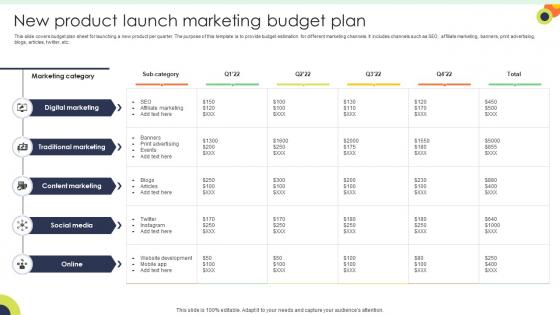
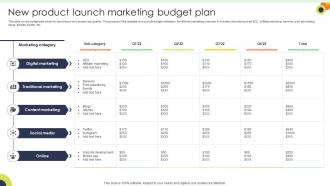
New Product Launch Marketing Budget Plan




Try Before you Buy Download Free Sample Product
 Impress Your
 Audience
 100%
100% Editable
 Save Hours
 of Time


This slide covers budget plan sheet for launching a new product per quarter. The purpose of this template is to provide budget estimation for different marketing channels. It includes channels such as SEO, affiliate marketing, banners, print advertising, blogs, articles, twitter, etc.
People who downloaded this PowerPoint presentation also viewed the following :
New Product Launch Marketing Budget Plan with all 6 slides:
Use our New Product Launch Marketing Budget Plan to effectively help you save your valuable time. They are readymade to fit into any presentation structure.





FAQs for New Product Launch
Key components include market research and competitive analysis, digital advertising spend, content creation and creative development, public relations and influencer partnerships, and performance tracking tools. These elements work together by establishing target audience insights, maximizing reach across multiple channels, and enabling real-time optimization, with many organizations finding that strategic budget allocation across these areas delivers faster market penetration and stronger initial sales momentum.
Determining optimal resource allocation requires analyzing historical channel performance, target audience behavior, competitive landscape analysis, and cost-per-acquisition metrics across platforms. Through data-driven testing and attribution modeling, organizations can identify high-performing channels like digital advertising, content marketing, and social media, while continuously optimizing budget distribution based on real-time ROI measurements and market response patterns.
Key metrics include customer acquisition cost (CAC), return on ad spend (ROAS), conversion rates, brand awareness lift, and lead generation volume across different channels. These measurements enable organizations to optimize budget allocation in real-time, identify high-performing campaigns, and calculate overall launch ROI, with many companies finding that tracking engagement metrics alongside revenue indicators ultimately delivers comprehensive insights for future product launches and strategic marketing investments.
Market research informs marketing budget allocation by identifying target audience preferences, competitive pricing strategies, channel effectiveness, and market opportunities. Through demographic analysis, competitor benchmarking, and consumer behavior studies, companies can strategically distribute resources across high-impact channels, optimize campaign timing, and prioritize messaging that resonates, ultimately delivering higher ROI and more targeted customer acquisition.
Competitive analysis shapes new product launch budgets by revealing market pricing strategies, promotional spend levels, and channel investment priorities across direct competitors. This intelligence enables strategic budget allocation for differentiation opportunities, identifies underfunded market gaps, and helps optimize spend distribution between awareness, acquisition, and retention activities, ultimately delivering competitive positioning advantage.
Social media marketing leverages budget constraints through organic content creation, targeted paid advertising, influencer partnerships, user-generated content campaigns, and community engagement strategies. These approaches enable businesses to maximize reach and engagement while minimizing costs, with many companies finding that strategic social media allocation delivers higher ROI than traditional marketing channels.
Digital marketing typically deserves 60-70% of new product launch budgets, with traditional advertising receiving 30-40%, though this varies by target demographics and industry. Tech startups and consumer goods companies increasingly find that digital channels deliver better ROI through precise targeting, real-time optimization, and measurable engagement, while traditional media enhances brand credibility and broader market awareness.
Accounting for unexpected costs requires establishing a contingency fund of 10-15% of your total launch budget, maintaining flexible budget categories that allow reallocation between marketing channels, and implementing regular budget reviews throughout the launch timeline. This strategic approach enables companies to address unforeseen challenges like additional market research, extended advertising campaigns, or crisis management, while maintaining launch momentum and competitive positioning.
Maximizing marketing budget ROI involves strategic channel diversification, data-driven allocation, performance tracking, and targeted audience segmentation across digital and traditional platforms. Through analytics-powered optimization, companies can reallocate resources to high-performing channels like social media advertising, content marketing, and email campaigns, while continuously testing messaging variations, ultimately delivering measurable customer acquisition costs and enhanced conversion rates.
Partnerships reduce marketing costs by sharing advertising expenses, co-creating content, and accessing each other's customer bases, while expanding reach through cross-promotion and joint campaigns. Strategic collaborations enable brands to leverage complementary strengths, split promotional investments, and achieve greater market penetration, with many companies finding that collaborative marketing delivers enhanced ROI and broader audience engagement.
Underestimating marketing budget for new product launches risks insufficient market awareness, limited customer acquisition, poor competitive positioning, inadequate channel support, and reduced sales momentum during critical launch periods. These budget shortfalls often result in missed revenue targets, extended payback periods, and lost market share opportunities, with many companies finding that initial marketing investment directly correlates with long-term product success and market penetration.
Historical data from previous launches influences budget decisions by revealing which channels delivered the highest ROI, identifying optimal spending timing, and highlighting cost-effective promotional strategies. Through analyzing past performance metrics, companies can allocate resources more strategically, avoid previously unsuccessful tactics, and scale successful approaches, with many organizations finding that data-driven budget planning reduces waste while maximizing market impact.
Marketing budget tracking tools include Google Analytics, HubSpot, Salesforce, Adobe Analytics, and specialized platforms like Allocadia or Planning Maestro. These technologies streamline budget management by providing real-time spending visibility, campaign performance metrics, and automated reporting capabilities, with many marketing teams finding that integrated dashboards ultimately deliver enhanced ROI tracking and faster budget reallocation decisions.
Early adopter feedback can be incorporated through flexible budget reallocation, real-time performance monitoring, and agile campaign adjustments based on initial market response data. By establishing contingency funds and feedback loops, companies can quickly pivot marketing spend from underperforming channels to high-impact areas, ultimately optimizing ROI and accelerating market penetration during critical launch phases.
Contingency plans should include additional digital advertising reserves, crisis communication funds, product modification budgets, extended customer support resources, and market research allocations for rapid feedback analysis. These safeguards enable organizations to address unexpected competitive responses, negative publicity, supply chain disruptions, or lower-than-expected adoption rates, with many companies finding that maintaining 15-20% contingency reserves ultimately delivers faster market recovery and sustained competitive advantage.
-
You know what? I'm so glad I opted for this PPT design. It has been a total game-changer for me and my presentations. Thank you!
-
Fantastic collection of visually appealing PowerPoint templates. They certainly uplift the look of the presentation.