


New york city landmark vector illustration of brooklyn bridge ppt template




Try Before you Buy Download Free Sample Product
 Impress Your
 Audience
 100%
100% Editable
 Save Hours
 of Time


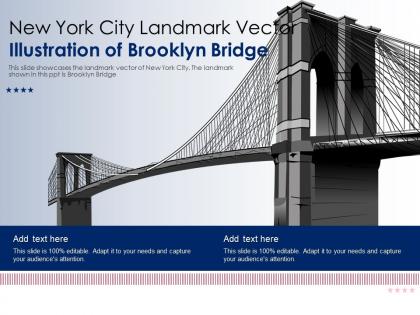
This slide showcases the landmark vector of New York City. The landmark shown in this ppt is Brooklyn Bridge
People who downloaded this PowerPoint presentation also viewed the following :
New york city landmark vector illustration of brooklyn bridge ppt template with all 2 slides:
Use our New York City Landmark Vector Illustration Of Brooklyn Bridge Ppt Template to effectively help you save your valuable time. They are readymade to fit into any presentation structure.

FAQs for New york city landmark vector illustration of brooklyn
The Brooklyn Bridge showcases Gothic Revival architecture in its iconic stone towers, combined with innovative suspension engineering that pioneered modern bridge design principles. This strategic architectural combination delivers both aesthetic grandeur and structural efficiency, with many urban planners finding that Gothic elements enhance visual appeal while the suspension system revolutionized transportation infrastructure, ultimately creating competitive advantages for cities through enhanced connectivity and landmark recognition.
The Brooklyn Bridge revolutionized New York's urban development by connecting Manhattan and Brooklyn, spurring massive population growth, commercial expansion, and real estate development in previously isolated Brooklyn neighborhoods. This landmark infrastructure project established the precedent for large-scale bridge construction, ultimately enabling the consolidation of the five boroughs and transforming New York into a unified metropolitan powerhouse.
The Brooklyn Bridge construction faced pneumatic caisson disease from underwater work, innovative steel cable spinning techniques, unprecedented foundation depths in challenging riverbed conditions, and coordinating massive stone tower construction. These engineering obstacles required groundbreaking solutions including compressed air management, new wire rope technology, and advanced masonry techniques, ultimately delivering structural innovations that revolutionized suspension bridge design worldwide.
John A. Roebling's vision emphasized unprecedented scale, innovative engineering, and architectural grandeur, incorporating his pioneering steel cable suspension system, Gothic Revival towers, and hybrid cable-stayed design. His forward-thinking approach created a structure that would span 1,595 feet while supporting massive loads, ultimately delivering enhanced urban connectivity and establishing engineering principles that many modern suspension bridges continue to leverage today.
The Brooklyn Bridge primarily used steel for its cables, granite for the towers, and limestone for foundations, chosen for their exceptional strength and durability in marine environments. These materials enabled engineers to create the world's first steel-wire suspension bridge, with granite towers withstanding harsh weather and steel cables supporting unprecedented spans, ultimately delivering a revolutionary transportation link that transformed urban connectivity and economic development across New York's boroughs.
The Brooklyn Bridge revolutionized 19th-century transportation by demonstrating that suspension bridge technology could span major waterways, connecting previously isolated urban areas and enabling rapid population growth. It eliminated ferry dependencies for Brooklyn-Manhattan transit, reduced travel time significantly, and established engineering precedents that influenced bridge construction across America, ultimately transforming how cities approached infrastructure development and urban expansion.
The Brooklyn Bridge has adapted through structural reinforcements, updated traffic configurations separating vehicles from pedestrians and cyclists, and enhanced maintenance protocols to handle increased loads. While originally designed for horse-drawn carriages, modern engineering upgrades enable it to support contemporary traffic demands, with ongoing preservation efforts ensuring continued functionality for millions of annual crossings while maintaining its historic architectural integrity.
The Brooklyn Bridge faces significant maintenance challenges including steel cable corrosion, concrete deterioration, structural fatigue from heavy traffic loads, seismic vulnerability assessments, and lead paint removal. These aging infrastructure issues require continuous monitoring and strategic renovation investments, with transportation authorities finding that proactive maintenance programs help preserve this historic structure while ensuring public safety and operational longevity.
The Brooklyn Bridge has been immortalized through paintings by Georgia O'Keeffe and John Marin, poems by Hart Crane and Walt Whitman, novels, films, and photography capturing its architectural grandeur. These artistic interpretations showcase the bridge as a symbol of American innovation, urban transformation, and human achievement, with many artists finding that its Gothic towers and sweeping cables represent the intersection of industrial progress and aesthetic beauty.
Viewing the Brooklyn Bridge from Manhattan offers proximity to iconic skylines and bustling city energy, while Brooklyn provides expansive harbor views and less crowded vantage points with clearer photographic opportunities. Many visitors find that Brooklyn's waterfront parks, especially Brooklyn Bridge Park, deliver more relaxed experiences and better sunset perspectives, ultimately enabling more comprehensive bridge appreciation and strategic photo compositions.
The Brooklyn Bridge has hosted its opening ceremony in 1883, centennial celebrations in 1983, New Year's Eve festivities, and numerous cultural events including art installations and marathons. These milestone celebrations showcase the bridge's enduring cultural significance, with many organizations finding that its iconic status enhances public engagement, tourism revenue, and community pride across New York's increasingly vibrant cultural landscape.
The Brooklyn Bridge contributes to New York City's cultural identity by serving as an enduring symbol of innovation, resilience, and architectural achievement that connects communities and represents the city's pioneering spirit. Through its iconic presence in literature, film, and art, the bridge enhances New York's global recognition, ultimately delivering cultural continuity and symbolic strength that defines the metropolitan experience.
Current safety measures on the Brooklyn Bridge include dedicated pedestrian walkways elevated above traffic, protective railings along the promenade, bicycle lane designations, regular structural inspections, and surveillance monitoring systems. These safety protocols enhance visitor experiences by minimizing vehicle conflicts, preventing accidents, and ensuring structural integrity, with many transportation authorities finding that proactive maintenance and clear pathway separation ultimately deliver safer crossings and reduced liability concerns.
Weather significantly impacts the Brooklyn Bridge through thermal expansion and contraction of steel cables, salt corrosion from winter de-icing, wind stress on suspension systems, and freeze-thaw cycles affecting masonry towers. These conditions require continuous monitoring, protective coating applications, cable inspections, and preventive maintenance protocols, with transportation authorities finding that proactive weather-responsive strategies minimize structural deterioration while ensuring operational safety.
The Brooklyn Bridge ranks among history's most influential suspension bridges alongside the Golden Gate Bridge, Tower Bridge, and Akashi Kaikyo Bridge, representing pioneering engineering achievements of their respective eras. While newer bridges surpass its span and capacity, the Brooklyn Bridge remains internationally celebrated for its architectural innovation, cultural significance, and enduring design influence on modern suspension bridge construction worldwide.
-
Unique design & color.
-
Excellent design and quick turnaround.
-
Appreciate the research and its presentable format.
-
Commendable slides with attractive designs. Extremely pleased with the fact that they are easy to modify. Great work!
-
Thanks for all your great templates they have saved me lots of time and accelerate my presentations. Great product, keep them up!
-
Great product with highly impressive and engaging designs.
-
Great designs, really helpful.
-
Perfect template with attractive color combination.
-
Great quality slides in rapid time.