


New Zealand Population Density Map




Try Before you Buy Download Free Sample Product
 Impress Your
 Audience
 100%
100% Editable
 Save Hours
 of Time


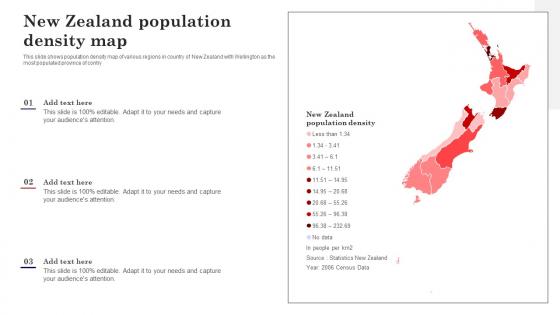
This slide shows population density map of various regions in country of New Zealand with Wellington as the most populated province of contry.
People who downloaded this PowerPoint presentation also viewed the following :
New Zealand Population Density Map with all 9 slides:
Use our New Zealand Population Density Map to effectively help you save your valuable time. They are readymade to fit into any presentation structure.








FAQs for New Zealand
New Zealand's current population density is approximately 18.2 people per square kilometer, representing a significant increase from around 16.4 people per square kilometer a decade ago. This growth, driven by immigration and natural increase, presents both opportunities and challenges for infrastructure development, urban planning, and resource allocation, with many regions finding that strategic population distribution enhances economic development while maintaining environmental sustainability.
New Zealand's population density of approximately 18 people per square kilometer ranks among the lowest in the Asia-Pacific region, significantly below countries like Japan (330), South Korea (527), and Singapore (8,000). This relatively sparse distribution presents both strategic advantages for sustainable development and challenges for infrastructure efficiency, with many businesses finding that lower density enables enhanced quality of life while requiring innovative approaches to service delivery.
New Zealand's population density variations stem from geographic accessibility, economic opportunities, infrastructure development, climate conditions, and historical settlement patterns. Urban centers like Auckland and Wellington attract residents through concentrated employment, educational institutions, and transportation networks, while remote areas face challenges from mountainous terrain and limited services, ultimately creating stark density contrasts between metropolitan and rural regions.
New Zealand's highest population densities are found in Auckland, Wellington, Canterbury, and Waikato regions, with Auckland alone housing over one-third of the country's population. These areas attract residents through concentrated employment opportunities, robust infrastructure, educational institutions, and diverse economic sectors, while offering proximity to ports, transport networks, and urban amenities that enhance quality of life.
Urbanization significantly concentrates New Zealand's population into metropolitan areas like Auckland, Wellington, and Christchurch, creating density clusters while leaving rural regions increasingly sparse. This urban migration pattern enhances economic efficiency, infrastructure utilization, and service delivery in cities, while presenting both opportunities for streamlined resource allocation and challenges for balanced regional development across the nation's diverse landscapes.
Immigration policies significantly influence New Zealand's population density by determining settlement patterns, skilled worker distribution, and regional growth allocation through visa categories, residency requirements, and regional development incentives. These policies enable strategic population distribution across urban centers like Auckland and Wellington while encouraging regional settlement, with many councils finding that targeted immigration programs help address labor shortages and ultimately deliver balanced demographic growth and economic development.
New Zealand's mountainous terrain, extensive coastlines, and varied climate create distinct settlement patterns, with over 86% of the population concentrated in urban areas along accessible coastal plains and river valleys. The country's geography naturally channels development toward major cities like Auckland, Wellington, and Christchurch, while the rugged Southern Alps and remote terrain limit inland settlement, ultimately creating a highly urbanized society with strategic economic centers.
High population density in major New Zealand cities strains infrastructure through increased traffic congestion, overloaded public transport systems, housing shortages, and overwhelmed healthcare facilities. While these challenges require strategic investment and planning, they also present opportunities for innovative urban solutions, with cities like Auckland and Wellington increasingly adopting smart city technologies, enhanced public transport networks, and integrated housing developments to streamline services and ultimately deliver more efficient urban experiences.
New Zealand's urban centers demonstrate strong correlations between population density and economic opportunities through concentrated employment markets, specialized industries, and infrastructure investments. Auckland and Wellington particularly exemplify this intersection, with dense populations supporting diverse service sectors, financial markets, and technology hubs, while smaller centers like Christchurch leverage density for manufacturing and agricultural processing, ultimately delivering enhanced career mobility and business growth.
New Zealand's coastal population density creates environmental concerns including marine pollution, coastal erosion, habitat destruction, stormwater runoff, and pressure on freshwater resources. These challenges present opportunities for sustainable urban planning, with cities like Auckland and Wellington implementing green infrastructure, enhanced waste management systems, and coastal protection measures, ultimately delivering environmental resilience while maintaining competitive livability standards.
Māori communities influence population density through cultural connections to ancestral lands, marae-centered settlements, and iwi territorial boundaries that concentrate populations in specific regions. While urbanization has drawn many Māori to cities like Auckland and Wellington, traditional tikanga and whakapapa maintain strong rural community clusters, particularly in Northland and East Coast areas, ultimately creating unique settlement patterns that balance cultural preservation with economic opportunities.
Climate change impacts on New Zealand's population distribution include coastal retreat from rising sea levels, urban migration from agricultural areas facing drought, relocation from flood-prone regions, and increased density in climate-resilient cities like Auckland and Wellington. These demographic shifts enable strategic urban planning, infrastructure investment, and resource allocation optimization, with many regional councils finding that proactive climate adaptation policies ultimately deliver enhanced community resilience and economic stability.
New Zealand's population density significantly impacts housing affordability by increasing demand while constraining supply, particularly in Auckland and Wellington where density drives up property values and rental costs. Higher density areas experience limited land availability and increased construction costs, with many urban centers finding that concentrated populations create competitive housing markets, ultimately delivering reduced affordability and longer wait times for quality housing options.
New Zealand implements urban intensification policies, regional development initiatives, infrastructure investment programs, housing density regulations, and transportation network expansions to manage population distribution. These strategies work by encouraging growth in smaller cities, improving connectivity between regions, and creating affordable housing options, with many councils finding that strategic urban planning ultimately delivers more balanced population distribution and enhanced livability across both urban and rural areas.
New Zealand's low population density creates both healthcare access challenges and opportunities, with rural communities facing longer travel distances to specialists while urban areas benefit from concentrated medical resources. Many remote regions increasingly leverage telemedicine and mobile health services to bridge gaps, ultimately delivering more equitable care distribution and improved patient outcomes across diverse geographic landscapes.
-
Well-designed and informative templates. Absolutely brilliant!
-
World-class PowerPoint designs that are fully customizable!