


Nike Business Strategy SWOT Analysis




Try Before you Buy Download Free Sample Product
 Impress Your
 Audience
 100%
100% Editable
 Save Hours
 of Time


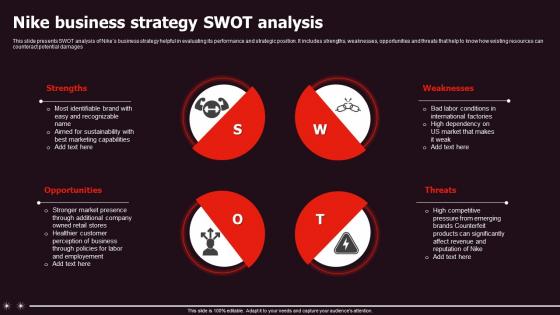
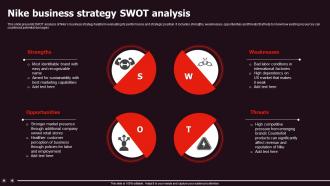
This slide presents SWOT analysis of Nikes business strategy helpful in evaluating its performance and strategic position. It includes strengths, weaknesses, opportunities and threats that help to know how existing resources can counteract potential damages.
People who downloaded this PowerPoint presentation also viewed the following :
Nike Business Strategy SWOT Analysis with all 6 slides:
Use our Nike Business Strategy SWOT Analysis to effectively help you save your valuable time. They are readymade to fit into any presentation structure.





FAQs for Nike Business
Nike's primary strengths include its globally recognized brand power, extensive athlete endorsements, innovative product development, robust distribution networks, and strong financial performance. These strategic advantages enable Nike to command premium pricing, drive customer loyalty across diverse markets, and consistently outpace competitors, with many athletic brands finding that Nike's combination of innovation and marketing creates an almost insurmountable competitive moat.
Nike's brand image significantly enhances customer loyalty and sales performance by establishing emotional connections, delivering consistent quality experiences, and maintaining aspirational positioning that resonates across demographics. Through strategic athlete partnerships, innovative product launches, and powerful storytelling, Nike cultivates devoted customer communities who repeatedly choose the brand, ultimately driving premium pricing power and sustained revenue growth in competitive markets.
Nike's weaknesses include heavy dependence on third-party manufacturers, vulnerability to supply chain disruptions, premium pricing that limits market accessibility, and intense competition from Adidas and emerging brands. These challenges can impact operational efficiency and market share expansion, with many retailers finding that diversified supply chains and competitive pricing strategies ultimately deliver greater resilience and broader customer reach in increasingly saturated markets.
Nike leverages advanced materials engineering, data analytics, digital manufacturing, smart wearables, and AI-driven personalization to enhance its product offerings. Through technologies like Flyknit construction and Nike Fit scanning, the company delivers lighter performance gear, customized sizing solutions, and connected fitness experiences, while streamlining production processes, ultimately maintaining its competitive advantage in the increasingly technology-driven athletic market.
Global supply chain challenges significantly impact Nike's operational efficiency through manufacturing delays, increased logistics costs, inventory management complexities, and quality control difficulties across international facilities. While these disruptions can affect production timelines and cost structures, they also drive Nike toward supply chain diversification, automation investments, and strategic partnerships with regional suppliers, ultimately enhancing resilience and competitive positioning.
Nike can expand in emerging economies through localized product lines, strategic partnerships with regional retailers, increased digital marketing presence, and affordable pricing strategies tailored to local purchasing power. These markets present significant growth potential, especially in countries like India, Brazil, and Southeast Asian nations, where rising middle classes and increasing health consciousness create demand for athletic wear, ultimately delivering new revenue streams and reduced dependence on saturated Western markets.
Nike's competitive landscape drives strategic differentiation through premium brand positioning, innovation leadership, and global market dominance, while rivals like Adidas focus on lifestyle segments and Under Armour targets performance niches. This competition enhances Nike's investment in cutting-edge technologies, celebrity partnerships, and direct-to-consumer channels, ultimately delivering sustained market share growth and enabling the company to command higher price points across diverse athletic categories.
Nike faces significant threats as consumers increasingly prioritize sustainable materials, ethical labor practices, transparent supply chains, and environmentally responsible manufacturing processes. While this shift presents challenges for traditional production models, it also drives innovation opportunities, with many athletic brands finding that sustainable practices ultimately enhance brand loyalty, attract conscious consumers, and deliver long-term competitive advantage.
Nike has adapted its marketing strategy through direct-to-consumer digital platforms, personalized mobile apps, influencer partnerships, data-driven customer insights, and immersive social media campaigns. These digital initiatives streamline customer engagement, enhance brand loyalty, and deliver personalized experiences, with many retailers finding that integrated digital strategies ultimately provide competitive advantage in increasingly connected markets.
Endorsements and sponsorships serve as Nike's primary brand equity drivers, creating emotional connections through elite athletes, major sports leagues, and high-profile teams across basketball, soccer, tennis, and running. These strategic partnerships enhance brand prestige, expand global reach, and generate authentic storytelling opportunities, with many consumers associating Nike's innovation with athletic excellence, ultimately delivering increased market share and premium pricing power.
Nike's R&D investment is strategically vital, driving innovations in sustainable materials, performance technologies, digital integration, and manufacturing processes that maintain competitive differentiation. Through advanced footwear cushioning systems, eco-friendly material development, and smart product integration, Nike consistently delivers breakthrough products that command premium pricing, ultimately strengthening market position and enabling long-term growth in increasingly competitive athletic markets.
Geopolitical factors significantly influence Nike's market access, supply chain operations, and revenue streams across different regions through trade policies, tariffs, and regulatory changes. These dynamics require Nike to diversify manufacturing locations, adapt marketing strategies for local markets, and navigate international tensions, ultimately driving strategic flexibility and risk management approaches that help maintain competitive positioning in an increasingly complex global landscape.
Nike's commitment to diversity and inclusion enhances its corporate reputation by attracting socially conscious consumers, improving employee engagement, and strengthening brand authenticity in global markets. Through inclusive marketing campaigns, diverse leadership representation, and community investment programs, Nike builds deeper customer loyalty while appealing to younger demographics, ultimately delivering competitive differentiation and sustained brand value.
E-commerce growth presents both challenges and opportunities for Nike's distribution strategy, requiring enhanced digital infrastructure, direct-to-consumer capabilities, omnichannel integration, and supply chain optimization. Through strategic digital transformation, Nike can streamline inventory management, accelerate delivery services, and enhance customer experiences, while reducing reliance on traditional retail partners, ultimately delivering competitive advantage in an increasingly digital marketplace.
Nike can enhance digital customer engagement through personalized fitness apps, AI-driven product recommendations, interactive social media campaigns, augmented reality try-on features, and exclusive member content. These technologies streamline customer experiences by delivering tailored workouts, seamless shopping integration, and community building, with many athletic brands finding that personalized digital ecosystems ultimately drive loyalty and competitive advantage.
-
“One of the best experiences with SlideTeam for my presentation.Everything on time, communication is efficient and price is reasonable. All good in one place.”
-
One word for SlideTeam–Versatile!