


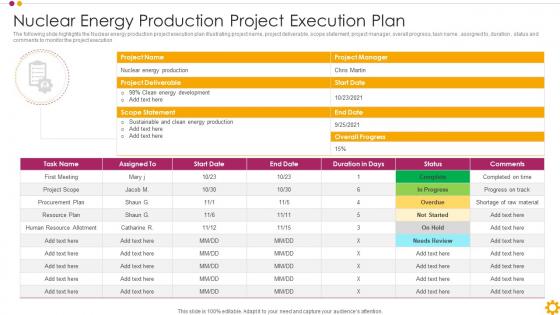
Nuclear Energy Production Project Execution Plan




Try Before you Buy Download Free Sample Product
 Impress Your
 Audience
 100%
100% Editable
 Save Hours
 of Time


The following slide highlights the Nuclear energy production project execution plan illustrating project name, project deliverable, scope statement, project manager, overall progress, task name , assigned to, duration , status and comments to monitor the project execution.
People who downloaded this PowerPoint presentation also viewed the following :
Nuclear Energy Production Project Execution Plan with all 6 slides:
Use our Nuclear Energy Production Project Execution Plan to effectively help you save your valuable time. They are readymade to fit into any presentation structure.





FAQs for Nuclear Energy Production
Nuclear energy project execution involves site preparation and licensing, reactor design and engineering, construction and installation, testing and commissioning, and operational startup phases. These phases streamline development by ensuring regulatory compliance, managing complex technical requirements, and coordinating specialized contractors, with many utilities finding that systematic phase management ultimately delivers safer operations, reduced project delays, and enhanced long-term energy security.
Regulatory approvals significantly extend nuclear energy project timelines, often adding 5-10 years through multi-phase licensing, environmental assessments, and safety reviews. These comprehensive processes, while challenging, ultimately enhance project credibility and operational safety, with many utilities finding that early regulatory engagement and stakeholder collaboration streamline approvals and minimize costly delays.
Safety protocols serve as the foundational framework for nuclear energy project execution, encompassing radiation protection measures, emergency response procedures, regulatory compliance standards, containment systems, and personnel training requirements. These comprehensive protocols streamline project timelines by ensuring regulatory approval, minimize costly delays through proactive risk management, and ultimately deliver operational reliability and public confidence, with many nuclear facilities finding that robust safety integration enhances both project efficiency and long-term viability.
Stakeholders influence nuclear energy project decisions through regulatory oversight, community engagement, environmental impact assessments, and financial approvals at critical milestones. Through structured consultation processes, government agencies, local communities, and investors shape safety protocols, environmental mitigation strategies, and operational timelines, while utilities increasingly find that transparent stakeholder collaboration accelerates approvals and enhances project viability.
Common challenges during nuclear construction include regulatory compliance complexities, supply chain disruptions for specialized components, skilled workforce shortages, stringent quality assurance requirements, and coordinating multiple specialized contractors. These projects face extended timelines, cost overruns, and technical integration issues, with many utilities finding that early stakeholder engagement and robust project management frameworks ultimately deliver safer facilities and improved operational outcomes.
Agile methodologies work best for nuclear energy projects' research, design, and software development phases, while Waterfall suits regulatory compliance, construction, and safety-critical components requiring sequential validation. Many nuclear organizations adopt hybrid approaches, combining Waterfall's structured oversight for regulatory milestones with Agile's iterative flexibility for innovation phases, ultimately delivering faster project adaptation while maintaining the rigorous safety standards essential in nuclear environments.
Technology and innovation are fundamental to modern nuclear energy project execution, enabling enhanced safety systems, streamlined construction processes, advanced monitoring capabilities, and improved operational efficiency. These advancements help minimize project risks, reduce construction timelines, and optimize resource allocation, with many energy companies finding that strategic technology integration ultimately delivers competitive advantage in an increasingly complex energy landscape.
Environmental impact assessments fundamentally reshape nuclear project execution by mandating comprehensive site evaluation, ecological monitoring protocols, community engagement strategies, and regulatory compliance frameworks from inception through decommissioning. These assessments drive strategic decisions around reactor placement, cooling systems, waste management approaches, and construction timelines, with many utilities finding that early environmental integration ultimately streamlines permitting processes and enhances long-term operational sustainability.
Nuclear energy project success metrics include schedule adherence, budget compliance, safety performance indicators, regulatory milestone achievement, and quality assurance benchmarks. These comprehensive measures enable project managers to track construction progress, environmental impact, stakeholder satisfaction, and operational readiness, with many utilities finding that integrated dashboard monitoring ultimately delivers enhanced risk management and strategic competitive advantage.
Risk management integrates into nuclear energy project execution through comprehensive hazard assessments, regulatory compliance frameworks, continuous safety monitoring, and multi-layered contingency planning. These systematic approaches enable project teams to identify potential issues early, maintain strict safety protocols, and ensure regulatory adherence, while delivering projects on schedule and budget with enhanced operational reliability.
Past nuclear energy project failures reveal critical lessons including inadequate risk assessment, insufficient stakeholder engagement, regulatory compliance gaps, cost estimation errors, and poor project timeline management. These failures demonstrate that successful nuclear projects require comprehensive planning, transparent communication with communities, rigorous safety protocols, and adaptive project management, with many energy organizations finding that early stakeholder involvement and robust contingency planning ultimately deliver more resilient project outcomes.
Public perception significantly influences nuclear energy project execution by affecting regulatory approval timelines, community acceptance processes, and political support for funding initiatives. While safety concerns and environmental debates can delay projects, strategic communication and transparency help utilities and governments build trust, with many nuclear facilities finding that early community engagement ultimately delivers smoother implementation and stronger long-term operational success.
Best practices for managing multidisciplinary teams in nuclear energy projects include establishing clear communication protocols, implementing robust safety coordination systems, defining precise role boundaries, creating integrated project schedules, and maintaining regulatory compliance oversight. These approaches streamline complex interactions between engineers, safety specialists, and regulatory experts, with many nuclear organizations finding that structured cross-functional collaboration ultimately delivers faster project timelines and enhanced safety outcomes.
International partnerships significantly enhance nuclear energy project execution by combining expertise, sharing financial burdens, and facilitating technology transfer between nations. Through strategic collaborations, countries leverage shared resources, regulatory knowledge, and technical capabilities, with projects like Finland's Olkiluoto reactor and the UK's Hinkley Point finding that multinational approaches deliver enhanced safety standards and operational efficiency.
Training and workforce development ensure nuclear project success by building specialized technical expertise, maintaining rigorous safety protocols, and developing regulatory compliance capabilities throughout project lifecycles. These programs enable organizations to reduce operational risks, accelerate commissioning timelines, and enhance long-term plant performance, with many utilities finding that comprehensive workforce preparation ultimately delivers safer operations and improved project outcomes.
-
It makes easy work of my work presentations. I’ve never had to be nervous about my presentations for meetings.
-
The templates are handy and I can personalize them as per my needs. Glad to be your subscriber!