


Office Stationery Business Plan Powerpoint Presentation Slides





Try Before you Buy Download Free Sample Product
 Impress Your
 Audience
 100%
100% Editable
 Save Hours
 of Time


Here is a competently designed Office Stationery Business Plan PowerPoint Presentation. This Presentation has been carefully crafted to assist aspiring entrepreneurs in achieving success in the competitive real estate market. It offers a comprehensive roadmap for executing a profitable house flipping strategy. This Presentation encompasses essential elements such as an executive summary, a thorough market analysis, and a detailed breakdown of key success factors. It also highlights the mission, vision, and start up summary, providing a clear direction for the business. Additionally, the Presentation delves into the necessary expenses involved in the venture. The plan incorporates a comprehensive business environment analysis to ensure sustainable growth, including a SWOT analysis, Porters Five Forces analysis, customer analysis, and market sizing. Moreover, the Presentation outlines a robust offline and online marketing strategy to reach the target audience effectively. It also includes a sales funnel that aims to enhance customer retention. The financial summary section of the plan provides a scenario analysis, profit and loss statement, cash flow statement, balance sheet, and a detailed discounted cash flow DCF valuation model projecting the businesss worth over five years. Get access to this 100 percentage editable template now.
People who downloaded this PowerPoint presentation also viewed the following :
Content of this Powerpoint Presentation
Slide 1: This slide introduces Office Stationery Business Plan. Commence by stating Your Company Name.
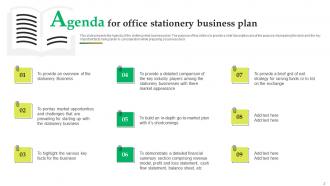
Slide 2: This is an Agenda slide. State your agendas here.
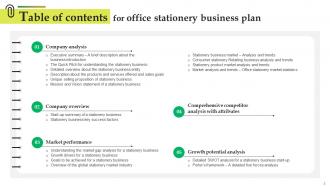
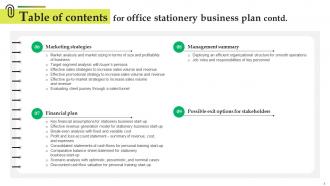
Slide 3: This slide incorporates the Table of contents.
Slide 4: This slide highlights the Title for the Topics to be discussed further.
Slide 5: The purpose of this slide is to provide a broader overview of the stationery industry and the business.
Slide 6: This slide covers a brief glimpse of what the quick pitch of the business to the customers with market information.
Slide 7: The purpose of the slide is to portray organization details.
Slide 8: This slide reveals the Description about the products and services offered and sales goals.
Slide 9: This slide portrays the Unique selling propositions of stationery business.
Slide 10: This slide provide a gist about the business mission and vision.
Slide 11: This slide shows the Heading for the Contents to be covered next.
Slide 12: This slide provides a gist of company start-up summary.
Slide 13: This slide reveals the Start-up summary of a stationery business.
Slide 14: This slide depicts the Title for the Ideas to be discussed further.
Slide 15: This slide highlights the market gap which the industry is undergoing.
Slide 16: This slide continues Understanding the market gap analysis for a stationery business.
Slide 17: This slide provides a detailed information about the market opportunity.
Slide 18: This slide shows details about the business’s milestone, the business’s five year growth plan and it’s sales assumption to achieve.
Slide 19: This slide portrays a glimpse of industry overview of the global stationery market.
Slide 20: This slide provides a glimpse of market overview concerning with the US stationery market, its growth, demand and future forecast.
Slide 21: This slide contains the industry overview concerning with the US stationery consumer retailing market, its growth, demand in future.
Slide 22: This slide shows the industry overview concerning with the men clothing market, its growth, demand in future.
Slide 23: This slide provides a glimpse of industry overview concerning with the office stationery market, its growth, demand in future.
Slide 24: This slide exhibits the Heading for the Ideas to be covered next.
Slide 25: This slide illustrates a competitive framework of stationery company competitive analysis.
Slide 26: The purpose of this slide is to provide a glimpse of key competitors in the industry.
Slide 27: This slide displays the Title for the Contents to be discussed further.
Slide 28: The slide includes the strengths, weaknesses, opportunities, and threats analysis of the stationery business start-up.
Slide 29: The slide highlights porter’s framework and its implications in the stationery business.
Slide 30: This slide reveals the Heading for the Topics to be covered in the upcoming template.
Slide 31: This slide provides a brief gist of customer analysis of the clothing store business.
Slide 32: This slide covers an assessment of how the firm’s products and services will fit into a certain market.
Slide 33: This slide continues the Target segment analysis with buyer’s persona.
Slide 34: The purpose of this slide is to implement an effective go-to-market strategy for bringing stationery business to an end customer.
Slide 35: This slide reveals the effective promotional strategy to increase sales volume and revenue.
Slide 36: The purpose of this slide is to implement an effective go-to-market strategy for bringing stationery business to an end customer.
Slide 37: This slide highlights customer journey mapping to track users' actions and key touch points across levels.
Slide 38: The purpose of this slide is to facilitate managers to convey project progress updates to stakeholders and get their approvals.
Slide 39: This slide portrays the Title for the Topics to be further discussed.
Slide 40: This slide provides a glimpse of important financial assumptions that are to be made while setting up the firm.
Slide 41: This slide presents revenue model of clothing retail business.
Slide 42: This slide reveals the Breakeven analysis.
Slide 43: This slide represents breakeven graph.
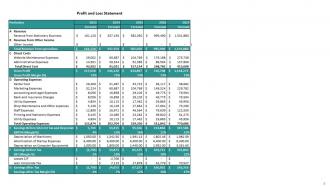
Slide 44: This slide shows the profit and loss statement.
Slide 45: This slide presents graphs of gross profit of the business and earnings before interest tax & depreciation.
Slide 46: This slide highlights the graphs of total revenue from operations and earnings after tax.
Slide 47: This slide represents the business’s historical and forecasted cash flow results and the amount of cash the business will introduce to starts its operations.
Slide 48: This slide portrays a graph on cash flow analysis and total assets.
Slide 49: This slide presents balance sheet statement.
Slide 50: This slide represents a graph on cash flow analysis and total assets.
Slide 51: This slide highlights the different scenarios for deriving final annual profit after tax on the basis of best case, nominal case and worst case.
Slide 52: This slide continues the scenario analysis of annual revenue break-even, annual profit after tax and break-even analysis.
Slide 53: This slide represents the DCF valuation analysis of a business’s financials based on the free cash flow to firm.
Slide 54: This slide portrays the Heading for the Contents to be covered in the forthcoming template.
Slide 55: This slide represents organizational structure of the business.
Slide 56: This slide reveals the job role and responsibilities of the employees in the business.
Slide 57: The slide highlights the professional summary section of the café.
Slide 58: The slide shows the Title for the Ideas to be discussed next.
Slide 59: This slide represents exit strategy for stakeholders such as venture capitalists, private offerings and initial public offer.
Slide 60: This is the Icons slide containing all the Icons used in the plan.
Slide 61: The slide portrays information related to the additional information.
Slide 62: This is the Puzzle slide with related imagery.
Slide 63: The slide shows the company's Timeline.
Slide 64: This is the Idea generation slide for encouraging fresh ideas.
Slide 65: This slide presents the organization's Roadmap.
Slide 66: This slide depicts the team-related information.
Slide 67: This is the Quotes slide for motivation.
Slide 68: This is the Venn slide.
Slide 69: This slide contains Post it notes for reminders and deadlines.
Slide 70: This is the Thank you slide for acknowledgement.
Office Stationery Business Plan Powerpoint Presentation Slides with all 75 slides:
Use our Office Stationery Business Plan Powerpoint Presentation Slides to effectively help you save your valuable time. They are readymade to fit into any presentation structure.























FAQs for Office Stationery Business Plan
Okay so you'll need market research first - figure out who's actually buying this stuff and what they want. Financial projections are huge but most people totally overestimate year one sales, which is a mistake I see everywhere. Get your supplier relationships locked down early for sourcing and inventory. Marketing strategy obviously, but honestly? Local businesses should be your main focus since they're steady customers. Operations covers the boring stuff - where you'll store everything, shipping, maybe hiring help later. Oh and definitely test demand in your area before you blow money on tons of inventory you can't move.
Honestly, market research just shows you what people actually buy vs what you assume they want. Those are usually way different lol. You'll figure out your real competitors, what prices work, and which products are hits. Plus you might find weird gaps - like maybe everyone's sleeping on targeting small businesses or something. Amazon's actually great for this stuff, you can see what's selling like crazy. The whole thing helps with your product lineup and how you talk to customers. I know it sounds boring but the data really does help with pretty much every decision you make.
Start by checking what competitors charge - that's your baseline. Cost-plus pricing is solid for bulk orders where you just add markup to wholesale costs. Offices love volume discounts since they're always trying to save money on supplies. Premium pricing works if you've got specialized or eco-friendly stuff that stands out. This might sound weird, but psychological pricing ($9.99 vs $10) actually still works in B2B - people are people, right? Back-to-school season is your goldmine for higher prices. Map out competitor pricing first, then build from there.
Start by figuring out who's actually buying this stuff - small businesses, corporate offices, schools, people working from home. Each group wants different things and has different budgets. Honestly, I'd just walk around business areas and see what's already there! Then figure out their real problems: bulk pricing, quick delivery, hard-to-find items? Send out surveys, read competitor reviews (those are goldmines), or just call local businesses directly - most people are surprisingly willing to chat. The trick is matching what you sell to what they actually care about, not what sounds good on paper.
Start by figuring out who you're actually selling to - small biz, big corps, schools? They all want different things. Pricing's gonna be huge here since everyone shops around for the cheapest pens and paper. I'd focus on what makes you different - maybe it's your delivery speed or eco stuff. Online vs retail partnerships will totally change your approach too. Back-to-school season is where the money's at, obviously. Oh, and bulk discounts work really well in this space. Map out how your customers actually buy stuff and build your strategy around that process.
Stop trying to be everything to everyone - that's a losing game. Pick a niche instead. Maybe eco-friendly stuff, small businesses needing custom orders, or some weird specialized industry. The boring suppliers aren't touching those markets anyway. Offer what they don't: same-day delivery, subscription boxes, design help. Price doesn't matter as much when you're actually solving real problems. I'd probably pick 2-3 things max and go all-in on those. Being okay at ten things beats being amazing at nothing, but barely.
So there's a bunch of ways you could go with this. Direct sales to businesses is probably your best bet - hit up offices, coworking spaces, small companies nearby. You'll definitely want your own website plus Amazon Business. Local office supply stores might partner with you too, which is cool. Honestly, subscription boxes are kind of everywhere now but people seem to love them for office stuff. B2B wholesale could work once you get some traction, though that's more down the road. I'd pick one thing and nail it first before spreading yourself too thin.
Honestly, start with your supply chain - look for recycled materials and suppliers with green certifications. Quick wins? Cut down packaging and maybe add a take-back program for used stuff. Customers eat up the environmental angle in marketing, so don't be shy about it. Refillable products are huge right now too. If you can swing renewable energy, great, but don't stress if that's not realistic yet. The main thing is weaving sustainability into your actual brand, not just slapping it on later. Pick 2-3 things you can do right now and build from there.
Yeah, you definitely need digital marketing for that stationery biz. Most B2B people start their research online now anyway. I'd hit LinkedIn first - that's where all the office managers and procurement folks hang out. Google Ads work great too, especially for searches like "bulk pens" or whatever. Oh, and don't sleep on email marketing - seriously, it's perfect for getting repeat orders from existing customers. Content stuff is solid long-term, like blog posts about office organization that show off your products. Honestly though? Start with LinkedIn and Google Ads. They'll get you results faster while you figure out the rest.
So you'll want to break down your revenue by categories - paper, pens, office supplies, that whole deal. Monthly and yearly forecasts too. Startup costs are gonna hit you hard honestly - inventory, equipment, rent all pile up quick. Don't forget the boring stuff like utilities and salaries in your operating expenses. Cash flow statements are huge because timing matters - when money's actually coming in vs going out. Oh and definitely do a break-even analysis so you know when you'll stop bleeding money and start turning profit. Most investors want to see 3-5 years projected out.
Dude, local partnerships are honestly a game changer. You get instant access to their customers - people who already trust them. So if you team up with printing shops or accounting firms, they're basically vouching for you to clients who obviously need office supplies. Cross-promotions work great, or just swap flyers. Way more legit than random ads since there's real connection there. I'd start by listing businesses that serve your same crowd but aren't competing directly with you. That's where the magic happens.
Start with ABC analysis - group stuff by value and how fast it sells so you don't get stuck with pricey items collecting dust. Set up automatic reorder points for basics like pens and paper because honestly, running out of those kills productivity. Weekly cycle counts beat doing one massive yearly inventory (trust me on this). Your turn rates matter more than most people think - shoot for 8-12 annually. Oh, and track shrinkage early or it'll bite you later. Simple spreadsheet works fine when you're starting out, but you'll want real inventory software once things pick up.
Yeah, it's more of a shift than people just buying less stuff. Corporate bulk orders are down for sure, but home workers are splurging on nicer individual items - fancy pens, cute planners, desk organizers. There's this whole aesthetic trend too where everyone wants their home office to look Pinterest-perfect (honestly kind of exhausting but whatever). The big change? You're now selling to individuals instead of companies, and they actually care about how things look. I'd focus on direct sales and smaller quantities of premium products. Way better margins anyway.
Definitely get an inventory system first - TradeGecko or inFlow are solid choices. They'll automatically track stock and ping you when you're low on stuff like pens or paper. POS with barcode scanning is a game changer for checkout speed. QuickBooks is pretty much the standard for invoicing and accounting, works well. Honestly? Excel is fine when you're starting out for basic order tracking. You'll probably outgrow it within a year though - we did. Shopify's worth considering if you want to sell online eventually. My advice: pick one or two tools max at first. Don't go crazy trying to set up everything at once.
Honestly, you're gonna get crushed by Amazon and big box stores on pricing - that's just reality. People aren't buying as much physical stationery anymore since everything's going digital. Cash flow is rough too because you need tons of inventory upfront. Plus it's kinda hard to get people excited about... well, pens and paper lol. Back-to-school season will be crazy busy, then you'll have these dead months where nobody's buying anything. But if you can find your niche - maybe fancy stuff or personalized services - you might carve out something decent. Focus on customers who actually care about quality over just getting the cheapest price.
-
The quality of the templates is as fine as it could get. It was a purchase well made!
-
They guys always go the extra mile to meet the expectations of their customers. Almost a year has been associated with them.